

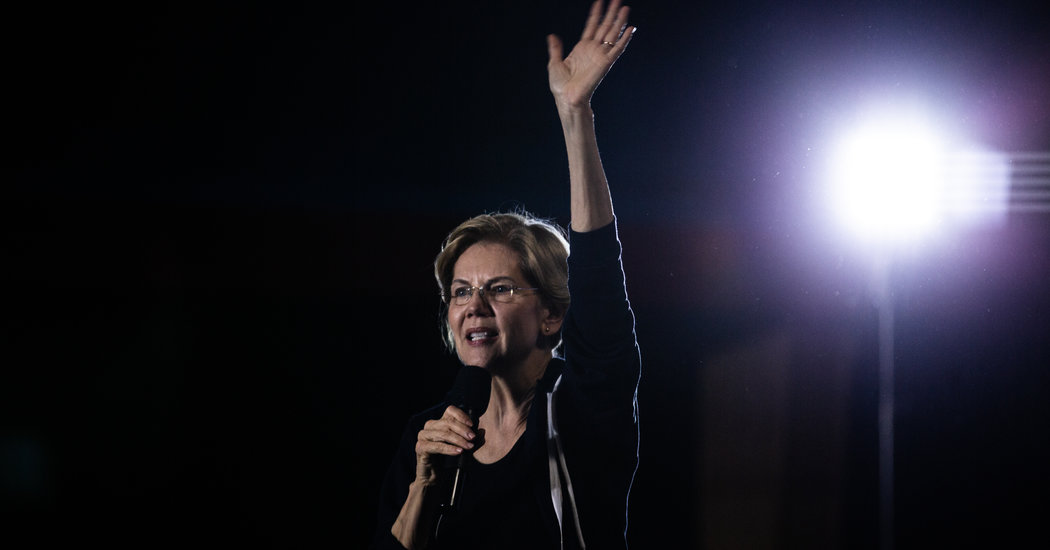
Senator Elizabeth Warren’s plan to tax the assets of America’s wealthiest individuals continues to draw broad support from voters, across party, gender and educational lines. Only one slice of the electorate opposes it staunchly: Republican men with college degrees.
Not surprisingly, that is also the profile of many who’d be hit by Ms. Warren’s so-called wealth tax, which has emerged as the breakout economic proposal in the Democratic presidential primary race.
Nearly a year after Ms. Warren proposed it, the wealth tax has the support of six in 10 Americans, according to a new nationwide poll conducted by the online research firm SurveyMonkey for The New York Times. That support has dipped slightly since July, but Ms. Warren’s plan remains more popular than most proposed tax increases, and its appeal across coalitions is unusual among high-profile campaign proposals.
Senator Bernie Sanders of Vermont has also proposed a wealth tax, which would hit more taxpayers than Ms. Warren’s version, and several other candidates have announced their own plans to raise taxes on the rich, with varying degrees of detail.
The other policy plan dominating the primary debate so far — the conversion to a government-financed health care system known as “Medicare for all” — enjoys narrower support that breaks much more cleanly along party lines. Republicans overwhelmingly oppose it. Independents favor it two to one, and Democrats support it by an even higher ratio.
As the Democratic contest barrels toward the first caucuses in Iowa and beyond, the polling continues to show a racial fissure on the subject of the economy, with nonwhite Democrats expressing more concern about their economic situations than white Democrats. Those more anxious voters are less likely to support Ms. Warren, or her wealth tax, a dynamic that could prove consequential as Democrats winnow their field.
Here are three takeaways on Democratic voters, policy proposals and the role of the economy in the campaign.
College-educated Republican men take exception to a wealth tax.
The wealth tax has lost a few points of support since the last time The Times asked about the issue, in July. But it remains broadly popular, even more so than it was in February. Three-quarters of Democrats and more than half of Republicans say they approve of the idea of a 2 percent tax on wealth above $50 million.
Support for a wealth tax cuts across many of the demographic dividing lines in American politics. Men and women like it. So do the young and the old. The proposal receives majority support among every major racial, educational and income group.
College-educated Republican men, though, disapprove of it by a 15-point margin — though a vast majority of Republican men with college degrees would have a net worth below the tax threshold. (College-educated Republican women approve of the policy by an even wider margin than their male counterparts oppose it.)
One note that might give Republicans pause: The wealth tax is much more popular than the tax-cut package that President Trump signed in 2017, which only 45 percent of Americans in this Times survey said was a good move. That’s a decline from April, when the law was drawing slightly more approval than disapproval.
The movement against the Trump tax cuts since then has been powered, oddly enough, by Republicans. They largely still back the law — by 76 percent over all, compared with 20 percent of Democrats — but that support has dropped six percentage points since April.
The shift appears most pronounced among high-earning Republicans, and it contributes to a striking contrast in tax-plan approval: Americans earning more than $150,000 a year are far more likely to favor a tax increase on the very wealthy than a package of tax cuts that delivered the bulk of its benefits to the rich.
Education and race divide Democrats on economic policy.
Among Democrats, education has emerged as a key dividing line on economic policy. Ms. Warren’s tax is overwhelmingly popular (86 percent support) with Democratic voters who have graduate degrees. Among voters with a high school diploma or less, the policy is still popular, but meaningfully less so, drawing 75 percent support.
Accordingly, less-educated voters are also less likely to say they favor Ms. Warren on the economy. That fits with other polling that has found the Massachusetts senator struggling to win over voters without a college degree.
Strikingly for a candidate who has put so much emphasis on the economy, Ms. Warren is viewed with caution by voters who care the most about the economy, and by those who are most worried about it. Among Democrats who say they are “very concerned” about losing their job, for example, 15 percent say they would trust Ms. Warren most on the economy out of all the Democratic candidates, compared with 23 percent of other Democratic voters.
Those struggles for Ms. Warren may partly reflect another important divide in the Democratic electorate: race. Black and Hispanic voters tend to rate the economy more highly as an issue than their white counterparts. They are also less likely to trust Ms. Warren on the economy.
Black and Hispanic voters are more likely to choose former Vice President Joseph R. Biden Jr. as the candidate they would trust on the economy. So are voters who say they are concerned about their jobs or their economic prospects. But voters’ preferences don’t fall neatly along ideological lines: Those same groups also tend to give high ratings to Mr. Sanders, who is closer to Ms. Warren than to Mr. Biden on most policy matters.
The survey suggests that the newest member of the Democratic field, former Mayor Michael R. Bloomberg of New York, may have at least a narrow opening with voters on economic issues. About 6 percent of Democrats said they trusted Mr. Bloomberg most on the economy, putting him outside the four-person top tier (Mr. Biden, Ms. Warren, Mr. Sanders and Mayor Pete Buttigieg of South Bend, Ind.) but ahead of the rest of the field.
Mr. Bloomberg drew less support on his handling of health care and international affairs, however. The other late entrant to the race, former Gov. Deval Patrick of Massachusetts, was well outside the top tier of candidates on all three issues. The findings on that question came after Mr. Patrick entered the race and after Mr. Bloomberg filed paperwork for a presidential bid; he formally announced his candidacy later in the month.
Health care remains a partisan issue.
Apart from taxes, health care policy has been perhaps the most significant point of disagreement among the Democratic candidates. Among the top tier of candidates, Mr. Sanders and Ms. Warren have emphasized their support for a government-run insurance system that they call Medicare for all, while Mr. Biden and Mr. Buttigieg have argued for less significant changes to the existing system.
Compared with the wealth tax, Medicare for all is a much more partisan issue. Republicans strongly oppose the idea; Democrats even more strongly support it. (Independents support it, too, but by a narrower margin.)
And Medicare for all doesn’t divide Democrats the way the wealth tax does. Democrats of all ages, races and education and levels support the policy by similar margins.
About the survey: The data in this article came from an online survey of 2,672 adults conducted by the polling firm SurveyMonkey from Nov. 4 to Nov. 11. A supplemental survey of 2,489 adults was conducted from Nov. 14 to Nov. 17 to collect more data on opinions of the Democratic candidates; that survey did not ask about taxes or health care policy.
In both cases, SurveyMonkey selected respondents at random from the nearly three million people who take surveys on its platform each day. Responses were weighted to match the demographic profile of the population of the United States. The primary survey has a modeled error estimate (similar to a margin of error in a standard telephone poll) of plus or minus three percentage points, so differences of less than that amount are statistically insignificant.







