

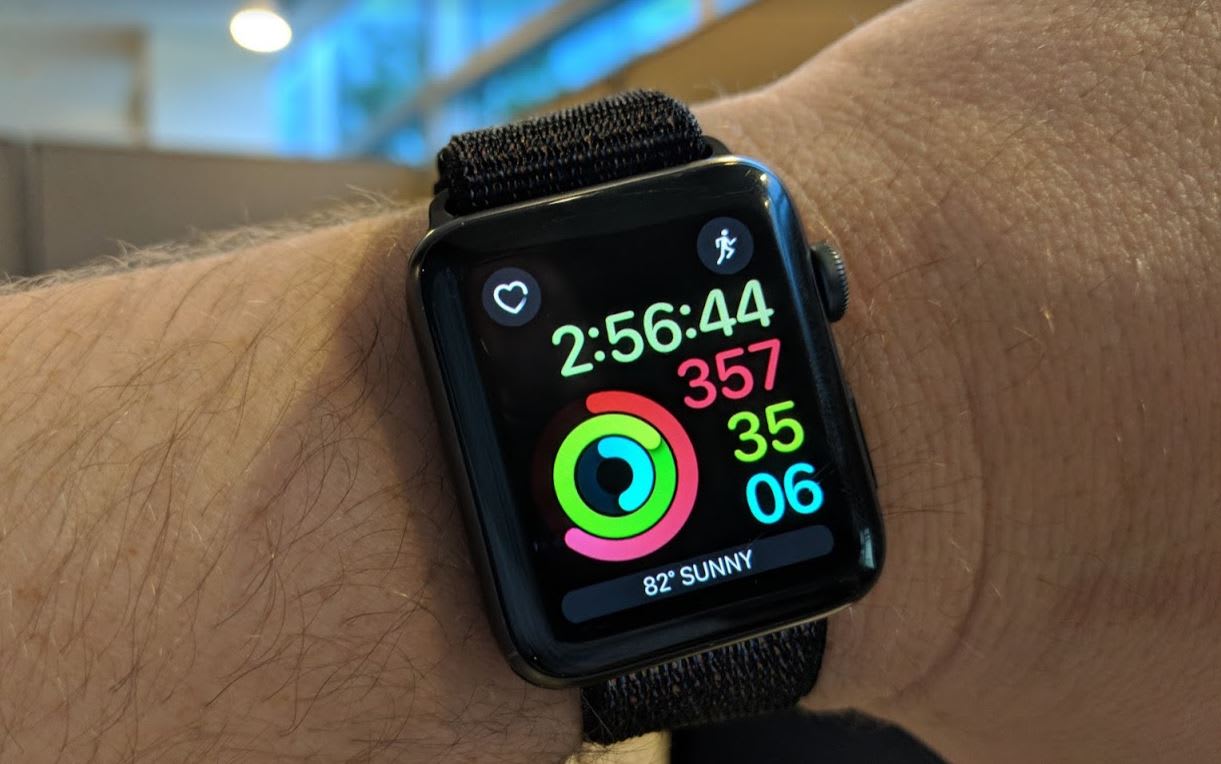
The Activity App on the Apple Watch.
Todd Haselton | CNBC
Tech giants like Amazon, Apple and Alphabet‘s Google might be raking in cash from their core businesses, but they aren’t always successful in everything they try to do.
Health care is an Achilles’ heel for many of them.
In the past decade, almost all of the tech giants have dabbled in the space. Most, including Google and Microsoft, have failed in a high-profile manner at least once. Microsoft HealthVault, its software to store medical records, was officially shuttered earlier this year, and Google Health, an effort to help patients gather their health information, lasted just a few years before it got shut down in the early part of the decade in 2012.
But there have been some success stories, too. One example is Apple’s health records feature, which consumers can use to gather up their medical information from across their various doctors via an iPhone. Apple, in part because of its brand recognition, made quick work of convincing hospitals to integrate with its feature, which is no easy feat given that other attempts at making health information more accessible to patients and clinicians have struggled.
So here’s our roundup of tech’s efforts to disrupt the $3.5 trillion medical sector, which range from total flops to some ambitious bets that are genuinely improving people’s lives. Overall, the most successful efforts have involved tech companies playing to their strengths, and forging out partnerships with industry. If there’s a common thread among the failures, it’s that tech companies often overestimate consumers’ trust in them and underestimate the influence of traditional health players.
Early failures
Technology companies often succeed when they enter new spaces, whether it’s Apple’s march into financial services, or Amazon’s foray into the home. So it must have been a humbling experience for executives at these companies to build out new products for the medical sector and totally bomb.
Google Health and Microsoft HealthVault are among the biggest imbroglios, given the initial hype and promise. For these companies, the idea behind their products was to make it easier for people to access medical information. That’s a laudable goal, because it is notoriously challenging to gather up disparate records.
But both went about it the wrong way.
In Google’s case, it was an error of judgement to think that patients would put in the effort to manually compile these records themselves. Microsoft suffered a similar problem, and struggled to find a successful business model after partnerships with companies like Fitbit petered out.
One potential lesson from these failed experiments, which former employees of these teams have described as “ahead of their time“: it’s hard to succeed without partners in the health industry.
But tech companies have sometimes blown it even when they teamed up with health companies.
Another public embarrassment, again from Google, involved its partnership with a chain of hospitals known as Ascension. In 2019, the news broke that some Google employees had access to Ascension patients’ private health information, as well as vast datasets of de-identified data. The news prompted a public outcry about the partnership, described internally as “Project Nightingale,” even though Google wasn’t doing anything particularly different from what health companies do all the time.
Rhetoric that outstrips reality
Apple has made bold pronouncements about its mission to change the medical industry, with its chief executive, Tim Cook, noting that he hopes it will be the “greatest contribution to mankind.”
But it hasn’t yet had the major impact that many believe it could.
For example, take first-of-its-kind electrocardiogram app and sensor for the Apple Watch. On the one hand, the technology is impressive and it already seems to have saved lives, according to a smattering of news reports.
But some medical experts have worried about false positive results leading to a wave of worried patients who do not, in fact, have a problem with their heart. Others noted that the Apple Watch’s EKG sensor was designed to pick up on asymptomatic and early stage atrial fibrillation, which may not help patients that much — the condition isn’t well understood and there’s no obvious treatment. Doctors don’t even agree whether such broad screening is advisable.
The company could have taken a different approach here: Rather than a screening tool, it could have looked to diagnose atrial fibrillation and monitor those who have already been diagnosed with the condition.
Apple’s other moves in health have been similarly modest. It has introduced apps to enroll people in medical research studies and software kits to make it easier for health developers to leverage health data. Its wearable device, the Apple Watch, is still more focused on helping people reach their fitness goals than on making a difference for people with medical conditions.
The inventor of the iPhone could do a lot more. Imagine if the company took on the highly fragmented medical billing space and took a stance of putting patients first, or used its growing expertise in managing patients’ primary care via its own employee medical clinics to work with insurers and take on risk for large patient populations. Other potential breakthroughs that would knock the socks off the medical industry include adding noninvasive and continuous blood pressure or blood glucose monitoring to the watch.
Big bets, but still unproven
Amazon has perhaps the biggest and most diverse ambitions in health of any of the big tech companies, but its efforts are still in early stages.
Amazon has a research and development group called Grand Challenge, which is looking at new products outside of the company’s typical scope, including many in health. That group recently spun out the employee health clinics, dubbed Amazon Care, which are looking to bring a digital-first approach to primary care.
It also bought an internet pharmacy called PillPack, and has recently been exploring direct deals with pharmaceutical companies that might cut out all the middlemen in the drug supply chain that are associated with the increased cost of prescription medications. PillPack, since the 2018 acquisition, has already done battle with e-prescribing company Surescripts and pharmacy giant CVS. And it’s showing no signs of giving up.
The company has joined up with J.P. Morgan and Berkshire Hathaway on an employer-driven initiative to improve the quality of health care while pushing down prices. And it’s invested big in an ambitious start-up, Grail, which is working to develop the first blood test for early stage cancer.
But most of these projects haven’t reached market yet, and there’s no guarantee Amazon will succeed with any of them. In a rare interview about its health plans, Amazon Alexa’s Rachel Jiang hinted that it’s still “day one” for the company when it comes to its march into health care.
Stick with what you know
Despite a decade of mixed results at best, tech companies are showing no signs of giving up in the medical sector. They’re most likely to succeed where they’ve made a strategic decision to home in on what they do best.
Amazon has arguably been the most focused so far. The company’s biggest health acquisition to date has been PillPack, a company that specializes in packaging and delivering prescription drugs to the home. It’s easy to see how Amazon could improve on and scale the service, given its longstanding focus on logistics and distribution.
Apple’s best success so far is arguably its health records product, which gives customers direct access to their health info on their iPhones. Given Apple’s long-standing focus on user experience across all its hardware products, it’s unsurprisingly an easier and more intuitive user experience than either Google Health or Microsoft HealthVault.
Google, which has a dozen or more health efforts across its various groups, has seen the most success in sticking to its core competency of artificial intelligence: It’s furthest along, for instance, in developing machine learning tools to analyze medical records and in publishing academic research out of its research group, Google Brain.
Do you agree with this assessment? What are some of the most important contributions that technology companies have made to the sector in the past 10 years? Let us know @CNBCTech on Twitter.







