


Under the right circumstances, individual electrons can form partnerships that allow them to zip effortlessly through special materials called superconductors – letting them conduct electrical current without resistance.
That in itself is pretty impressive. But now physicists have found evidence these quantum partnerships – known as ‘Cooper pairs‘ – are also capable of acting as a brand new state of matter.
A collaboration of researchers from China and the US spotted the strange electron activity in an experiment designed to solve a long-standing question on whether there’s some middle ground between free roaming and locked-up Cooper pairs.
It was traditionally thought that Cooper pairs had just these two states – either they’re gliding effortlessly to create a superconducting state, or they’re creating an insulating state by getting jammed up in a material and not letting any current pass at all.
Now these quantum marriages have also been found to have an in between state – not superconducting current but also not blocking it, either. Sort of like normal, individual electrons.
And while that sounds like a loss of superpowers, this in between state is actually like nothing we’ve seen before. In fact, it’s attracting attention as a brand new state of matter.
To understand this, we have to go back a little bit.
Usually electrons, like any other ‘fermion‘ type particle, have their own identity embedded in a quantum signature, which means they can’t ever occupy the same space.
It’s why two fermions can’t occupy the same space, while particles called bosons can slip through one another like ghosts. And this is what causes resistance when electrons travel through a material – they end up bumping into each other and losing energy as they travel.
But in the 1970s, an American physicist named Leon Cooper worked out that electrons in the right kind of conductive material can form partnerships with one another at a sufficiently low temperatures.
They were named Cooper pairs, and a remarkable result of this pairing is a loss of a clear quantum identity, giving them a ghost-like nature similar to bosons. This helps them slip easily through the lattice of atoms making up a material, creating a superconductive state.
Superconductors are prized by engineers for their efficiency in carrying energy, losing little – if anything – as heat. Unfortunately the practicality of superconductors is rather limited, requiring either extreme cold or extreme pressure to work.
One of the major goals of modern physics is to determine exactly how Cooper pairs function, and how we might be able to create them without needing to squeeze hard or drop the temperature.
Back in 2007, a small team of physicists from Brown University in the US found out that Cooper pairs also had a second state – that it was possible to create a material that actually trapped these ghostly electron pairs on tiny superconducting islands, effectively freezing them in their tracks.
That meant Cooper pairs could either run full-steam ahead through a conductor, or sit relatively still in an insulator.
In the latest experiment, researchers from that same team wanted to make a material that allowed Cooper pairs to move at a leisurely pace, just like single electrons might as they travel through any garden variety metal at room temperature.
“There had been evidence that this metallic state would arise in thin film superconductors as they were cooled down toward their superconducting temperature, but whether or not that state involved Cooper pairs was an open question,” says Brown University physicist Jim Valles.
“We’ve developed a technique that enables us to test that question and we showed that, indeed, Cooper pairs are responsible for transporting charge in this metallic state.”
The technique centred on a wafer of material similar to one used in the 2007 experiments on Cooper pair insulation.
A thin strip of superconducting yttrium barium copper oxide peppered with hexagonal arrays of nano-sized pits (shown below) was exposed to magnetic fields while a current ran through it.
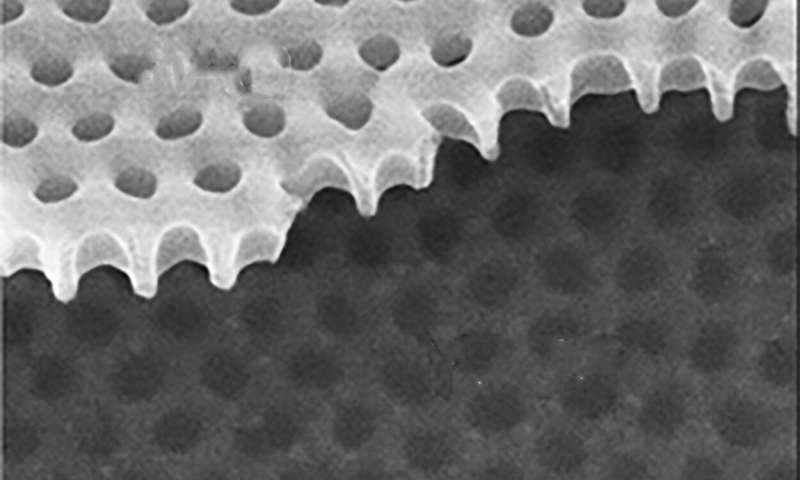 The superconducting material used in the experiment, with tiny holes punched in it. (Valles lab/Brown University)
According to their models, the magnetic field should cause the flow of electrons to run laps around the pits. To test whether they were running solo or as Cooper pairs, the researchers just needed to measure their frequency.
“In this case, we found that the frequency is consistent with there being two electrons going around at a time instead of just one. So we can conclude that the charge carriers in this state are Cooper pairs and not single electrons,” says Valles.
That means, it’s nothing like other known metallic states where electrons individually run a marathon or sprint in pairs. This third state shows there are degrees of control for boson-like electrons.
The physicists are yet to come up with an explanation for the strange behaviour, but given this particular superconductor can operate at a relatively balmy -181 Celsius (-294 Fahrenheit; better than near absolute zero!), they shouldn’t have trouble running more experiments.
Beyond the interesting aspects of finding a new state for metals, it could be the basis of new kinds of future technology.
“The thing about the bosons is that they tend to be in more of a wavelike state than electrons, so we talk about them having a phase and creating interference in much the same way light does,” says Valles.
“So there might be new modalities for moving charge around in devices by playing with interference between bosons.”
This research is published in Science.







