

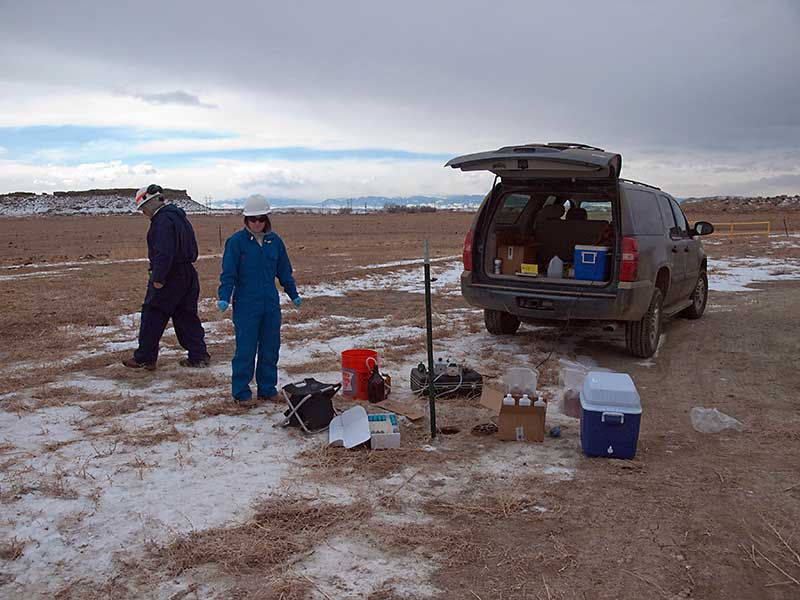

Sampling from January 2010. (American Environmental Protection Agency)
CASPER, Wyo. – An investigation into “the quality problems of drinking water in the rural area east of the town of Pavillion” exceeded $ 1.2 million in total costs.
Wyoming’s Department of Environmental Quality released its 4,226-page 2019 final report on Monday, December 23. This is a follow-up to a report of over 80,000 pages completed in 2016.
In addition to the cost of the investigation, the DEQ indicates that $ 929,268 was spent on a water supply project for the East Pavilion in order to install tank systems for landowners who have them made the request.
The article continues below …
The project was authorized by law and lasted from January 2014 to February 2015. The DEQ indicates that 31 tanks for 28 landowners have been installed.
For landowners who have not participated in the tank program, a bottled water delivery program was available until March 31, 2017.
Four of the eight well sites in the Pavillion gas field participating in the DEQ’s voluntary remediation program have obtained a “certificate of completion”.
The remaining sites are the subject of an “active investigation” and will be entered in the VRP as soon as the information is available and if the groundwater is affected. “
The DEQ survey dates back to 2013.
Their survey “included the collection of water quality and operational data for water supply wells (domestic, irrigation and stock), in order to assess the quality of the water water and to identify parameters or conditions that could cause palatability or toxicity problems. “
“An assessment of the integrity of nearby oil and gas wells and the historical use of surface wells in the Pavillion gas field was also carried out,” adds the DEQ in a fact sheet. 39 information on the investigation.
The 2019 report follows on from a number of things that the 2016 DEQ final report identified for further investigation.
The DEQ sampling of 13 wells in 2014 indicated that the organic compounds exceeded the “applicable” standards for drinking water. These included an “organochlorine” pesticide and a “phthalate ester”.
“Phthalate is used as a plasticizer in flexible PVC plastics and is a common contaminant in the laboratory,” explains the DEQ.
However, in the 2019 report, the DEQ indicates that the tests carried out in 2017 and 2018 did not indicate the presence of any of these organic compounds, which suggests that the concentrations detected in 2014 could have been ” artefacts from sampling or analysis process. “
The DEQ indicates that high levels of concentrations of salts, metals and radionuclides in the wells were confirmed in 2017 and 2018.
Although these compounds may be of natural origin, the DEQ adds that “industrial applications can use some of these same compounds (for example, oil and gas drilling mud contains chloride and potassium)”.
The DEQ does not believe that hydraulic fracturing is responsible for water problems with wells.
“The evidence does not indicate that hydraulic fracturing fluids have reached shallow depths used by water supply wells,” says their fact sheet. “In addition, based on an assessment of the history of hydraulic fracturing and the methods used in the Pavillion gas field, it is unlikely that hydraulic fracturing has caused impacts on the wells.” # 39; water supply. “
The DEQ believes rather that gas infiltration can be responsible for water quality problems.
“The gas in the upper Wind River formation appears to originate primarily from upward migration from deeper commercial gas zones and evidence suggests that upward gas infiltration (or gas load from the sands shallow) occurred naturally before the development of the gas well, “says DEQ.
Although seepage may have preceded the development of the gas wells, seepage may have continued after the installation of the gas wells.
“Some gas wells experience slow gas infiltration,” explains the DEQ. “The relative contribution of potential gas infiltration along gas wells compared to natural upward migration of gas is undefined and would be very difficult to quantify.”
The DEQ says that the “palatability” of water can be affected by another factor.
“The geochemical changes associated with the biodegradation of dissolved organic compounds have likely produced components associated with poor palatability of water and appear to be linked to lower well yields,” they say.
It may not be possible to draw definitive conclusions about the cause of the water quality problems.
“Limited baseline water quality data, prior to the development of the Pavillion gas field, precludes definitive conclusions about the causes and effects of the reported water quality changes”, indicates the DEQ.
More information and information on the Pavilion’s water quality survey is available from the United States Environmental Protection Agency.







