
GLOBAL RESEARCH SYNDICATE
No Result
View All Result
  • Login
  • Latest News
  • Consumer Research
  • Survey Research
  • Marketing Research
  • Industry Research
  • Data Collection
  • More
    • Data Analysis
    • Market Insights
  • Latest News
  • Consumer Research
  • Survey Research
  • Marketing Research
  • Industry Research
  • Data Collection
  • More
    • Data Analysis
    • Market Insights
No Result
View All Result
globalresearchsyndicate
No Result
View All Result
Home Data Analysis

Is transposable element expression affected by SARS-CoV-2 infection?

globalresearchsyndicate by globalresearchsyndicate
March 1, 2021
in Data Analysis
0
Is transposable element expression affected by SARS-CoV-2 infection?
0
SHARES
27
VIEWS
Share on FacebookShare on Twitter

A transposable element (TE) is a DNA sequence that is able to change relative position in the genome, and they in fact make up around 50% of the human genome. Most TEs appear to have no effect on the phenotype, though, depending on where they are inserted into the genome, they may cause mutations to arise. They are thought to be largely involved in homeostasis, and have been demonstrated to be involved in the generation of interferon in response to viral threat.

A study by researchers in Israel aims to establish whether TE expression is altered in severe acute respiratory syndrome coronavirus 2 (SARS-CoV-2) infected cells, and explores the implications for host immune response.

Study: Transposable elements as sensors of SARS-CoV-2 infection. Image Credit: NIAID / Flickr

The research team’s findings have been released on the bioRxiv* preprint server.

How are transposable elements involved in immune response?

TEs are involved in the transcriptional network that results in interferon response by a diverse range of overlapping and amplifying mechanisms. Additionally, TEs have been noted to be upregulated in T-lymphocyte enhancers, and throughout the whole genome in humans in response to some viruses. Avian flu, for example, has been found to elicit TE activity and subsequently enhance the host immune response.

Interestingly, early experiments with SARS-CoV-2 indicated that TE expression was heightened in A549 adenocarcinomic human alveolar basal epithelial cells, but not in NHBE primary lung epithelial cells, even with similar viral loads.  To test this phenomenon further, the group infected stem cell-derived alveolar type 2 (iAT2) cells with SARS-CoV-2, also noting only a mild TE response, though greater than that observed in NHBE. In all cases, the population of TEs was seen to rise before interferon upregulation was detected, indicating a causal relationship.

Several genes were found to correlate with TE expression, with mitochondrial-related processes doing so inversely, while those involved in pre-mRNA processing and transcription were enhanced. Importantly, many genes that produce proteins that interact with SARS-CoV-2 were noted to inversely correlate with TE expression, suggesting that the virus is mediating the host TE response.

Epigenetic alterations to the genome before and after SARS-CoV-2 or avian flu infection were analyzed in A549 cells. TEs generated by cells exposed to SARS-CoV-2 exhibited a distinct epigenetic profile that differed from those generated by avian flu-infected cells, specifically, being devoid of H3K27me3, an epigenetic modification that is associated with the downregulation of nearby genes. This epigenetic aberration, among others observed by the group, renders the cell prone to TE disorder.
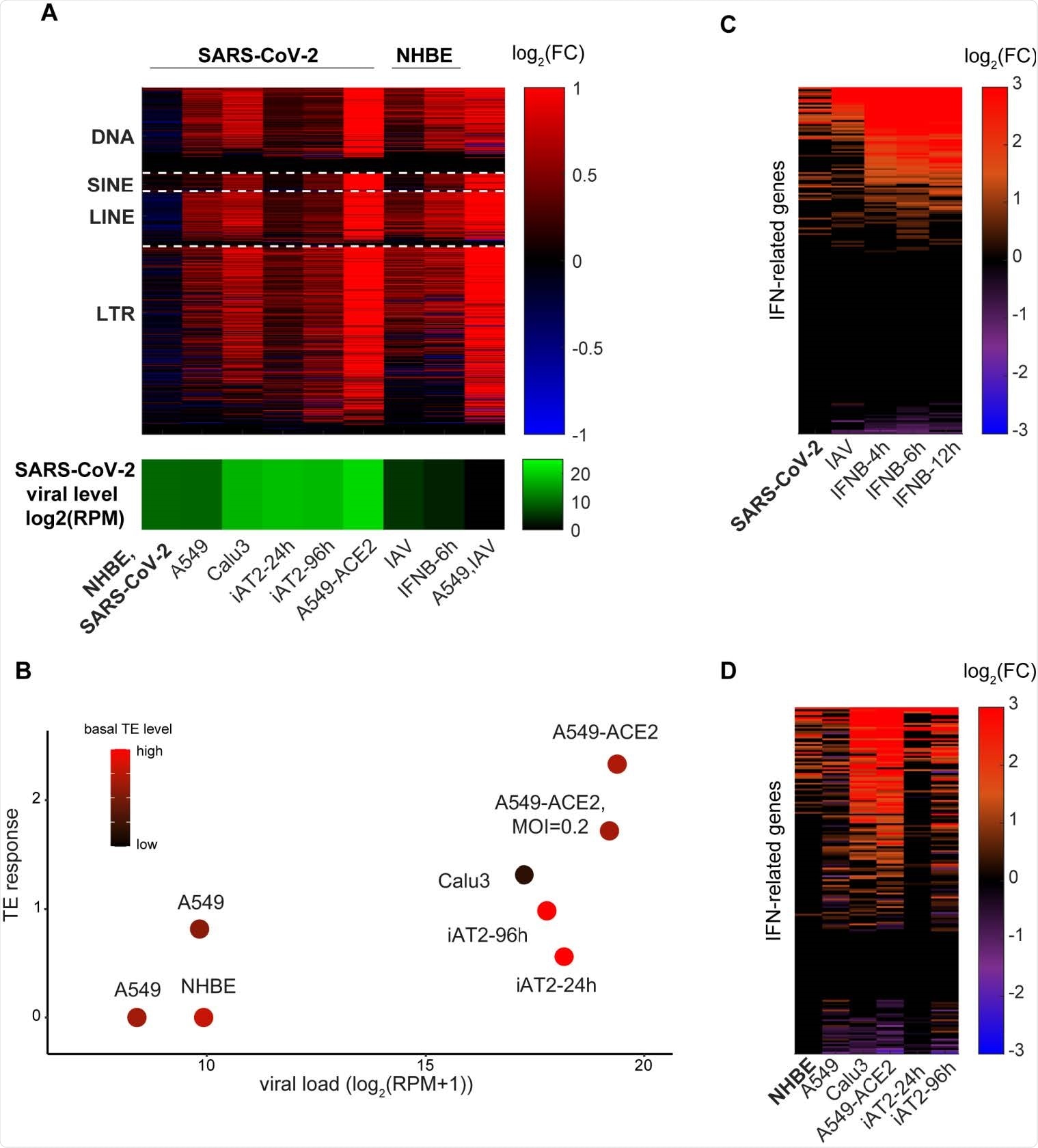
TEs expression changes and IFN response to SARS-CoV-2 and IAV infections. A. Log2-fold change in expression level of TE subfamilies (DNA, SINE, LINE and LTR) in different cell lines and in the different conditions indicated. SARS-CoV-2 viral levels (green) are depicted in the bottom panel. B. TE induction levels is correlated with TE basal levels pre-infection and SARS-CoV-2 viral levels. Linear regression coefficients are 0.158 and -0.57 for viral load and basal TE level, respectively (R2=0.81). C-D. The IFN transcriptional response among NHBE cells (C) and among SARS-CoV-2-infected cells (D).

TEs expression changes and IFN response to SARS-CoV-2 and IAV infections. A. Log2-fold change in expression level of TE subfamilies (DNA, SINE, LINE and LTR) in different cell lines and in the different conditions indicated. SARS-CoV-2 viral levels (green) are depicted in the bottom panel. B. TE induction levels is correlated with TE basal levels pre-infection and SARS-CoV-2 viral levels. Linear regression coefficients are 0.158 and -0.57 for viral load and basal TE level, respectively (R2=0.81). C-D. The IFN transcriptional response among NHBE cells (C) and among SARS-CoV-2-infected cells (D).

What are the implications for COVID-19?

A549 cells naturally exhibit lower baseline TE expression rates than iAT2 cells, which are lower still than observed in NHBE cells. Additionally, epigenetic dysregulation of TEs is usually observed in A549 cancer cells, impairing the TE response.

NHBE cells are sourced from a 79-year-old female donor, and TE expression is heightened with age, which is also the major risk factor for COVID-19. The group hypothesizes that TE expression could be a major influencing factor in the association between age and COVID-19 outcome. Those with heightened baseline TE levels experience a proportionately lesser spike in TE expression upon viral infection, resulting in a weaker interferon response. The cells are desensitized towards changes in TE expression.

The group proposes that the impaired TE response observed in SARS-CoV-2 infection results from active evasion mechanisms of the virus, exacerbated by age-resultant epigenetic dysregulation. A weakened initial interferon response could lead to an exaggerated inflammatory response, resulting in a life-threatening cytokine storm.

TE activation could therefore be utilized as a therapeutic tool against COVID-19, generating improved early interferon responses and thus lessening the severity or occurrence of serious inflammatory responses in the host.

*Important Notice

bioRxiv publishes preliminary scientific reports that are not peer-reviewed and, therefore, should not be regarded as conclusive, guide clinical practice/health-related behavior, or treated as established information.


Related Posts

How Machine Learning has impacted Consumer Behaviour and Analysis
Consumer Research

How Machine Learning has impacted Consumer Behaviour and Analysis

January 4, 2024
Market Research The Ultimate Weapon for Business Success
Consumer Research

Market Research: The Ultimate Weapon for Business Success

June 22, 2023
Unveiling the Hidden Power of Market Research A Game Changer
Consumer Research

Unveiling the Hidden Power of Market Research: A Game Changer

June 2, 2023
7 Secrets of Market Research Gurus That Will Blow Your Mind
Consumer Research

7 Secrets of Market Research Gurus That Will Blow Your Mind

May 8, 2023
The Shocking Truth About Market Research Revealed!
Consumer Research

The Shocking Truth About Market Research: Revealed!

April 25, 2023
market research, primary research, secondary research, market research trends, market research news,
Consumer Research

Quantitative vs. Qualitative Research. How to choose the Right Research Method for Your Business Needs

March 14, 2023
Next Post
Killings by Police Declined after Black Lives Matter Protests

Killings by Police Declined after Black Lives Matter Protests

Categories

  • Consumer Research
  • Data Analysis
  • Data Collection
  • Industry Research
  • Latest News
  • Market Insights
  • Marketing Research
  • Survey Research
  • Uncategorized

Recent Posts

  • Ipsos Revolutionizes the Global Market Research Landscape
  • How Machine Learning has impacted Consumer Behaviour and Analysis
  • Market Research: The Ultimate Weapon for Business Success
  • Privacy Policy
  • Terms of Use
  • Antispam
  • DMCA

Copyright © 2024 Globalresearchsyndicate.com

Welcome Back!

Login to your account below

Forgotten Password?

Retrieve your password

Please enter your username or email address to reset your password.

Log In
This website uses cookies to improve your experience. We'll assume you're ok with this, but you can opt-out if you wish. Cookie settingsACCEPT
Privacy & Cookies Policy

Privacy Overview

This website uses cookies to improve your experience while you navigate through the website. Out of these cookies, the cookies that are categorized as necessary are stored on your browser as they are essential for the working of basic functionalities of the website. We also use third-party cookies that help us analyze and understand how you use this website. These cookies will be stored in your browser only with your consent. You also have the option to opt-out of these cookies. But opting out of some of these cookies may have an effect on your browsing experience.
Necessary
Always Enabled
Necessary cookies are absolutely essential for the website to function properly. This category only includes cookies that ensures basic functionalities and security features of the website. These cookies do not store any personal information.
Non-necessary
Any cookies that may not be particularly necessary for the website to function and is used specifically to collect user personal data via analytics, ads, other embedded contents are termed as non-necessary cookies. It is mandatory to procure user consent prior to running these cookies on your website.
SAVE & ACCEPT
No Result
View All Result
  • Latest News
  • Consumer Research
  • Survey Research
  • Marketing Research
  • Industry Research
  • Data Collection
  • More
    • Data Analysis
    • Market Insights

Copyright © 2024 Globalresearchsyndicate.com



