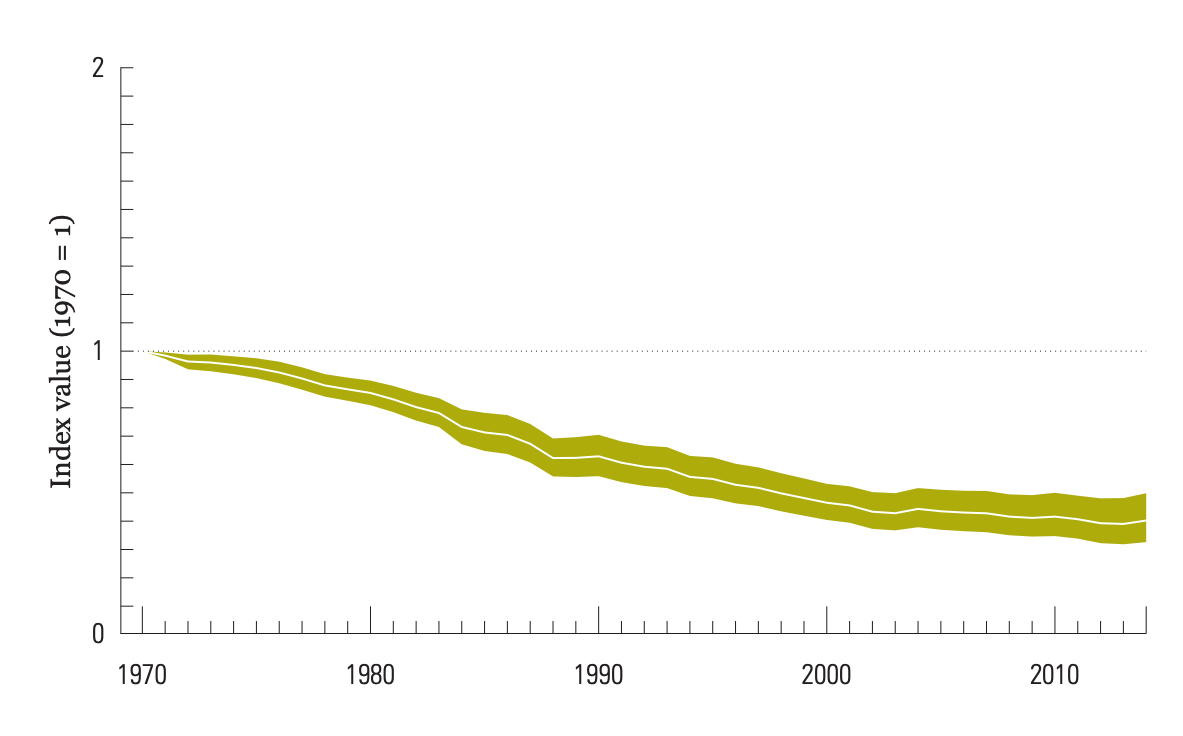
A 2018 World Wildlife Fund (WWF) report focusing on how human activity has affected wildlife found that between 1970 and 2014, there was an approximately 60 percent decline in populations of mammals, birds, fish, reptiles and amphibians. The report highlighted deforestation and other types of land degradation as a major driver of this trend, citing data showing only about one-quarter of land on Earth is largely free of human impacts. Protecting 30% of U.S. lands and waters—as part of the global 30×30 goal—is a critical step to shore up critical habitat, save migration corridors and stop the bleeding.
The chart below shows The Living Planet Index, an indicator of the state of global biodiversity cited by WWF. It measures the average rate of change over time across a set of species populations and shows an overall decline of 60% in the population sizes of vertebrates between 1970 and 2014–an average drop over half in less than 50 years.