

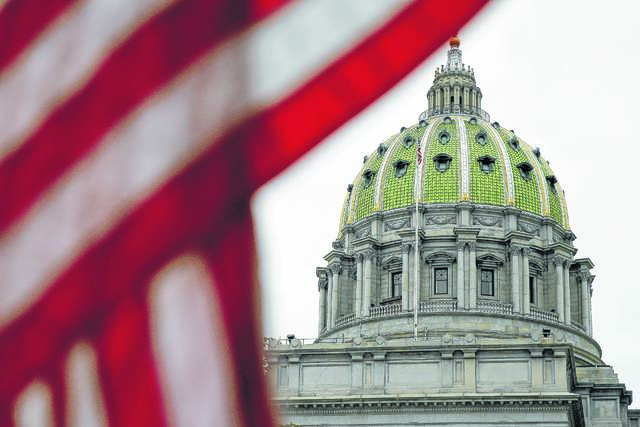
After being forced to close or severely curtail their businesses over the last 11 months, Pennsylvania’s struggling business owners are being invited to tell state House Republicans what they need to recover from the devastation of the COVID-19 pandemic.
The COVID-19 Economic Recovery Business Survey was unveiled Wednesday by House Majority Leader Kerry Benninghoff, R-Centre/Mifflin, Majority Policy Committee Chairman Martin Causer, R-Cameron/McKean/Potter, and Economic Recovery Task Force Chairman Rep. Aaron Kaufer, R-Kingston.
“For far too long, our business owners have had no say in their own fate thanks to the unilateral actions taken by Gov. Tom Wolf,” Causer said. “They’ve been told what they’re allowed to do and what they’re not allowed to do. When they’re allowed to do something, they’re told how they have to do it. They make investments to comply with the directives and then the directives change. Enough is enough.”
Benninghoff agreed, stating, “This survey is about ensuring our business owners have the voice they deserve and, frankly, have earned through their commitments to taking care of their employees and trying to serve their communities in the midst of this pandemic. Working together, we can make Pennsylvania the ‘envy of the east’ when it comes to economic recovery.”
As chairman of the House Republican Caucus’ Economic Recovery Task Force, Kaufer urged owners of businesses of all shapes and sizes from across the state to share their experiences.
“We want your feedback, advice and ideas so we can facilitate a swift and robust economic recovery for the Commonwealth and our communities in 2021,” Kaufer said.
The brief survey seeks information about each respondents’ business or industry and then invites feedback about the challenges facing that business or industry, the type of assistance that would be most beneficial, the one most impactful thing state government could do to support future success, and any other ideas to kick-start the Commonwealth’s recovery.
Responses to the survey will be reviewed by the Policy Committee and Economic Recovery Task Force as they work to develop initiatives to expedite the state’s recovery from the COVID-19 pandemic and related mitigation orders.
The survey is available via www.PAHouseGOP.com. It will remain open for responses through March 19.
Meuser, colleagues ask Shapiro for
report on long-term care facilities
U.S. Rep. Dan Meuser, R-Dallas, this week was joined by Pennsylvania members of the U.S. House of Representatives including U.S. Reps. Glenn ‘GT’ Thompson (PA-15), Mike Kelly (PA-16), Scott Perry (PA-10), Lloyd Smucker (PA-11), Guy Reschenthaler (PA-14), John Joyce (PA-13), and Fred Keller (PA-12) in sending a letter to Pennsylvania Attorney General Josh Shapiro, asking whether his office intends to release a report on guidance issued by the PA Department of Health that called for admittance of COVID-19 positive individuals in long-term care facilities:
“As you may have seen, the Attorney General of New York recently released a report on their office’s ongoing investigation related to nursing homes and their responses to the COVID-19 pandemic. One of the most troubling revelations of this report is that COVID-19 nursing home fatalities were under-counted by roughly 50 percent in New York State.
“One of the primary causes of the large number of nursing home fatalities in New York was the state government’s order that nursing homes admit COVID-19 positive individuals. The Pennsylvania Department of Health (PA DOH) issued a similar guidance on March 18, 2020, requiring that nursing homes allow new admissions and re-admissions, including individuals that had been diagnosed with COVID-19. Public reporting from PA DOH indicates that more than half of the COVID-19 related deaths in Pennsylvania have been attributable to nursing and personal home care populations.
“We have heard from many Pennsylvanians that are concerned with the state policies that put nursing and personal care home facility residents at risk. Does your office plan to offer a similar report as the New York State Attorney General’s office? What is your plan to ensure that all publicly available information on this important topic is reliable and accurate?”
Tobyhanna Depot collects data
on military overwhite uniforms
Danielle E. Weinschenk, Lead Public Affairs Specialist at Tobyhanna Army Depot, offered a report this week on data collected at Tobyhanna Army Depot that will help improve specialty uniforms for U.S. Army Soldiers and Marines.
The depot hosted four government entities in late January in support of an ongoing study to assess the effectiveness of military overwhite uniforms.
Also called “snow camouflage,” the attire is designed to conceal soldiers from an array of sensors in different snow environments.
Tobyhanna was selected as a data collection site after analysis by the U.S. Army Corps of Engineers found that the depot’s terrain resembled potential combat environments in the Baltic region of Northern Europe. Other sites included in the study were Camp Dawson in West Virginia and Fort Drum in New York.
The study team was comprised of representatives from the U.S. Army Combat Capabilities Development Command, Naval Surface Warfare Center Dahlgren Division (NSWCDD), Product Manager Soldier Clothing and Individual Equipment (PM-SCIE) and Program Executive Office (PEO) Soldier. Those involved commended Team Tobyhanna’s hospitality.
“Tobyhanna’s support was phenomenal. Everything went right – the weather conditions were perfect and we captured the exact data we needed. The Tobyhanna team went above and beyond,” said Clay Williamson, the future programs officer at PEO Soldier.
The study’s mission was to capture imagery of the uniforms in locales that were similar to areas where future battles may occur. The imagery will then be used in an experiment to determine success of the uniforms’ “signature mitigation properties”. Called a “probability of detection study,” the test is similar to a scientific version of ‘Where’s Waldo?” according to technical lead Jacob Quartuccio, PhD. Hundreds of Soldiers will view the imagery taken at the three locations and indicate if they can “find” the person wearing the overwhite uniform. Results from the study will be used for future product development and procurement.
Depot personnel say they were happy to accommodate such an important mission.
“Team Tobyhanna is ready, willing and able to support Soldier requirements of all kinds. We’re here when the Soldier needs us,” said Edward Kovaleski, an architect in the Installation Services Directorate.
About 4,000 personnel are employed at Tobyhanna, which is located in the Pocono Mountains of northeastern Pennsylvania. Tobyhanna Army Depot is part of the U.S. Army Communications-Electronics Command. Headquartered at Aberdeen Proving Ground, Maryland, the command’s mission is to empower the Soldier with winning C5ISR capabilities.
Cartwright bill wouod expand
Medicare to cover hearing benefits
U.S. Rep. Matt Cartwright, D-Mosoic, and Republican U.S. Rep. John Katko (NY-24) this week re-introduced the Help Extend Auditory Relief (HEAR) Act to expand hearing benefits for seniors on Medicare.
Currently, Medicare Part B covers auditory examinations in the event of an accident or illness, but not routine checkups – which physicians recommend to address gradual loss of hearing — or hearing aids.
If prescribed a hearing device, the out-of-pocket expenses may be impossible to afford. Typical hearing aid models can cost over $1,000, with the most state-of-the-art devices topping $5,000. People who need devices for both ears face double the cost.
Specifically, the HEAR Act would amend the Social Security Act to include Medicare coverage for hearing rehabilitation, including a comprehensive audiology assessment to determine if a hearing aid is appropriate. It would also extend Medicare Part B coverage to hearing aid devices.
“Hearing loss among older Americans is common, and more serious conditions like depression and anxiety often follow if it’s not addressed. Exams and hearing aids are simple ways to mitigate hearing loss, but those resources are far too costly without insurance coverage,” Cartwright said. “This common-sense bill supported by both Democrats and Republicans will extend Medicare coverage for hearing aid devices so seniors can access these life-enhancing solutions without breaking their bank.”
According to the National Institute on Aging, about one-third of Americans between the ages of 65 and 74 experience hearing loss, and nearly 50 percent of those over 75 have difficulty hearing. People with untreated hearing loss are more likely to report depression, anxiety, anger and frustration, and emotional instability and paranoia, and are less likely to participate in organized social activities than those who wear hearing aids.







