

“We will not stand for the needless desecration of our homelands.”
Two years ago, Governor Andrew Cuomo touted his important 2019 State of the State address announcement of 20 large-scale solar, wind energy and storage projects that were scheduled to take shape across New York State — some even in Indian Country.
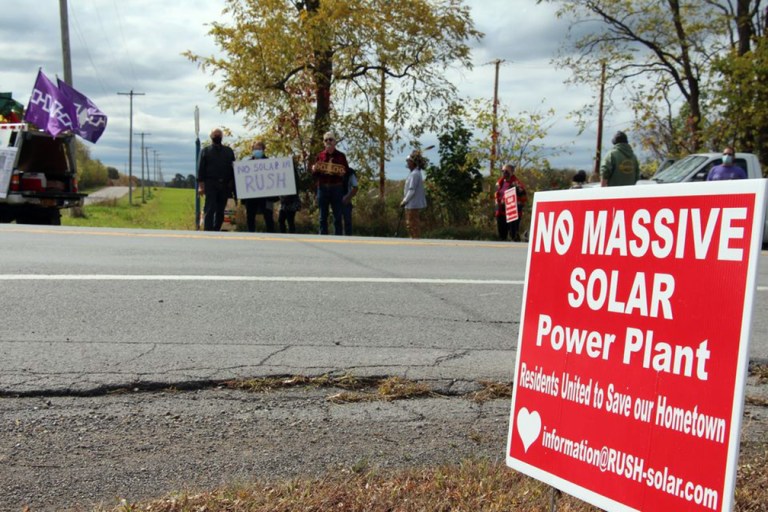
 The towns of Caledonia and Rush are trying to stop a state-sponsored massive solar plant project from popping-up in the homelands of the Seneca Nation. Photo Courtesy: Seneca Media & Communications Center.
 Seven were slated to be built in the Finger Lakes — seven towns, and one Nation for that matter, just not in name.
“Invenergy will build a 180 megawatt solar facility in the town of Caledonia,” the single bullet-point summary reads.
Although one of Cuomo’s pressers labelled the Horseshoe Solar project as technically taking place within the confines of Livingston County, the expansive project that’ll sprawl across more than 1,000-acres of land undeniably bears great significance to the Seneca Nation.
It’s a part of their homeland — not just for the Seneca, but Tonawanda and other surrounding Indigenous communities as well.
That’s the historic Canawaugus territory, where a town once stood, and more recently, relics and human remains have been found.
In short, there’s no mention of the Seneca Nation whatsoever in any of the governor’s press statements relating to this particular Article 10 Public Service Commission project, which is directly overseen through Cuomo’s New York State Energy Research and Development Authority.
Led by a board of 13 members, nine of those seats are filled by the presiding governor. The other four posts are held by commissioners from the Department of Transportation and Department of Environmental Conservation, state’s Power Authority president and CEO and chair of the Public Service Commission.
Like any other public involvement program, developers are supposed to identify stakeholders and list all of them before a project gets approved.
Chicago’s Invenergy, a global sustainable energy solutions company, didn’t identify the Keeper of the Western Door in their initial or revised public involvement program reports.
Their most recent report from Feb. 2019 reveals that there’s no recognition of the Seneca Nation either.
Any mention of the Nation is absent from those original documents — just like Invenergy’s acknowledgement of artifacts for the Indigenous peoples of Upstate New York.
“The Horseshoe Solar project threatens to destroy a sacred landscape rich with Seneca, Haudenosaunee, and American history.”
Dooren M. Harris, the president and CEO at the New York State Energy Research and Development Authority, is subject to the Seneca Nation’s aired grievances in their latest letter dated from Feb. 16.
Her department directly reports to Cuomo, who has propelled wide-sweeping clean and renewable energy efforts across the state — at the expense of the Keeper of the Western Door.
“The Nation understands that the ambitious goal of achieving zero greenhouse gas emissions from all man-made sources will require large-scale development of renewables. Generally speaking, we support this concept. But we are emphatic that it not come at an irreversible cultural cost,” Matthew B. Pagels, the president of the Seneca Nation of Indians, wrote.
Specifically, the Horseshoe Solar project that’s overseen by Invenergy, has largely ignored Indigenous voices after repeated calls for the new solar site to be moved elsewhere, only after disturbing burial grounds that are directly connected to their own cultural identities — and their ancestors.
Cuomo’s ongoing environmental development project now poses to force the erasure of the Nation’s direct connection those sacred lands in their traditional homelands.
Originally, the Seneca acquired the Canwaugus territory through the 1797 Big Tree Treaty, which remained in their possession until 1826 after a contentious treaty-making process resulted in the forced removal of that community.
The legality behind that treaty remains largely in question with advocates arguing that the fraudulent treaty was agreed upon by the Seneca peoples, but also illegally ratified by Congress after failing to secure a two-thirds super-majority vote in accordance with the U.S. Constitution.
Even now, 195 years later, the Nation still sees external governments setting priorities at the expense of irreplaceable Indigenous cultural sites.
And the state’s continued actions only highlight “the sidelining of the Nation’s interest in preserving cultural and archeological resources,” according to Pagels.
Pagels also presses that “the Horseshoe Solar project threatens to destroy a sacred landscape rich with Seneca, Haudenosaunee, and American history” — a legacy that the Cuomo administration would incur if the project isn’t all but abandoned.
Under the state’s Article 10 law, Horseshoe Solar must comply with conducting an archaeological survey along Golah Road, which started in September and ended in November.
Thus far, the Nation has unearthed “over 10,000 Native American artifacts within six of the 44 parcels that comprise the project area” after the conclusion of their Phase 1B field investigation at their burial site within the Canawaugus territory.
Despite those concrete archeological findings, the Invenergy company is now actively calling to bypass the Phase II survey, ending any further discoveries from ever occurring on the site.
In a previous FingerLakes1.com press statement from Oct. 2020, Kate Millar, the Horseshoe Solar project developer, insisted that they’re “not proposing to build on burials” and “actively consulting with the Nations throughout the permitting process.”
However that doesn’t seem to be the case, given the company’s current stance on the project. Instead Invenergy broke its own pact and promises, much like the treaty-making process in the United States.
On Indigenous Peoples’ Day, Senecas mobilized a rally against the active encroachment of their homelands through the Article 10 Horseshoe Solar project.
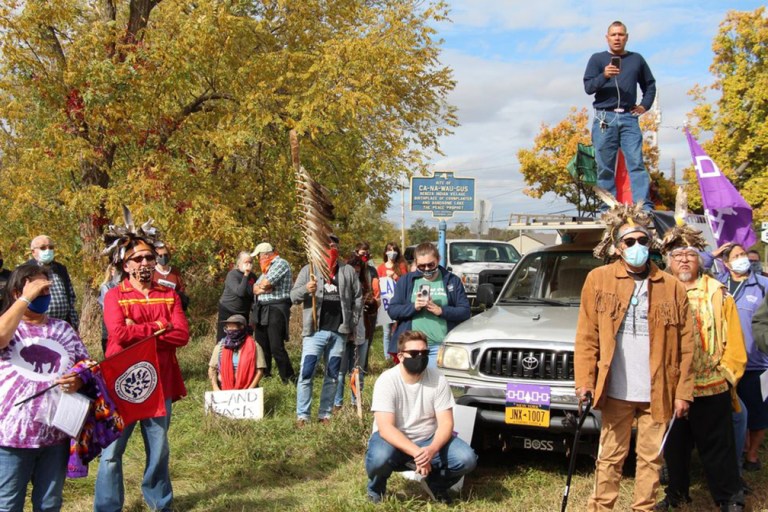 Indigenous peoples and their allies converged on Oct. 12, Indigenous Peoples’ Day, to protest the encroachment of the state’s Horseshoe Solar project. Photo Courtesy: Seneca Media & Communications Center.
Shortly after, Jason Corwin, the director of the Seneca Media and Communications Center, produced a documentary titled “Protecting Our Ancestors: Saving Native Burial Grounds,” which has chronicled the ongoing situation in Caledonia and Rush.
Since then, Invenergy has proposed a consolatory compromise following the completion of the Phase 1B survey.
They’re willing to offer a modification to the current project, which would remove more than 70-acres from the site “to ensure culturally significant areas are preserved and remain undisturbed,” according to Millar’s latest comments to FingerLakes1.com.
“This significant modification ensures that culturally significant sites are preserved and that ground disturbance associated with any further stages of archeological investigation is avoided,” Millar added.
However, that proposal hasn’t been officially set in stone yet. In fact, it’s unclear whether it’ll be considered.
Paul Winnie, 66, a member of the Tonawanda Seneca Nation, has been closely following the project and advocating on behalf of the Nations.
But even if this concession actually occurs, Winnie suggests that it’s not enough, speaking as someone who’s openly opposed to the project in its entirety.
“A 70-acre reduction at Golah, about five-percent of the project, in two of a total of 44 parcels, based on a preliminary study is not the answer,” Winnie insisted.
Before the project got announced, Invenergy reportedly initiated “ongoing cultural resources consultation” on behalf of Horseshoe since 2018.
“Throughout this process, Invenergy has worked with the Indian Nations and State Historic Preservation Office (SHPO) to ensure surveying was conducted in a respectful, comprehensive manner and to establish clear protocols to protect the areas,” Millar shared.
Winnie also explained that the Phase 1B survey doesn’t set a mandate to have a monitor oversee the archeological study unlike the Phase II survey, which actually requires tribal representation throughout the process.
With thousands of relics and remains already found on-site within six of the 44 parcels, Winnie believes that “they don’t want to dig and find more.”
In accordance with Article 10, the archaeological findings cannot simply be hidden or shielded from the public eye, and an actual judge presides over the project and makes decisions.
The full Phase 1B summary, report has already been published on the Department of Public Service’s website.
However, the Seneca Nation strongly asserts their sovereign agency, calling upon Invenergy to conduct the Phase II survey.
“The Nation strongly opposes this request. As a starting point, we believe that Invenergy has a moral responsibility to conduct a Phase II archeological survey of the project sites located within the Canawaugus Reservation to make certain that no historical artifacts are inadvertently destroyed in the name of fast-tracking this private project to achieve admittedly ambitious clean energy goals,” Pagels added.
Dr. Joe Stahlman, the museum director of the Seneca Iroquois National Museum has been advising the Nation’s approach to handling the Canawaugus territory’s historical significance.
Serving as the tribal historic preservation officer, Stahlmann represents an additional 182 recognized sovereign nations, spanning across 50-million acres of tribal lands, as a part of the National Association of Tribal Historic Preservation Officers.
Unlike Indigenous communities, non-Native communities are not facing an upheaval of their homelands, which are currently under attack by the state government even though the Seneca Nation still “remains committed to mitigating the costly impact of climate change.”
If the state approves Invenergy’s request to proceed developing the site without any additional surveying “would set a dangerous precedent in connection with these and other sites, further diminishing the voices of Native communities whose needs and opinions have been overlooked and pushed aside for far too long,” according to Pagels.
That precedent has already been in effect, long before the Horseshoe Solar project ever encroached upon the homelands of the Seneca Nation.
The letter also reveals that two gravel pits and a small solar facility are already stationed within the boundaries of their reservation — in the absence of the Nation’s prior knowledge and actual consent.
“The Nation was not consulted on either project, and thus was unable to assess if and how much those projects damaged priceless and irreplaceable cultural and historical resources,” he said.
This is a historical reality that the Seneca Nation hopes to finally correct for the preservation of sovereign lands for future generations — not just for the Nation either.
In his closing remarks, Pagels advocates for the “earlier notification of any project within its aboriginal lands.”
“The Nation is willing to work with the State on a cooperative basis to streamline responsible clean energy projects, but we cannot support any project that only allows us to mitigate irreversible damage to those historical sites,” Pagels’ letter stated.
“You’re in our shoes now.”
Two years later, Cuomo’s ambitious clean energy projects continue to grow in local communities all across New York State — without any foreseeable hitches in sight.
He announced 24 new large-scale renewable energy efforts this year alone, increasing the total count to 100 statewide projects in 2021.
Ahead of Indigenous Peoples’ Day, Winnie believed that there are vested state interests involved in this particular project, even naming Cuomo and his ‘Green New Deal’ initiative as a culprit, who seems to actively undercut Indigenous perspectives at the state level.
The financial prioritization of Upstate communities isn’t a new trend either for the Cuomo administration, which disclosed that 23 solar projects and a hydroelectric facility created 3,400 jobs and $2.9 billion of investment within 16 counties.
Part of that unprecedented growth comes from the Independent Power Producers of New York, a trade association that represents companies “in the competitive power industry.”
Since 2018, Invenergy has peddled thousands of dollars to the their political action committee: IPPNY PAC, according to the New York State Board of Elections website.
Gavin J. Donohue, the president and CEO of IPPNY, had been personally tapped by Cuomo, naming him as the first appointment to the New York State Climate Action Council in 2019.
Last year’s budget also approved the Accelerated Renewable Energy Growth and Community Benefit Act “to dramatically speed up the siting and construction of clean energy projects to combat climate change.”
That decision led to the creation of the Department of State’s new Office of Renewable Energy Siting, which allows for the Cuomo administration to directly oversee their ongoing efforts to lead the nation by creating 70-percent of the state’s electricity from renewable sources through the Climate Leadership and Community Protection Act.
 Indigenous peoples aren’t the only ones who are opposed to the Horseshoe Solar project. The Residents United to Save our Hometown [RUSH] are disgruntled non-Indigenous demonstrators, who are equally opposed to the massive solar power plant project. Photo Courtesy: Seneca Media & Communications Center.
This top-bottom approach to achieving Cuomo’s ambitious clean energy goals is leaving local governments powerless within their own communities — much like the Tonawanda and Seneca.
That’s how communities like Caledonia and Rush are “losing your local rights,” Winnie said. “You’re in our shoes now.”







