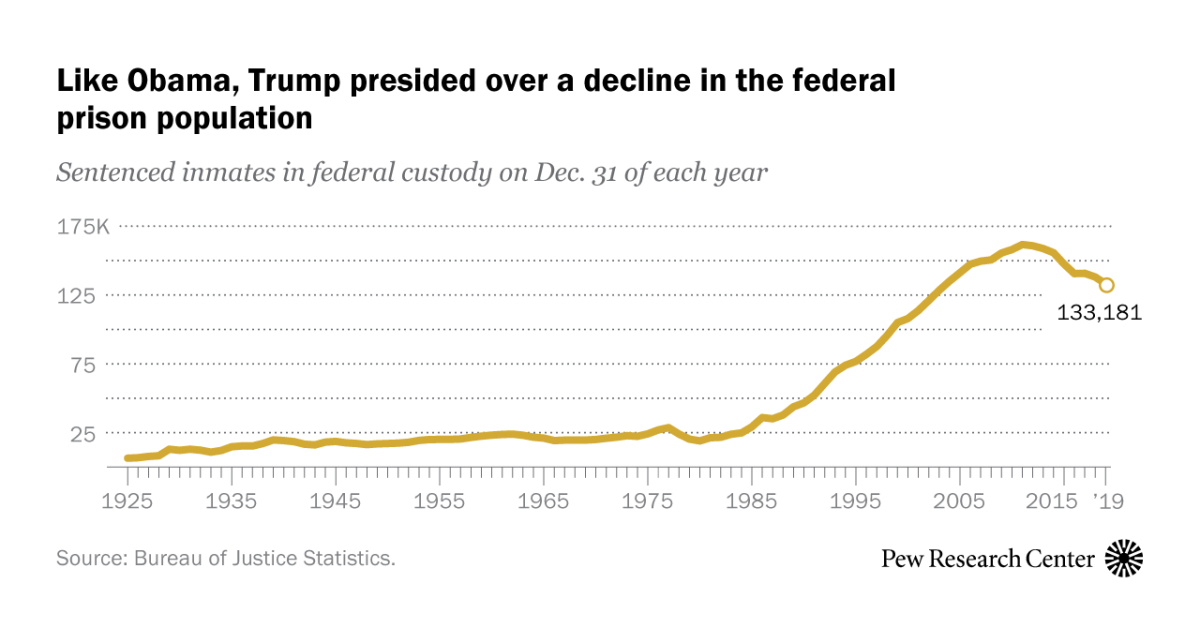
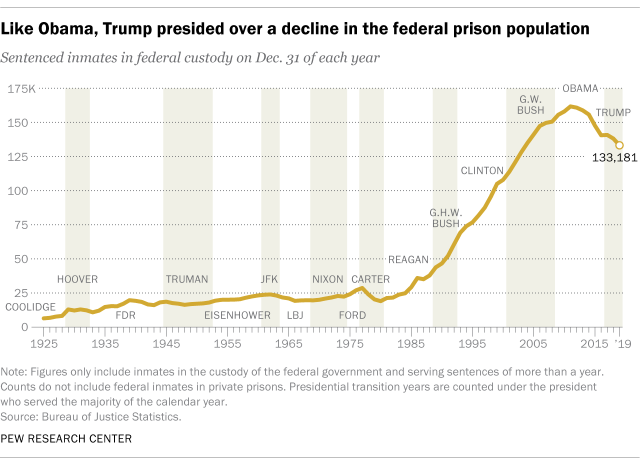
The federal prison population, which declined for the first time in decades under President Barack Obama, fell further during the administration of President Donald Trump.
The number of federal prisoners sentenced to more than a year behind bars decreased by 5% (or 7,607 inmates) between 2017, Trump’s first year in office, and the end of 2019, the most recent year for which final data is available from the Bureau of Justice Statistics. Preliminary figures for 2020 show that the decline continued – and even accelerated – during Trump’s last full year in office, meaning that the overall reduction in inmates during his tenure will likely exceed 5% once final data is available. Part of the decrease in prisoners in 2020 may have been attributable to policy changes in response to the coronavirus pandemic.
Obama made criminal justice issues a focus of his presidency and became the first president since Jimmy Carter to leave the White House with fewer inmates than when he arrived. Among other things, he oversaw a Justice Department initiative that emphasized lighter sentences for those convicted of lower-level crimes and used his executive clemency power more frequently than any modern president. The number of prisoners fell by 10% (or 14,988 inmates) during Obama’s tenure, the biggest decline in absolute numbers of any president on record.
This analysis examines how the federal prison population changed under President Donald Trump and other presidents dating back to Calvin Coolidge.
To calculate changes in the federal prison population under each administration, we analyzed Bureau of Justice Statistics data from 1925 to 1986, as well as separate BJS data from 1987 to 2019 that is publicly available through the Corrections Statistical Analysis Tool. Preliminary data for 2020 is drawn from the Bureau of Prisons website.
In years that spanned multiple administrations, we attributed the change in the inmate population to the president who served the majority of the calendar year. Richard Nixon, for example, served until August 1974, so we counted that year under his administration, rather than Gerald Ford’s.
The BJS data in this analysis focuses on prisoners who are in the custody of the federal government and serving sentences of more than one year. It excludes prisoners sentenced to a year or less, unsentenced prisoners and those who are not in the custody of the federal government (such as those in private, contracted prisons). Inmates in the custody of the federal government and sentenced to more than a year accounted for 76% of all prisoners under the jurisdiction of the federal government at the end of 2019.
In some respects, Trump took a notably different approach from Obama when he entered office. His Justice Department quickly reversed the Obama-era policy of seeking lighter sentences for some criminal suspects, and Trump granted far fewer acts of clemency than nearly every other modern president. At the same time, Trump signed into law the First Step Act, a significant overhaul of criminal justice policies aimed in part at reducing the federal prison population. In its first year, the law led to shorter sentences for thousands of federal offenders and earlier release dates for many others, according to a 2020 report from the U.S. Sentencing Commission.
It’s important to note that presidential policies are just one of many factors that can affect the size of the federal prison population. Crime rates, law enforcement practices and judicial sentencing patterns all play a role. For instance, crime rates rose sharply during the 1980s and early 1990s but have fallen dramatically since then. It’s also important to keep in mind that the vast majority of people who are behind bars in the United States are held in state and local correctional facilities, not the federal system. As of the end of 2019, the federal system held 11% of all U.S. inmates sentenced to more than a year in prison, according to the Bureau of Justice Statistics.
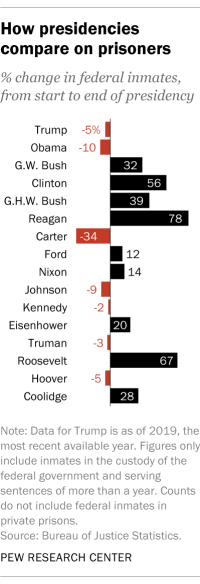
Still, presidents can help set federal criminal justice policies, and those policies can affect the prison population. Ronald Reagan signed into law several measures that increased federal criminal penalties, including one that eliminated parole in the federal prison system. The number of sentenced federal inmates rose by 78% (or 16,539 prisoners) during Reagan’s eight years in office, the largest percentage increase for any administration on record.
In absolute numbers, the largest increase in federal prisoners occurred under Bill Clinton. The number of sentenced inmates rose by 38,769 (or 56%) under Clinton, who signed into law a major crime bill that increased funding for prisons and authorized 100,000 additional police officers (though many of the law’s provisions focused on state correctional systems, rather than the federal system). Current President Joe Biden was chairman of the Senate Judiciary Committee at the time and helped write the law that Clinton signed in 1994.
Despite serving only four years, Jimmy Carter presided over the largest percentage decrease in federal prisoners (-34%) of any president on record.