

Life famously “finds a way,” even outside of Jurassic Park.
In a new study, scientists reveal a form of life in Antarctica that breaks all the rules of previously established science. The research provides the first recorded evidence of immobile marine life on the seafloor far beneath the floating Antarctic ice shelf. These stationary animals may include sponges, but for now, are broadly categorized as “sessile organisms.”
It’s still unknown how the lifeforms got there, how long they have been there, and exactly what are they.
“This discovery is one of those fortunate accidents that pushes ideas in a different direction and shows us that Antarctic marine life is incredibly special and amazingly adapted to a frozen world,” said lead author and biogeographer Huw Griffiths of the British Antarctic Survey.
This finding was published Monday in Frontiers in Marine Science.
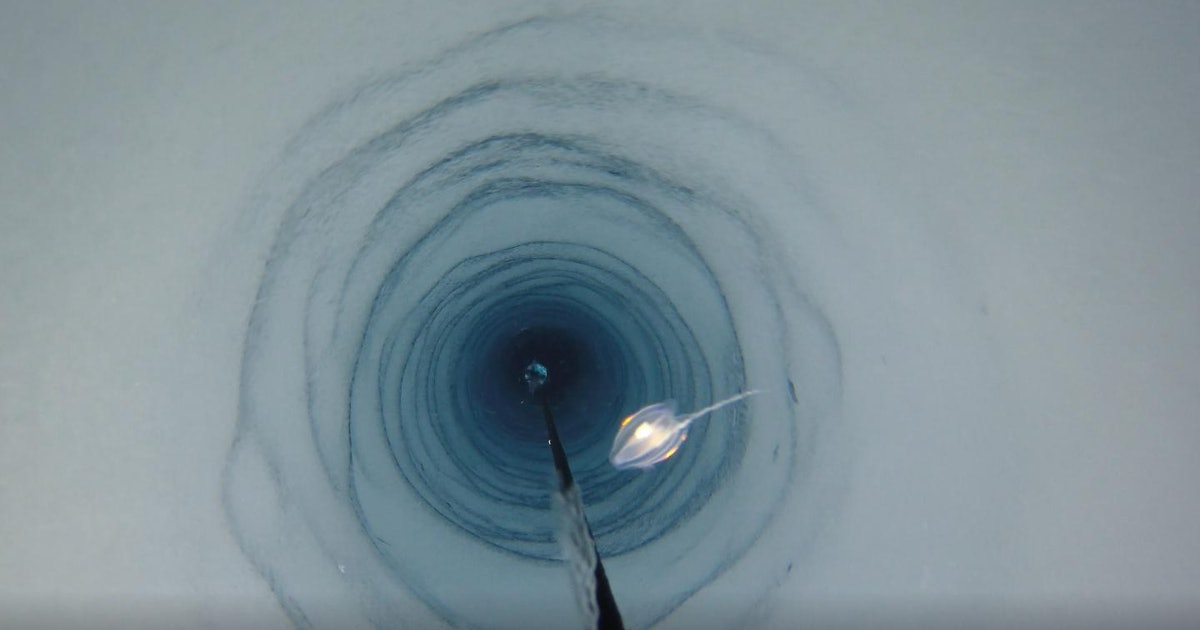
How they did it — In the summers of 2015–2016 and 2016–2017, scientists drilled access holes — also known as ‘boreholes’ — into the Filchner-Ronne Ice Shelf using the British Antarctic Survey’s hot-water drill system.

The scientists measured water temperature and also captured footage using a GoPro video camera.
What’s new — During the course of their expedition, the scientists bumped into a boulder by mistake at one after drilling through 872 meters of ice. Clinging to this boulder was life.
For the first time ever, scientists captured recordings of living creatures stuck to a hard substrate — like a boulder — deep beneath the ice shelf. This community of probably filter-feeding organisms raises “significant questions,” the team writes. Previously, it was thought filter-feeding organisms could not survive at these depths.
The scientists recorded three types of marine animals, mostly sponges:
- Stalked sponges
- Non-stalked sponges
- Unidentifiable animals (possibly sponges, ascidians, hydroids, barnacles, cnidarian, or polychetes)
The scientists even think they could have stumbled upon some carnivorous sponges.
By capturing these recordings, scientists challenged previous findings, which incorrectly stated that only mobile — not stationary life — could be found at these depths. This community is living 260 kilometers under a floating ice shelf. Previously no fauna of this sort has been observed from greater than 200 kilometers under an ice shelf.
While scientists are unsure about where these animals came from, it’s possible that they recorded species endemic or unique to this environment deep beneath the ice shelf, which may actually resemble life in the deep sea.
Why it matters — By challenging all previous data, this study makes a significant mark on the scientific community and carves open a new path to interpreting life on Antarctica’s seafloor, which comprises one-third of its continental shelf.
“These observations challenge our understanding of what types of organisms can survive so far from daylight,” the scientists write.
It also possibly informs our understanding of how Earth’s first complex creatures evolved during the “snowball Earth” period some 635 million years ago, as well as how organisms in the South Pole survived the last glacial maximum when ice sheets were at their thickest point.
Learning about how these animals survived the past could also inform our present. Recent ice shelf collapses in Antarctica, such as the Larsen C ice shelf, have “have highlighted how little we know about the habitat beneath these floating ice shelves,” the study suggests.
And although there is no significant ice melt near this particular ice shelf, other ice shelves in Antarctica are not so lucky. Is there other life waiting to be discovered underneath other ice shelves? And will climate change melt these ice shelves before we can find them?
What’s next — With every new discovery, science opens more doors, often revealing more questions than answers. And perhaps the most important finding to come out of this study are the questions that it raises about life deep beneath the Antarctic ice shelf. Two of the most pressing questions listed in the study are:
- What will happen to these lifeforms in the event of ice shelf collapse?
- How does the existence of this community change our understanding of environments under ice shelves?
Dr. Huw Griffiths explains his team’s discovery.
The most logical next step, the study authors argue, is to establish a “concerted international effort to systematically observe, sample, and quantify these communities; their wider role in the Southern Ocean; and their physiological adaptations to this extreme environment.”
The researchers also need to gather more data, which involves getting up close and personal to these animals, collecting physical specimens that can later be analyzed.
But since these animals are dwelling beneath nearly 900 meters of thick ice — far from the researchers’ ship — that’s easier said than done.
“To answer our questions, we will have to find a way of getting up close with these animals and their environment,” Griffiths said.
“This means that as polar scientists, we are going to have to find new and innovative ways to study them and answer all the new questions we have.”
Abstract: The seafloor beneath floating ice shelves accounts roughly a third of the Antarctic’s 5 million km2 of continental shelf. Prior to this study, our knowledge of these habitats and the life they support was restricted to what has been observed from eight boreholes drilled for geological and glaciological studies. The established theory of sub-ice shelf biogeography is that both functional and taxonomic diversities decrease along a nutrient gradient with distance from the ice shelf front, resulting in a depauperate fauna, dominated by mobile scavengers and predators toward the grounding line. Mobile macro-benthic life and mega-benthic life have been observed as far as 700 km under an ice shelf. New observations from two boreholes in the Filchner-Ronne Ice Shelf challenge the idea that sessile organisms reduce in prevalence the further under the ice you go. The discovery of an established community consisting of only sessile, probably filter feeding, organisms (sponges and other taxa) on a boulder 260 km from the ice front raises significant questions, especially when the local currents suggest that this community is somewhere between 625 km and 1500 km in the direction of water flow from the nearest region of photosynthesis. This new evidence requires us to rethink our ideas with regard to the diversity of community types found under ice shelves, the key factors which control their distribution and their vulnerability to environmental change and ice shelf collapse.







