

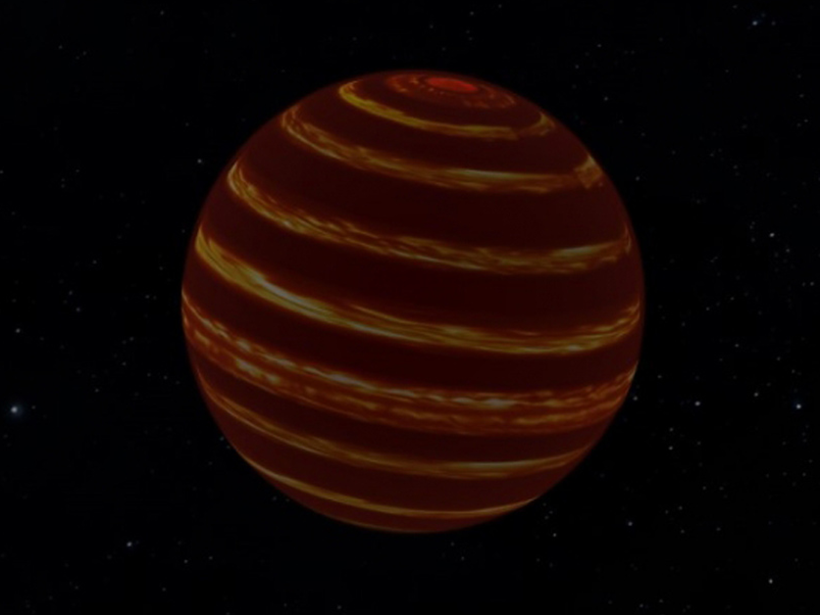
One of the brown dwarfs nearest to Earth may look like a darker version of Jupiter, the largest planet in the solar system. A new study, which provides the most detailed look at a brown dwarf’s atmospheric patterns to date, found that horizontal bands of thick clouds may alternate with relatively cloud-free bands, giving the object a striped appearance. Also like Jupiter, whirling storm systems as big as terrestrial continents may dominate the brown dwarf’s polar regions. Combined with findings from earlier studies, the report suggests that many brown dwarfs may exhibit a similar appearance.
A brown dwarf, often described as a failed star, is more massive than a giant planet but not massive enough to sustain fusion reactions in its core and shine as a true star. Brown dwarfs typically are about the same size as Jupiter but can be dozens of times more massive.
Scientists, who published their research in the Astrophysical Journal in January, used the Transiting Exoplanet Survey Satellite (TESS) to observe the binary brown dwarf system Luhman 16 AB. At a distance of just 6.5 light-years, its two objects are the brown dwarfs closest to Earth. Because the system is faint, however, it wasn’t discovered until 2013, and scientists are just beginning to study it. They’ve found that Luhman’s primary brown dwarf, A, is about 34 times the mass of Jupiter, with B tipping the scales at more than 28 times Jupiter’s mass.
TESS provided the most extensive observations of any brown dwarf to date. The satellite, which is designed to detect planets passing across the faces of nearby dwarf stars, stares at a small patch of sky for roughly 4 weeks before moving on to the next search area. Its cameras record other objects in addition to exoplanet transits, including variable stars, exploding stars, and brown dwarfs.
Luhman 16 was in the craft’s viewing field during March and April of 2019. TESS observed the system every 30 minutes.
“This data set’s continuous coverage of nearly 22 days straight is what really sets it apart,” said Max Millar-Blanchaer, an assistant professor of physics at the University of California, Santa Barbara who has also found evidence of clouds on Luhman 16 but was not a member of this team. “Never before have we been able to monitor the weather in a brown dwarf continuously for so long.”
Analysis revealed several periods in the system’s light curve, including one of almost 7 hours, which probably represents the rotation rate of the A component, and another of almost 91 hours, which may be dominated by vortices at the poles of B.
Variations in the Light Curve Reveal Structure in the Clouds
The researchers were most interested, though, in a period of 5.28 hours, which the team interpreted as the rotation rate of B. At that rate, TESS observed more than 100 turns of the brown dwarf. Although the period was steady, there were slight variations in the cycle’s peak brightness—an average of about 4% from cycle to cycle, although some periods peaked at more than 10% above average.
“As the brown dwarf rotates, we see different hemispheres as a function of time,” said lead author Daniel Apai, an astronomer at the University of Arizona. “It’s like looking at a spinning soccer ball with a large, dark spot on it. Even if we don’t have sharp eyesight, we’ll still see that spot as the ball becomes brighter and fainter as it rotates.” For Luhman 16 B, the subtle changes in brightness provided insights into the structure of the atmosphere.
Previous studies of Luhman 16 AB and several other brown dwarfs with both ground- and space-based telescopes had provided evidence of cloud structures. “What had remained unclear was whether the skies were dominated by belts or by vortexes like those at the poles of Jupiter and Saturn,” Apai said.
The timing revealed by the TESS observations argues strongly for alternating light and dark bands in the atmosphere that rotate in opposite directions and at different speeds, Apai said. Darker bands probably contain thicker clouds, whereas lighter bands provide a deeper view into Luhman 16 B’s hot interior.
If the belts exist, they probably are propelled by high-speed jets, some moving eastward and others moving westward. The largest eastward belt circles the equator, with several alternating belts running parallel to it. The observations suggest that the winds are stronger than those on Jupiter, which can zip along at hundreds of kilometers per hour.
At Luhman 16 B’s surface temperature of roughly 1,000 K, Apai said, models suggest that a brown dwarf that began with roughly the same composition as the Sun would produce clouds of silicate minerals at high altitudes, with aluminum oxides and droplets of liquid iron at lower altitudes. “You’d probably have a variety of minerals, and many of the particles would be about the size of particles of cigarette smoke,” Apai said. “But it’s a very open question of how distinct the clouds are. It depends on the amount of vertical mixing—it’s possible they could get all mixed up.”
Brown dwarfs similar to Luhman 16 B probably will show similar weather patterns, Apai said, although slower rotators may be dominated by large vortexes similar to Jupiter’s Great Red Spot.
“I think there is mounting evidence that suggests that the bands we’ve seen in Luhman 16 B are quite common, although I don’t think we can quite say that we’d expect all of them to be exactly the same,” said Millar-Blanchaer. “Extending this work to a much larger sample is a critical next step in determining the ubiquity of bands in brown dwarf atmospheres.”
Apai also said that Luhman 16 and other brown dwarfs are “excellent analogues” for giant exoplanets. “They probably have very similar composition, but they’re harder to study, so we won’t get any data comparable to [these] for a long time. There’s probably some overlap in terms of atmospheric processes that we can model through what we see on brown dwarfs.”
TESS is scheduled to return its focus to the field that includes the Luhman system in March and April, allowing scientists to extend their observations of the system.
—Damond Benningfield ([email protected]), Science Writer







