

GLOBAL RESEARCH SYNDICATE
No Result
View All Result
  • Login
  • Latest News
  • Consumer Research
  • Survey Research
  • Marketing Research
  • Industry Research
  • Data Collection
  • More
    • Data Analysis
    • Market Insights
  • Latest News
  • Consumer Research
  • Survey Research
  • Marketing Research
  • Industry Research
  • Data Collection
  • More
    • Data Analysis
    • Market Insights
No Result
View All Result
globalresearchsyndicate
No Result
View All Result
Home Data Collection

Galileo’s OSNMA Message under Official Testing; First GNSS Signal Authentication Broadcast – Inside GNSS

globalresearchsyndicate by globalresearchsyndicate
February 14, 2021
in Data Collection
0
Galileo’s OSNMA Message under Official Testing; First GNSS Signal Authentication Broadcast – Inside GNSS
0
SHARES
3
VIEWS
Share on FacebookShare on Twitter

The European Space Agency officially announced testing of Galileo’s Open Service Navigation Message Authentication (OSNMA) in its signal-in-space, allowing the first OSNMA-protected position fix to be successfully computed. This is the first-ever transmission of authentication features in open signals of a GNSS. Testing has been underway since November 18, 2020.

OSNMA test signals are broadcast by the Galileo constellation using the spare bits from the current navigation message, therefore not impacting the legacy OS receivers implementing the current OS Signal-In-Space Interface Control Document (OS SIS ICD). Testing will continue over the next months, leading to a public observation phase.

[Photo: European Space Research and Technology Centre (ESTEC), in Noordwijk, the Netherlands. Courtesy ESA.]
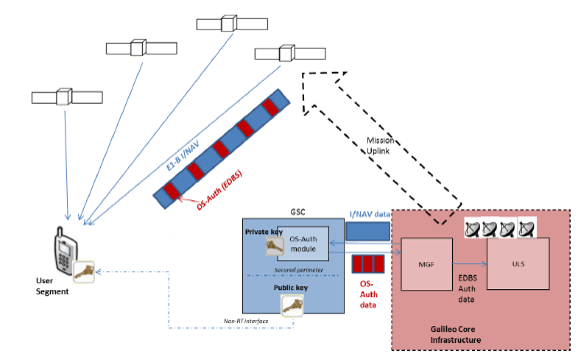
Open_Service_Navigation_Message_Authentication
OSNMA structure, courtesy ESA.

The Galileo OSNMA allows GNSS receivers to verify the authenticity of GNSS information, making sure that the data they receive are indeed from Galileo and have not been modified in any way. Its structure and functioning was generally described in the GNSS Solutions January 2018 column of Inside GNSS magazine, and further elaborated in a February 2020 article.

On November 18, 2020, Galileo satellites started the transmission of authentication data for testing purposes, and some users immediately began testing it once they noticed the signal in their receivers, as reported here. The first tests used eight Galileo satellites for around two hours on that day. Tests have continued since mid-November for intermittent periods, and will continue over the next months.

Upon successful completion of the internal testing phase, a public observation phase will begin, in which the OSNMA signal will be publicly accessible. In preparation of this phase, the OSNMA user Signal-In-Space Interface Control Document (OSNMA SIS ICD), receiver implementation guidelines, and the necessary cryptographic materials will be published. This will allow receiver manufacturers and application developers to test and prepare their products.

During the public observation phase, feedback will be gathered from users, leading to the consolidation of the service.

“Ensuring the validity of positions elaborated by GNSS is one of the main challenges before addressing an entirely new set of applications demanding dependability and resilience. Galileo is now set on course to deliver on this highly anticipated feature and has many more novel features in store for the coming years,” stated Matthias Petschke, Director of Space at the European Commission, DG DEFIS.

“Galileo’s Open Service Navigation Message Authentication is one of its key differentiators. The additional robustness that it will provide to the Galileo signal will be critical for many applications, particularly those where security and trustworthiness are a priority, making the OSNMA a key component in any resilient PNT solution,” said Rodrigo da Costa, Executive Director of the European GNSS Agency.

Testbed_vehicle_by_ESA_s_Navigation_Lab
ESA testbed vehicle.

“Up until now, as a navigation satellite disseminates navigation and timing data, there is no way of confirming these data are indeed coming from their apparent originator. As a result, the data could be falsified, a phenomenon known as spoofing, where corrupt false signals mislead receivers about their position, misleading their users in turn, with potentially serious consequences,” commented Paul Verhoef, Director of Navigation at the European Space Agency.


Related Posts

How Machine Learning has impacted Consumer Behaviour and Analysis
Consumer Research

How Machine Learning has impacted Consumer Behaviour and Analysis

January 4, 2024
Market Research The Ultimate Weapon for Business Success
Consumer Research

Market Research: The Ultimate Weapon for Business Success

June 22, 2023
Unveiling the Hidden Power of Market Research A Game Changer
Consumer Research

Unveiling the Hidden Power of Market Research: A Game Changer

June 2, 2023
7 Secrets of Market Research Gurus That Will Blow Your Mind
Consumer Research

7 Secrets of Market Research Gurus That Will Blow Your Mind

May 8, 2023
The Shocking Truth About Market Research Revealed!
Consumer Research

The Shocking Truth About Market Research: Revealed!

April 25, 2023
market research, primary research, secondary research, market research trends, market research news,
Consumer Research

Quantitative vs. Qualitative Research. How to choose the Right Research Method for Your Business Needs

March 14, 2023
Next Post
Human Activin A Market Primary Research, Secondary Research, Product Research, Key Players and Forecast 2028

Epitaxial Wafer Market Primary Research, Secondary Research, Product Research, Key Players and Forecast 2028

Categories

  • Consumer Research
  • Data Analysis
  • Data Collection
  • Industry Research
  • Latest News
  • Market Insights
  • Marketing Research
  • Survey Research
  • Uncategorized

Recent Posts

  • Ipsos Revolutionizes the Global Market Research Landscape
  • How Machine Learning has impacted Consumer Behaviour and Analysis
  • Market Research: The Ultimate Weapon for Business Success
  • Privacy Policy
  • Terms of Use
  • Antispam
  • DMCA

Copyright © 2024 Globalresearchsyndicate.com

Welcome Back!

Login to your account below

Forgotten Password?

Retrieve your password

Please enter your username or email address to reset your password.

Log In
This website uses cookies to improve your experience. We'll assume you're ok with this, but you can opt-out if you wish. Cookie settingsACCEPT
Privacy & Cookies Policy

Privacy Overview

This website uses cookies to improve your experience while you navigate through the website. Out of these cookies, the cookies that are categorized as necessary are stored on your browser as they are essential for the working of basic functionalities of the website. We also use third-party cookies that help us analyze and understand how you use this website. These cookies will be stored in your browser only with your consent. You also have the option to opt-out of these cookies. But opting out of some of these cookies may have an effect on your browsing experience.
Necessary
Always Enabled
Necessary cookies are absolutely essential for the website to function properly. This category only includes cookies that ensures basic functionalities and security features of the website. These cookies do not store any personal information.
Non-necessary
Any cookies that may not be particularly necessary for the website to function and is used specifically to collect user personal data via analytics, ads, other embedded contents are termed as non-necessary cookies. It is mandatory to procure user consent prior to running these cookies on your website.
SAVE & ACCEPT
No Result
View All Result
  • Latest News
  • Consumer Research
  • Survey Research
  • Marketing Research
  • Industry Research
  • Data Collection
  • More
    • Data Analysis
    • Market Insights

Copyright © 2024 Globalresearchsyndicate.com



