

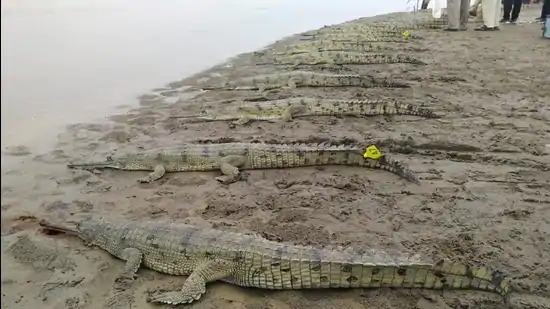
Under the gharial reintroduction project in the Beas Conservation Reserve, 23 critically endangered long-snouted gharials were released in the Beas river near Salempur and Tahli forests in Hoshiarpur district on Friday.
The gharials were transported in boxes from Chhatbir Zoo in Chandigarh, where they had been kept for a year after being brought from the natural hatchery at Morena in Madhya Pradesh.
Project to establish breeding population of the species in state’s rivers
The gharial reintroduction project of the Punjab forests and wildlife preservation department aims to establish a breeding population of the species in the state’s rivers.
In phase-1 of this project, 47 juvenile gharials were released in the Beas Conservation Reserve in three batches — 10 on December 25, 2017, 15 on January 31, 2018, and 22 on March 15, 2018 — in Amritsar and Tarn Taran districts. The number of gharials released has now reached 70.
“Punjab chief wildlife warden RK Sharma helped us in choosing a suitable undisturbed stretch of the Beas river near Salimpur and Tahli Forest in Hoshiarpur district for re-introduction of current batch of gharials,” said Gursharan Singh, district forest officer (wildlife) Hoshiarpur.
Rajesh Mahajan, divisional forest officer, wildlife, Pathankot range, said, “This time they were released from Hoshiarpur side as there we found the conditions needed for release.”
In the presence of Manish Kumar, conservator of forest, and Chhatbir Zoo field director M Sudhakar, a joint monitoring team of the Wildlife Division Hoshiarpur and World Wildlife Fund (WWF), India, has been formed for daily monitoring of gharials for the next one month, officials said.
Reintroduction will complete area’s food chain
Gitanjali Kanwar, coordinator WWF India, who took part in the release event as an expert, informed that post release monitoring is one of the vital aspects of the gharial reintroduction. “The surveys will focus on understanding dispersal, habitat preference, population ecology and general well-being of the released gharials,” she said.
“Field surveys conducted, so far, jointly with WWF-India indicate that gharials have dispersed both upstream and downstream of the release sites in the Beas Conservation Reserve. Between 40% and 50% of the reintroduced gharials can be spotted in the Beas Conservation Reserve depending on the water levels and season of survey,” Kanwar added. Mahajan said more gharials would be released next year this month.
Before its reintroduction, the endangered animal was spotted the last time in 1974. It was important to reintroduce gharials in this area to complete the food chain. Its presence in the river will help increase the yield of fish for human consumption, said officials.







