
GLOBAL RESEARCH SYNDICATE
No Result
View All Result
  • Login
  • Latest News
  • Consumer Research
  • Survey Research
  • Marketing Research
  • Industry Research
  • Data Collection
  • More
    • Data Analysis
    • Market Insights
  • Latest News
  • Consumer Research
  • Survey Research
  • Marketing Research
  • Industry Research
  • Data Collection
  • More
    • Data Analysis
    • Market Insights
No Result
View All Result
globalresearchsyndicate
No Result
View All Result
Home Data Analysis

Evaluating the effects of cardiometabolic exposures on circulating proteins which may contribute to severe SARS-CoV-2

globalresearchsyndicate by globalresearchsyndicate
February 8, 2021
in Data Analysis
0
Evaluating the effects of cardiometabolic exposures on circulating proteins which may contribute to severe SARS-CoV-2
0
SHARES
3
VIEWS
Share on FacebookShare on Twitter

Abstract

Background

Developing insight into the pathogenesis of severe acute respiratory syndrome coronavirus 2 (SARS-CoV-2) is of critical importance to overcome the global pandemic caused by coronavirus disease 2019 (covid-19). In this study, we have applied Mendelian randomization (MR) to systematically evaluate the effect of 10 cardiometabolic risk factors and genetic liability to lifetime smoking on 97 circulating host proteins postulated to either interact or contribute to the maladaptive host response of SARS-CoV-2.

Methods

We applied the inverse variance weighted (IVW) approach and several robust MR methods in a two-sample setting to systemically estimate the genetically predicted effect of each risk factor in turn on levels of each circulating protein. Multivariable MR was conducted to simultaneously evaluate the effects of multiple risk factors on the same protein. We also applied MR using cis-regulatory variants at the genomic location responsible for encoding these proteins to estimate whether their circulating levels may influence severe SARS-CoV-2.

Findings

In total, we identified evidence supporting 105 effects between risk factors and circulating proteins which were robust to multiple testing corrections and sensitivity analyzes. For example, body mass index provided evidence of an effect on 23 circulating proteins with a variety of functions, such as inflammatory markers c-reactive protein (IVW Beta=0.34 per standard deviation change, 95% CI=0.26 to 0.41, P = 2.19 × 10−16) and interleukin-1 receptor antagonist (IVW Beta=0.23, 95% CI=0.17 to 0.30, P = 9.04 × 10−12). Further analyzes using multivariable MR provided evidence that the effect of BMI on lowering immunoglobulin G, an antibody class involved in protection from infection, is substantially mediated by raised triglycerides levels (IVW Beta=-0.18, 95% CI=-0.25 to -0.12, P = 2.32 × 10−08, proportion mediated=44.1%). The strongest evidence that any of the circulating proteins highlighted by our initial analysis influence severe SARS-CoV-2 was identified for soluble glycoprotein 130 (odds ratio=1.81, 95% CI=1.25 to 2.62, P = 0.002), a signal transductor for interleukin-6 type cytokines which are involved in inflammatory response. However, based on current case samples for severe SARS-CoV-2 we were unable to replicate findings in independent samples.

Interpretation

Our findings highlight several key proteins which are influenced by established exposures for disease. Future research to determine whether these circulating proteins mediate environmental effects onto risk of SARS-CoV-2 infection or covid-19 progression are warranted to help elucidate therapeutic strategies for severe covid-19 disease.

Funding

The Medical Research Council, the Wellcome Trust, the British Heart Foundation and UK Research and Innovation.

Research in context

Evidence before this study

It remains unclear why certain individuals develop more severe symptoms of coronavirus disease 19 (covid-19) compared to others. However, increasingly findings from the literature suggest that established cardiometabolic risk factors, such as body mass index and smoking, influence the risk of severe acute respiratory syndrome coronavirus 2 (SARS-CoV-2) which is caused by covid-19.

In this study, we used data from a resource involving genome-wide association studies (GWAS) of 97 unique proteins which may play a role in severe SARS-CoV-2 (available at https://omicscience.org/apps/covidpgwas/). This enabled us to use genetic variation to estimate the effects of 10 cardiometabolic risk factors on each of these proteins in turn using an approach known as Mendelian randomization (MR). We additionally used this approach to estimate the effects of these circulating proteins on risk of severe SARS-CoV-2, using studies from the literature who have made GWAS results on this outcome.

Added value of this study

Our study provides a systematic evaluation of the genetically predicted effects of 10 cardiometabolic risk factors on each of the 97 unique proteins. Altogether, we found 105 effects which were robust to multiple testing corrections which may be valuable for future covid-19 research. We also evaluated whether any of these proteins influence risk of SARS-CoV-2, with soluble glycoprotein 130 providing the strongest evidence of a genetically predicted effect using MR. This protein is involved on the interleukin 6 receptor pathway which plays an important role in the body’s immune response. However, further data is required to robustly support this gene’s putative role in risk of severe SARS-CoV-2.

Implications of all the available evidence

Our findings are important in terms of developing insight into the molecular pathways by which modifiable lifestyle factors influence disease risk. Specifically with respect to severe covid-19, we note that the GWAS datasets of SAR-CoV-2 used in this work will capture genetic effects on increased susceptibility to infection as well as progression to severe symptoms. This is particularly important when considering the implications of therapeutically targeting any of the proteins highlighted by our study.

1. Introduction

On the 11th of March 2020 the World Health Organisation (WHO) declared the coronavirus disease 2019 (covid-19) a global pandemic []. Although strict lockdown measures have been enforced in many countries to control the spread of infection, the number of deaths worldwide which have been attributed to severe acute respiratory syndrome coronavirus 2 (SARS-CoV-2) continues to rise [

2

An interactive web-based dashboard to track COVID-19 in real time.

]. Furthermore, despite widespread ongoing biomedical research it remains unclear why some individuals develop severe symptoms of SARS-CoV-2 once contracting covid-19, whereas an estimated 80% of individuals display either asymptomatic or mild infections [

3

Characteristics of and important lessons from the coronavirus disease 2019 (COVID-19) outbreak in China: summary of a report of 72314 cases from the Chinese center for disease control and prevention.

]. It is becoming increasingly evident however based on findings from the literature that established cardiometabolic disease risk factors play a role in the severity of symptoms for SARS-CoV-2 [

4

  • Sattar N.
  • McInnes I.B.
  • McMurray J.J.V.
Obesity is a risk factor for severe COVID-19 infection: multiple potential mechanisms.

,

5

  • Fang L.
  • Karakiulakis G.
  • Roth M.
Are patients with hypertension and diabetes mellitus at increased risk for COVID-19 infection?.

].

To address this challenge, researchers in the field, led by colleagues from the MRC Epidemiology Unit, have rapidly generated a curated dataset concerning the genetic architecture of 97 unique proteins which may be involved in influencing severe SARS-CoV-2 [

6

  • Pietzner M.
  • Wheeler E.
  • Carrasco-Zanini J.
  • et al.
Genetic architecture of host proteins interacting with SARS-CoV-2.

]. These include inflammatory cytokines and antibodies (such as immunoglobulin G) which are involved in immune response to infection, proteins involved in fibrinolysis and blood coagulation and gene products which have been reported to interact with SARS-CoV-2 proteins in human cells [

7

  • Gordon D.E.
  • Jang G.M.
  • Bouhaddou M.
  • et al.
A SARS-CoV-2 protein interaction map reveals targets for drug repurposing.

]. A complete list of these proteins can be found in Supplementary Table 1.

This curated resource provides an opportunity to undertake Mendelian randomization (MR) analyzes to develop insight into modifiable risk factors that influence these SARS-CoV-2-related proteins, as well as potential downstream consequences on risk of covid-19. MR can be implemented as a form of instrumental variable analysis which exploits the random assortment of genetic alleles at birth under Mendel’s laws of Inheritance [

8

  • Davey Smith G.
  • Ebrahim S.
Mendelian randomization’: can genetic epidemiology contribute to understanding environmental determinants of disease?.

,

9

Mendelian randomization: genetic anchors for causal inference in epidemiological studies.

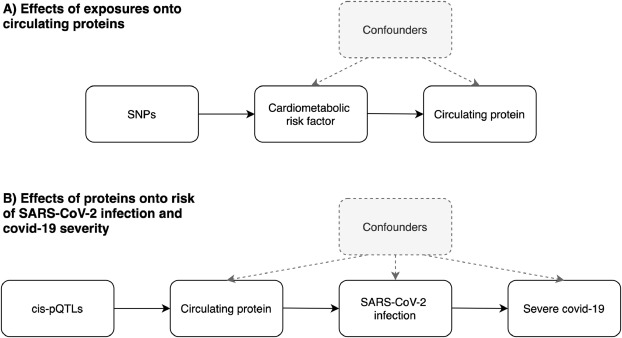
]. As such genetic variants can be leveraged as instrumental variables to investigate causal relationships between conventional exposures (such as cardiometabolic risk factors) and outcomes (such as circulating proteins) (Fig. 1A). As these inherited genetic variants are fixed at conception, MR is typically robust to confounding factors and reverse causation which can bias analyzes in an observational setting which do not make use of human genetics data.

Fig 1

Fig. 1Schematic representation of the analysis undertaken in this study using Mendelian randomization. A) We firstly leveraged genetic variants (referred to as single nucleotide polymorphisms (SNPs)) to systematically estimate the effect of 11 risk factors on 97 circulating proteins related to SARS-CoV-2. B) For proteins highlighted in the initial analysis, we applied MR to estimate their genetically predicted effects on risk of severe SARS-CoV-2. Note that the circulating protein could influence progression from SARS-CoV-2 infection to severe covid-19 without influencing risk of becoming infected (or it could influence the two processes in opposite directions). Instruments for proteins were SNPs robustly associated with their levels and located in the genome at the encoding genes region (commonly referred to as cis-protein quantitative trait loci (cis-pQTL)).

In this study, we systematically applied MR to estimate the effects of 10 cardiometabolic exposures and genetic liability to lifetime smoking in turn on each of the SARS-CoV-2 prioritized proteins. We focused on these types of exposures given findings from the literature providing evidence that they may increase risk of severe covid-19, including observations from cohort studies, healthcare records and previous genetic studies [

10

  • Williamson E.J.
  • Walker A.J.
  • Bhaskaran K.
  • et al.
Factors associated with COVID-19-related death using OpenSAFELY.

,

11

  • Ponsford M.J.
  • Gkatzionis A.
  • Walker V.M.
  • et al.
Cardiometabolic traits, sepsis, and severe COVID-19: a Mendelian randomization investigation.

,

12

  • Aung N.
  • Khanji M.Y.
  • Munroe P.B.
  • Petersen S.E.
Causal inference for genetic obesity, cardiometabolic profile and COVID-19 susceptibility: a mendelian randomization study.

,

13

  • Liu D.
  • Cui P.
  • Zeng S.
  • et al.
Risk factors for developing into critical COVID-19 patients in Wuhan, China: a multicenter, retrospective, cohort study.

,

14

  • Morawietz H.
  • Julius U.
  • Bornstein S.R.
Cardiovascular diseases, lipid-lowering therapies and European registries in the COVID-19 pandemic.

]. This was followed by a series of sensitivity analyzes as well as applying multivariable MR to evaluate whether exposures independently influence the same circulating protein or act along overlapping causal pathways. We also sought to investigate the potential effects of proteins highlighted by this analysis on risk of severe covid-19 using data from recently conducted genome-wide association studies (GWAS).

4. Discussion

We have undertaken a comprehensive Mendelian randomization study to systematically evaluate the effect of 11 established risk factors for disease on circulating levels of proteins related to SARS-CoV-2. Our main findings are that among the modifiable risk factors assessed, BMI and triglycerides showed the widest repertoire of causal effects on these circulating proteins (providing evidence of causation for 23 and 27 effects, respectively). Furthermore, of the circulating proteins investigated by our study, the strongest evidence of an effect on developing severe covid-19 was identified for glycoprotein 130, which is involved in the transmission of molecular signals for inflammatory interleukin cytokines.

It is important to recognise that the case definitions of severe covid-19 in these studies will capture both genetic effects on increased susceptibility to infection as well as increased progression to severe symptoms [

47

  • Paternoster L.
  • Tilling K.
  • Davey Smith G
Genetic epidemiology and Mendelian randomization for informing disease therapeutics: conceptual and methodological challenges.

]. It is likely that genetic effects will differ between infection and progression, indeed they could even be in different directions. MR estimates derived using these datasets should therefore take this into account when interpreting the potential implications of therapeutically targeting any proteins highlighted by this (and similar) studies (Fig. 1B).

Amongst the 105 effects which were robust to multiple testing and sensitivity analyzes there were several well-established relationships based on the literature. For example, having a high BMI is a known driver of systemic inflammation as indexed by C-reactive protein levels [

45

  • Timpson N.J.
  • Nordestgaard B.G.
  • Harbord R.M.
  • et al.
C-reactive protein levels and body mass index: elucidating direction of causation through reciprocal Mendelian randomization.

] and acute inflammatory markers such as fibrinogen [

48

  • Kaptoge S.
  • White I.R.
  • et al.
Fibrinogen Studies Collaboration
Associations of plasma fibrinogen levels with established cardiovascular disease risk factors, inflammatory markers, and other characteristics: individual participant meta-analysis of 154,211 adults in 31 prospective studies: the fibrinogen studies collaboration.

]. Other findings fit with the known biology of cardiometabolic risk factors and proteins identified by our analysis, such as the effect of HDL cholesterol on serum amyloid A-1 and A-2 proteins, which have previously been proposed as clinically applicable surrogates of HDL vascular functionality [

49

  • Zewinger S.
  • Drechsler C.
  • Kleber M.E.
  • et al.
Serum amyloid A: high-density lipoproteins interaction and cardiovascular risk.

]. Whilst our results are therefore of immediate importance for SARS-CoV-2 research, they may also be valuable for future endeavors interested in the therapeutic potential of these proteins with respect to a wide range of disease outcomes.

There were several results from our study which may assist in unraveling the complex pathogenesis of severe SARS-CoV-2. For example, immunoglobulin G (IgG) is a class of antibodies produced by plasma B cells in the immune system in response to a pathogen [

50

Immunoglobulin G and its function in the human respiratory tract.

]. Our results indicate that having a high BMI may reduce levels of circulating IgG, suggesting that people with obesity have less of this class of antibody to help protect from infection. That being said, an important consideration when interpreting this finding is that IgG levels were measured in individual’s in a healthy state and can therefore only act a proxy for IgG response to infection. Additionally, generic IgG levels were measured rather than the specific adaptive immune response to SARS-CoV-2.

Additionally, our multivariable MR estimates for the effect BMI on IgG attenuated when accounting for the effect of triglycerides on this class of antibodies. This suggests that triglycerides may mediate the lowering effect of BMI on IgG, which we estimated as 41.1% of the total effect of BMI on IgG levels being mediated via triglycerides. Further research into the role of IgG and B cell immunity in response to the covid-19 pathogen is therefore warranted, particularly given that IgG is being measured by tests for antibody responses to SARS-CoV-2 [

51

  • Long Q.X.
  • Liu B.Z.
  • Deng H.J.
  • et al.
Antibody responses to SARS-CoV-2 in patients with COVID-19.

]. Along with evaluating the effect of modifiable risk factors on antibody mediated immunity to covid-19, it will be critical to develop insight into how these factors influence cell mediated immunity given the emerging importance of the adaptive immune response to SARS-CoV-2 [

52

  • Le Bert N.
  • Tan A.T.
  • Kunasegaran K.
  • et al.
SARS-CoV-2-specific T cell immunity in cases of COVID-19 and SARS, and uninfected controls.

].

Using MR to estimate the genetically predicted effects of circulating proteins on severe covid-19 risk highlighted glycoprotein 130 as the protein with the strongest evidence of an effect on severe SARS-CoV-2 (OR=1.81, 95% CI=1.25 to 2.62, P = 0.002), however we were unable to replicate these findings in larger samples. A possible explanation for this could be the heterogeneity between the SARS-CoV-2 GWAS datasets analyzes and their variable case definitions. This requires robust replication that would be necessary before initiating further in-depth analyzes. Glycoprotein 130 is encoded by the IL6ST gene and belongs to the interleukin-6 family of cytokines [

46

  • Heinrich P.C.
  • Behrmann I.
  • Haan S.
  • Hermanns H.M.
  • Muller-Newen G.
  • Schaper F.
Principles of interleukin (IL)-6-type cytokine signalling and its regulation.

]. It’s activation is dependent upon the binding of cytokines with their receptors, such as interleukin-6 (IL6) with interleukin-6 receptor (IL6R) [

53

  • Kurth I.
  • Horsten U.
  • Pflanz S.
  • et al.
Activation of the signal transducer glycoprotein 130 by both IL-6 and IL-11 requires two distinct binding epitopes.

]. This is noteworthy due to the extensive interest in repurposing IL6R blockers as a potential therapeutic strategy for SARS-CoV-2 [

54

  • Xu X.
  • Han M.
  • Li T.
  • et al.
Effective treatment of severe COVID-19 patients with tocilizumab.

,

55

Time to reassess tocilizumab’s role in COVID-19 pneumonia.

,

56

  • Gupta S.
  • Wang W.
  • Hayek S.S.
  • et al.
Association between early treatment with tocilizumab and mortality among critically ill patients with COVID-19.

,

57

  • Salvarani C.
  • Dolci G.
  • Massari M.
  • et al.
Effect of tocilizumab vs standard care on clinical worsening in patients hospitalized with COVID-19 pneumonia: a randomized clinical trial.

,

58

  • Hermine O.
  • Mariette X.
  • Tharaux P.L.
  • et al.
Effect of tocilizumab vs usual care in adults hospitalized with covid-19 and moderate or severe pneumonia: a randomized clinical trial.

]. As lowering the levels of circulating IL6R will lead to lower activation of glycoprotein 130, estimates in this study suggest that this might result in reduced risk of severe SARS-CoV-2 symptoms. These findings therefore corroborate results from a recent MR study which used human genetic data to support the efficacy of IL6R inhibition as a potential treatment option for severe SARS-CoV-2 symptoms [

59

  • Bovijn J.
  • Lindgren C.M.
  • Holmes M.V.
Genetic variants mimicking therapeutic inhibition of IL-6 receptor signaling and risk of COVID-19.

]. However the MR studies to date have not been able to reliably separate influences on risk of becoming infected from risk of progressing to severe disease following infection (Fig. 1B). Thus they do not provide robust evidence as to whether IL6R inhibition would be expected to favourably influence outcome in severe covid-19. Adequately powered randomized controlled trial data are essential for evaluating the clinical value of therapeutic intervention targeting IL6R [

55

Time to reassess tocilizumab’s role in COVID-19 pneumonia.

].

This study has several limitations which should be taken into account when interpreting its findings. The current sample sizes of the SARS-CoV-2 GWAS are (as one would expect) relatively modest compared to large-scale GWAS data which MR studies are contemporaneously applied to, meaning that our cis-pQTL analysis is likely underpowered. We analyzed severe covid-19 as an outcome to mitigate reported selection bias of cases [

29

  • Griffith G.J.
  • Morris T.T.
  • Tudball M.J.
  • et al.
Collider bias undermines our understanding of COVID-19 disease risk and severity.

], so larger sample sizes of severe SARS-CoV-2 GWAS in the future should improve the statistical power of our approach. Furthermore, although data from plasma is of unprecedented sample size compared to previous large-scale pQTL analyzes (n = 10,708), it remains comparably modest to the sample sizes of GWAS used to derive instrument for the cardiometabolic exposures in this work. This is exaggerated by the fact that protein MRs are typically conducted using instruments relating to a single gene and therefore these genetic variants will explain a lower proportion of variance in the exposure than if instruments are taken from across the genome [

60

  • Holmes M.V.
  • Richardson T.G.
  • Ference B.A.
  • Davies N.M.
  • Davey Smith G
Integrating genomics with biomarkers and therapeutic targets to invigorate cardiovascular drug development.

]. Therefore, although we have undertaken thorough evaluations to interrogate bi-directional relationships between the exposures and proteins in this study, the discrepancies between the samples sizes makes the direction of effect challenging to orientate (the majority of exposure instruments were derived using sample sizes of n=~440,000). Finally, although data from plasma pQTL studies provide an exceptional opportunity to leverage instruments for MR studies, it should be noted that serum plasma may not capture signatures confined to disease or cell-type relevant tissues. This is particularly important for a disease with a large autoimmune component such as covid-19 and further emphasis should therefore be noted when interpreting the results of our study on proteins such as IgG. Finally, studies need to be conducted on data that allow MR to separately investigate modifiable influences on acquiring SARS-CoV-2 and on progressing to severe covid-19 or death (Fig. 1B).

In conclusion, our MR study identified many effects between conventional risk factors and circulating proteins which provides a platform for prospective endeavors to dissect related disease pathways. Future research into the pathogenesis of the proteins highlighted by this study are warranted to discern whether they may hold therapeutic potential for severe covid-19.


Related Posts

How Machine Learning has impacted Consumer Behaviour and Analysis
Consumer Research

How Machine Learning has impacted Consumer Behaviour and Analysis

January 4, 2024
Market Research The Ultimate Weapon for Business Success
Consumer Research

Market Research: The Ultimate Weapon for Business Success

June 22, 2023
Unveiling the Hidden Power of Market Research A Game Changer
Consumer Research

Unveiling the Hidden Power of Market Research: A Game Changer

June 2, 2023
7 Secrets of Market Research Gurus That Will Blow Your Mind
Consumer Research

7 Secrets of Market Research Gurus That Will Blow Your Mind

May 8, 2023
The Shocking Truth About Market Research Revealed!
Consumer Research

The Shocking Truth About Market Research: Revealed!

April 25, 2023
market research, primary research, secondary research, market research trends, market research news,
Consumer Research

Quantitative vs. Qualitative Research. How to choose the Right Research Method for Your Business Needs

March 14, 2023
Next Post
Authenticity And Vulnerability – Keys To A Gender Equal Future

Authenticity And Vulnerability – Keys To A Gender Equal Future

Categories

  • Consumer Research
  • Data Analysis
  • Data Collection
  • Industry Research
  • Latest News
  • Market Insights
  • Marketing Research
  • Survey Research
  • Uncategorized

Recent Posts

  • Ipsos Revolutionizes the Global Market Research Landscape
  • How Machine Learning has impacted Consumer Behaviour and Analysis
  • Market Research: The Ultimate Weapon for Business Success
  • Privacy Policy
  • Terms of Use
  • Antispam
  • DMCA

Copyright © 2024 Globalresearchsyndicate.com

Welcome Back!

Login to your account below

Forgotten Password?

Retrieve your password

Please enter your username or email address to reset your password.

Log In
This website uses cookies to improve your experience. We'll assume you're ok with this, but you can opt-out if you wish. Cookie settingsACCEPT
Privacy & Cookies Policy

Privacy Overview

This website uses cookies to improve your experience while you navigate through the website. Out of these cookies, the cookies that are categorized as necessary are stored on your browser as they are essential for the working of basic functionalities of the website. We also use third-party cookies that help us analyze and understand how you use this website. These cookies will be stored in your browser only with your consent. You also have the option to opt-out of these cookies. But opting out of some of these cookies may have an effect on your browsing experience.
Necessary
Always Enabled
Necessary cookies are absolutely essential for the website to function properly. This category only includes cookies that ensures basic functionalities and security features of the website. These cookies do not store any personal information.
Non-necessary
Any cookies that may not be particularly necessary for the website to function and is used specifically to collect user personal data via analytics, ads, other embedded contents are termed as non-necessary cookies. It is mandatory to procure user consent prior to running these cookies on your website.
SAVE & ACCEPT
No Result
View All Result
  • Latest News
  • Consumer Research
  • Survey Research
  • Marketing Research
  • Industry Research
  • Data Collection
  • More
    • Data Analysis
    • Market Insights

Copyright © 2024 Globalresearchsyndicate.com



