

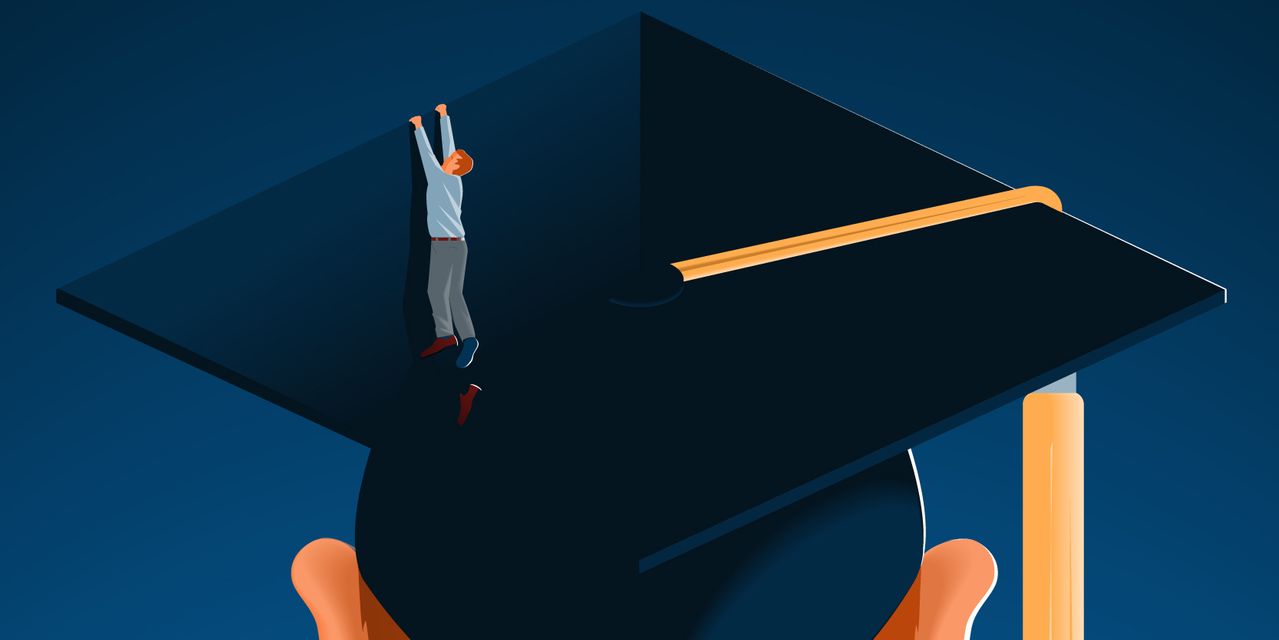
With the rollout of Covid-19 vaccines over the next few months, colleges may finally be able to consider a return to normalcy and the possibility of a safe opening in the fall. But despite the prospect of pandemic relief, there is another crisis facing higher education: Millions of students are set to graduate this spring into the worst job market in decades.
A study that we recently completed using data from Burning Glass Technologies, a labor-market analytics firm, found that since the start of the pandemic, hiring for entry-level college graduate positions has fallen 45%, more than for any other category of education. This is especially troubling because the first job after graduation is critical to launching a career. Those who start behind tend to stay behind.
Worse, those who graduate into underemployment are five times more likely to remain stuck in mismatched jobs after five years compared with those who start in a college-level job. Ten years later, three-quarters of workers underemployed at the five-year mark haven’t progressed.
“
In some professional fields, job openings have actually grown over the course of the pandemic.
”
But it doesn’t have to be this way. Colleges that work aggressively now to prepare students for the jobs that remain in demand can ensure that graduates still make a strong start. Covid-19’s impact on the job market might seem cataclysmic, but our research shows that not all hiring has dried up. In some professional fields, job openings have actually grown over the course of the pandemic.
For example, entry-level openings for college graduates as logistics analysts, distribution managers and loan officers have risen, up nearly 30% since 2019, and each of these jobs pays close to $50,000 a year. Even in fields where there are far fewer openings today than before, entry-level opportunities for recent graduates remain, especially for jobs such as business and financial analysts and software and web developers, both of which pay over $50,000. These jobs may be outside a student’s field of study, but that doesn’t mean they are out of reach.

Students at the University of Southern California in Los Angeles, March 2020.
Photo:
FREDERIC J. BROWN/AFP/Getty Images
Breaking into the postcollege job market is less about where graduates went to school or their specific degree than it is about the skills they possess. Those who have the problem-solving, communication and technical skills employers seek not only stand out but also command a 30% salary premium, according to our research. Having these abilities could be the difference between a decent job and underemployment.
That makes it all the more important for colleges to ensure that every student has a plan for entering the job market, identifying career pathways and the specific skills needed to travel them. It’s not enough just to make such help available, since 78% of graduates, according to a Gallup survey, report that they rarely if ever used their college’s career services office. Northern Illinois University has developed one model for doing more by creating for-credit courses that teach students how to navigate various careers.
Providing students, regardless of their major, with the skills that employers are seeking should be part of every academic department’s curriculum. For example, psychology, a perennially popular major with more than 100,000 graduates a year, is a field with limited prospects for those who don’t pursue advanced studies. But a psychology major who acquires data analysis skills through research or internships can unlock more than 100,000 additional entry-level jobs paying on average $60,000, versus $39,000 for psychology majors overall.
SHARE YOUR THOUGHTS
What do you think colleges should be doing to help graduates enter the job market? Join the conversation below.
None of this requires abandoning the liberal arts or social sciences; it’s just a matter of ensuring that students also acquire marketable skills. English departments don’t need to teach computer programming, but they should show students how to develop their writing and critical thinking skills in ways that resonate with employers. And they should help students to acquire more technical skills, whether on campus, through internships or through the growing array of online options. Faculty may scoff at helping students acquire “vocational” skills, but careers hang in the balance.
Even with the best of efforts, the hard reality is that some graduates will need to start a rung lower on the career ladder than they had hoped. But taking such a “lifeboat job” until the economy improves gives them a chance to build the skills to move up over time—if they are guided to the right lifeboats. When it comes to future prospects, there’s a big difference between taking a job on an IT help desk versus winding up as a barista. Once on the help desk, adding skills like Linux and VMWare offers a direct path to becoming a systems administrator, with a $30,000 salary bump.
Helping graduates to chart such a backup path requires colleges to give up their once-and-done model of education and open their course catalogs and career counseling to alumni. That will be important not only in helping graduates in fledgling careers recover but also in supporting the many others who are likely to find their professional lives upended by automation in the decade to come. Universities like to talk about their commitment to lifelong learning. Now is the time to show they mean it.
Colleges also need to prepare students for the emerging careers that will define the post-Covid economy. In our research, key trends from automation to remote work are already beginning to reshape the landscape of job opportunities for graduates.
For example, the pandemic has exposed vulnerabilities in our society’s readiness for crisis. Preparing for the next emergency, wherever it arises, will require investments in health care, biotech, cybersecurity, green technology and infrastructure. Companies and governments will spend heavily to prepare for the future, creating hundreds of thousands of good jobs. Students in the right fields may enjoy strong prospects for many years to come.
For generations, a college education has been a golden ticket to opportunity. Educators never thought they had to worry about what happened to their students after graduation. But the pandemic and recession threaten this assumption. More students and parents are questioning the return on investment for a degree. Gallup surveys show that the number of Americans who consider higher education “very important” has fallen nearly 20 points since 2013.
Ensuring that students achieve a strong return on investment is the great challenge of our day for higher education. Colleges have both an opportunity and an obligation to connect with the job market. At a time when students increasingly need new skills, institutions can no longer wash their hands of what happens to students after graduation. By providing ongoing advising and opportunities for lifelong learning, colleges can ensure a rough start doesn’t define a long-term trajectory. In a tough market, institutions that fail to deliver will become as imperiled as the students whose future they ignored.
—Mr. Selingo is the author of “Who Gets In and Why: A Year Inside College Admissions” and a special adviser and professor of practice at Arizona State University. Mr. Sigelman is CEO of Burning Glass Technologies.
Copyright ©2020 Dow Jones & Company, Inc. All Rights Reserved. 87990cbe856818d5eddac44c7b1cdeb8







