

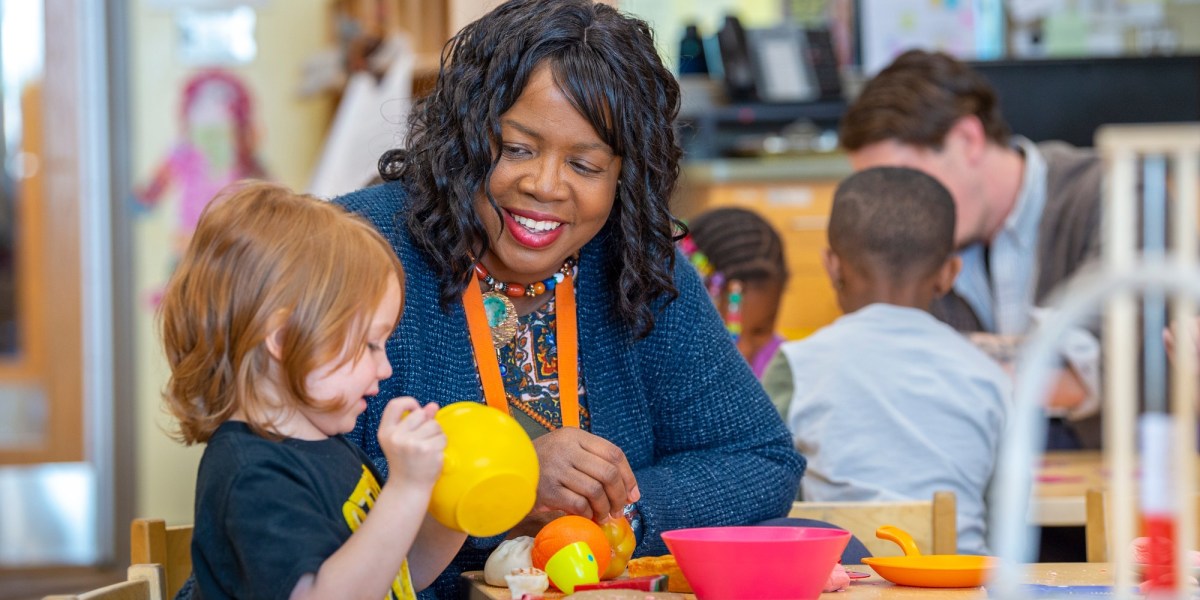
Even with all her years of experience, Perry said she doesn’t feel on the level of younger teachers coming straight into the field with a bachelor’s.
“I feel like having a bachelor’s degree would definitely increase my confidence,” she said. “I’m changing. I’m getting better.”
Attack The Barriers
“The position of higher ed has been, ‘Here’s our nice bachelor’s degree, come and get it,’” said Rebecca Kantor, dean of the University of Colorado Denver’s School of Education and Human Development.
That has not worked.
The barriers are significant: access, cost and the confidence to be a college student, particularly for marginalized communities and students of color. And for those already in the field who work long hours and who are poorly paid, they are unreachable. Still, in one Colorado study, more than 80 percent of those without a degree expressed the desire to pursue one.
Kantor and her colleagues thought, why not design a program that attacks those barriers one by one?
Together with three Denver child care centers, Clayton Early Learning, Sewall Child Development Center and Mile High Early Learning, the school designed the “place-based bachelor’s degree” pilot program. Twenty students are in the first cohort.
 Courtesy Patricia B. Smith/For Sewall Child Development Center/Sewall.org
The college-level learning takes place at a child care center, alongside a teacher and a coach — a senior member at the center hired by the university. Students are earning as they learn. A grant from Early Milestones Colorado funded by the Buell Foundation and Gary Community Investments, makes tuition free for six credits a semester for each enrollee.
Just applying to a university program can be intimidating. Rebecca Vlasin, a clinical assistant professor with the program, said staff walked students through all the steps and helped gather all the documentation needed. The cohort model, which includes lots of group discussion and collaboration, is designed to give students the peer support they need to persevere through a degree program.
In addition, Kantor and her colleagues asked, why can’t all the on-the-job professional development teachers regularly engage in work toward a degree? That means figuring out what courses and training they already have and getting them credit for it.
“People come into these programs with a patchwork that is really daunting,” Kantor said. “I had a young woman sit with me. She had 60 credits from six institutions. Trying to figure out with her what’s the best way to preserve the biggest number? We actually brought in almost all of them.”
That combination was the ticket for Susan Hmami to finally get her bachelor’s degree. The veteran teacher works at the Sewall Child Development Center.
“You don’t miss work,” she said. “You don’t miss the paycheck … the time, you don’t miss anything. It’s just wonderful. I can finally reach my goal of saying, ‘I really do know this and I have a degree to back it up.’”
 Courtesy Patricia B. Smith/For Sewall Child Development Center/Sewall.org
Hmami is eager to get a bachelor’s degree; it would allow her to one day teach classes for which her co-workers can receive credit.
Students like Brenda Perry, who already has an associate’s degree, may be able to finish her bachelor’s in two years with much of the cost fully covered. A bachelor’s degree could also open up the possibility of being a director of a center.
In Colorado, the proportion of white individuals serving as directors is twice as high as the proportion of Hispanics.
In a field dominated by women of color, the CU Denver team said it’s important to invest in the women of color who need a pathway to elevate them to “lead teacher” positions in high-quality centers. Eighty-five percent of students in the first cohort are women of color, “strongly motivated to earn their B.A. and are thriving,” said Rebecca Vaslin, of CU Denver.
“It’s about as relevant as you can possibly make academic learning,” Kantor said.
Applied, Real World Learning
A possible new future for early childhood education recognizes that learning happens best in real-world contexts, with paired readings, in partnership with schools and community-based centers, with regular coaching and feedback from teams of faculty and field-based coaches.
The idea pre-pandemic was that instructor-coaches, senior center employees hired by the university, would work alongside bachelor’s students, giving them feedback on their practice.
A lot of the program is customized to each student. During the pandemic, some of that coaching happens via video. Students meet weekly with a coach, and sometimes other university instructors, making meaning out of their teaching.
Students develop their own big projects guided by their own curiosities. In a recent Zoom class meeting, Hmami talked about her project on social justice, a topic she’s passionate about in her Green Valley Ranch workplace that enrolls many children of color.
“From the research I’ve done so far, I’m really shocked at how early the children start to recognize differences in people and everything around them,” Hmami told the group.
She’s become far more observant, noticing the ways dominant kids operate in class and said she is committed to finding ways to give shy children the tools to advocate for themselves.
Making Connections
Twentyseven-year-old Luke Grober likes that the program doesn’t have formal courses in a lecture hall. It’s individualized to let him pursue his passion and his love of reflecting on his practice.
“Hey, I found this really cool book I want to read,” he said. “Let me read this book and I can write a paper on it. Like, when do you ever have that opportunity?”
 Courtesy Scott Dressel-Martin/Clayton Early Learning
For the program’s book group, he’s reading “Don’t Look Away – Embracing Anti-Bias Classrooms.” He’s passionate about diversity, equity, and inclusion in child care.
Grober meets virtually once a week with his Clayton Early Learning coach and sometimes other university instructors for check-ins. He sends pictures and videos to document his work and reflects on it with them.
Before the weather got cold, he’d do an activity outside, part of ‘conscious discipline’ in social emotional learning, called “Baby Doll Circle Time.” Toddlers get their baby dolls ready for naps as they sing a song together with Grober. One day a little earlier than the circle time, he noticed children were picking up logs and holding them like baby dolls.
“It wasn’t until I was having the discussion with my professor, that I was like, ‘Wait a minute,’” he said.
The children were making connections, Grober thought. He talked with the professor about what that meant – perhaps placing more dramatic play material outside, but also an opportunity to extend the activity to stimulate thinking in the child, “If the log can be the baby, what can the bottle be?”
Degree Investments For Stability
Brenda Perry sees some teachers who enter the field straight from schools that don’t have on-the-job training. They often lack the skills to handle challenging behaviors, she said.
“A child who’s dealing with domestic violence … do you know how to really deal with that child when he comes to school? A child who doesn’t have enough food, what can you do to support that child? What can you do to support the parent?”
Without proper support, many early childhood educators, assistants and aides quit. Immediate feedback from an on-site coach and extra mentoring from university faculty can help. When a teacher quits, the three centers in the project say it costs them on average $17,000 to replace that teacher. CU Denver’s Kantor said that money could instead be plowed back into teachers’ salaries.
“That would be huge,” she said.
“Professionalizing” the workforce as a pathway to higher salaries hasn’t really played out because of the economics of child care.
The average difference in hourly wages for a teacher with a high school diploma and a teacher with a bachelor’s degree is $3.07, according to a 2017 Colorado survey.
The program’s organizers argue that a degree invests in the long-term stability of the workforce, helps retention, and lays the foundation for parity in salary by providing parity in preparation.
“Even if some of these teachers decide that early childhood is not the career path that they want to stay in, they will have a better quality of life because they have had this experience of success in school and they will go on to contribute,” CU Denver’s Vlasin said.
Others say the usefulness of a bachelor’s degree for these teachers is questioned only because there isn’t a system of public support for it, so the educational bar is set low and teachers are paid poverty wages.
“We’ve said that kindergarten, first- and second-grade teachers have to have a bachelor’s degree,” said Marsha Blasoe, president of the Child Care Services Association. “Well, how come they get to have a bachelor’s degree and [get] paid and [have] public benefits, but the early childhood field doesn’t?”
The University of Colorado Denver hopes to get funding to replicate their “place-based” model elsewhere in Colorado, creating partnerships between child care centers and regional colleges for site-based coaches. That also has the potential of bringing new people into the field who don’t have the minimum qualifications.
Right now, early childhood education teachers some training here and some training there.
“What we’re suggesting is let’s give them that support in a way that makes them eligible for credit so it’s not a temporary fix,” Kantor said. “It’s an investment in that person. It’s an investment in the field and the workforce.”
Early childhood education teacher Brenda Perry hopes the grant-funded bachelor’s program will continue “so that other people like myself could be a part of it, to be able to get the education that they really want but cannot afford.”
This story is part of a series produced as part of the Higher Education Media Fellowship at the Institute for Citizens & Scholars. The Fellowship supports new reporting into issues related to postsecondary career and technical education.







