

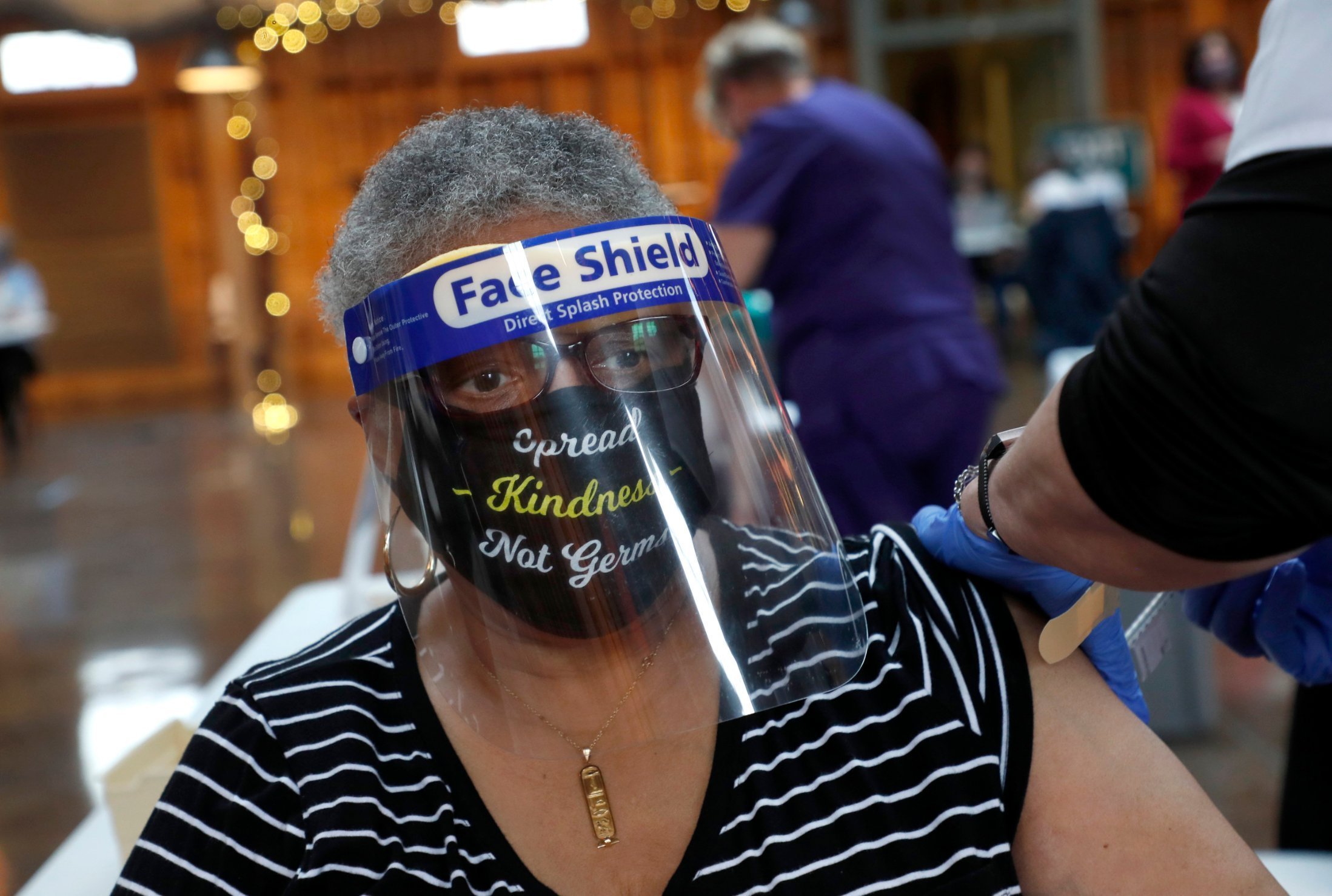
Early this week, simmering frustrations boiled over with a multimillion-dollar system the state of North Carolina bought to track vaccine administration.
“The COVID Vaccine Management System (CVMS) is burdensome and ineffective, creating an unnecessary bottleneck in the delivery of vaccines,” the state’s hospital association said in a letter to Gov. Roy Cooper.
“Speed to improvement has been slow.”
The association asked for changes that add up to an overhaul for the system, which local health care workers administering the COVID-19 vaccine have repeatedly panned as North Carolina works to speed shots into arms. The association also asked the state to consider an end-around, giving providers a better way to tell the state how many doses they have on hand.
That information is critical as the N.C. Department of Health and Human Services decides each week how many doses of the still limited COVID-19 vaccine to send to local health departments and hospitals. Health directors in some North Carolina counties said in recent weeks that they got less vaccine than they could have handled because of lag times in the vaccine management system.
“We’ve told the state: Can we do another system? Can we just do pencil and paper?” Caldwell County Health Director Anna Martin said last week.
“It’s just a disconnect from our end to Raleigh,” Martin said. “We have someone putting the changes in, but at the state, it says we have all this vaccine, but we really don’t.”
Not every local provider had such serious complaints, though a spokesperson for Edgecombe County’s health department said it has had the same problem as Caldwell. In fact, some counties say the system works fine.
But CVMS is expected to cost the state more than $7 million through May, and many local health officials say its functionality falls short. It doesn’t schedule vaccinations, nor does it send patients text message reminders as called for in the state’s contract with the vendor. Even its basic functionality, local workers say, is slowing them down.
State officials defend the system, which has already had multiple updates since it launched. They also put resources in the field to help, including the National Guard. As of Monday, the state had roughly 420 people supporting CVMS, many of them helping locals key in data from paper records, according to DHHS Deputy Secretary Kody Kinsley.
It’s clear from interviews with health officials around the state that, if nothing else, the system soaks up time and manpower.
Take Cabarrus County, which administered more than 1,000 vaccines last Friday, according to health department spokeswoman Marcella Beam. Each patient filled out three pages of paperwork that would eventually go into CVMS.
But the general public can’t create accounts in the system. That has to be done by a licensed provider. On average one staffer can get 115 patients uploaded in eight hours, Beam said. A 1,000-shot clinic means five or six nurses working on data entry for up to two days, she said.
CVMS’ 21 fields — 14 required by the federal government, the rest added by the state — could be filled out on a computer in real time at the clinic. But that would slow down the shots.
“It’s almost like a double-edged sword,” Beam said.
‘When the rubber met the road’
The state’s Department of Health and Human Services acknowledges the lag in data entry but says that would be an issue with any system since the federal government requires most of this data and uses it to decide how many doses to send each state.
And as of Wednesday, CVMS had more than 1.1 million people enrolled by more than 768 providers.
“Obviously, it is a system that is working,” DHHS Secretary Dr. Mandy Cohen said during a Tuesday coronavirus briefing.
The state could have used an existing federal vaccine administration system from the national Centers for Disease Control and Prevention to log these shots.
In an email Wednesday, CDC spokesperson Arleen Porcell said the agency provides the software and user support to jurisdictions and organizations for free. But she was unable to say how many states use the service instead of opting for their own systems.
DHHS decided to buy CVMS in part because a tailored platform lets the state make modifications without waiting on the federal government.
The state bought CVMS from Accenture, a multinational company that has been part of a number of state software projects over the years. That includes NC Fast, a management system for food stamps and other government benefits that had such a troubled rollout in 2013 that it endangered federal funding.
Accenture, with its Salesforce platform, was one of eight potential vendors interviewed for the system, according to an advisory committee summary of the selection process.
The company was selected “based on its in-depth knowledge with NC DHHS and ability to provide qualified resources immediately,” the department said, and the CVMS deal is part of a larger contract with a maximum cost, for now, of nearly $22 million.
Company spokespeople declined an interview request for this story, saying in a statement that Accenture is “proud to be supporting the state of North Carolina’s response to the pandemic.”
But the system doesn’t do everything the state contracted for, at least not yet. One of the first things listed in the state’s contract with Accenture is that the system should schedule appointments. It doesn’t, so providers are handling that separately, often with their own software.
Nor does the system send text message appointment reminders, another listed contractor responsibility.
Kinsley said the contract language covers “long-term functionality” and that the state is working with local officials who use CVMS daily to get a better read on what changes to prioritize.
“We knew there was going to be a lot of feedback when the rubber met the road and we needed to remain agile,” Kinsley said.
The clock is ticking. The state hopes to have millions of shots scheduled over the coming months.
The system also doesn’t mesh with patients’ electronic health records yet, one of the functions Cohen said she was excited about when she discussed the system’s advantages over its federal counterpart last fall.
But DHHS has said that integration will come eventually, and Kinsley said to expect a pilot project next month.
DHHS reaching out to counties to get count
Even with the CVMS database in place, DHHS also surveys providers every week as part of the vaccine allotment process, asking in part how many doses they have on hand.
Some local officials suggested the survey was a workaround for CVMS, which DHHS’ Kinsley denied.
He said the emails from local hospitals and health departments complaining about CVMS typically end up on his desk and that 99% of them aren’t about glitches or software problems but the time it takes to key in information. He said the state is meeting federal guidelines on how quickly shots should be reported —within 72 hours after they’re given.
But there have been problems.
After Katie Davis registered her 68-year-old mother for a vaccination appointment in Forsyth County, she got an auto-generated email telling her to answer some screening questions on CVMS. Upon logging in last Friday, Davis saw a message claiming her mother wasn’t eligible and that her appointment had been canceled.
Davis, correctly, figured that CVMS hadn’t been updated when the state changed its vaccine prioritization groups in mid-January. Her mom wouldn’t have been eligible when the state was only vaccinating people at least 75 years old but is under the current groups.
While her mom’s vaccination happened without any further confusion, Davis was worried that similar cancelation messages might deter others from getting the shot.
“This is not a bug. This is not an error,” Davis said. “This is just something they failed to update.”
Asked about the problem, a DHHS spokeswoman confirmed that the system hadn’t been updated to reflect the current categories but added that it wouldn’t have stopped providers from giving the vaccine to anyone in Groups 1 or 2.
“The problem is being addressed tonight with an update to the system that will reflect the current prioritization groups,” SarahLewis Peel, the spokeswoman, wrote in an email Tuesday evening.
Mixed reviews from county workers
County and hospital officials run the gamut in their opinions on the system, but most of the dozen reached for this story had complaints.
“Like with any new system … CVMS has had some quirks and had some bugs,” Guilford County Health Department spokeswoman Anita Ramachandran said.
At one point, there was a problem entering people in the system, and locals “had to wait on the bug to be fixed,” Ramachandran said. And, since CVMS isn’t used to schedule shots, the county “had to develop our own customized software,” Ramachandran said.
In Union County, CVMS is “working well and is efficient,” county spokeswoman Liz Cooper said.
Harnett County has “not experienced any major issues,” but the system runs slowly sometimes, the county spokesperson said.
In Iredell County, the system is working and data gets entered within 24 hours, a county spokesperson said.
Forsyth County Assistant Health Director Glenda Dancy called CVMS “a lagging indicator” of how much vaccine counties have on hand, sometimes slowed by small mistakes in data entry. Locals have to submit service requests to the state to fix those mistakes, Dancy said, and the expected turnaround time runs 48 hours.
Wake County would like to see the system opened up so patients can enter more of their own information, but that’s more wish than need, spokeswoman Stacy Beard said.
“Is it the most awesome ideal? No.” Beard said. “But I haven’t heard them say this is a showstopper.”
Mecklenburg County Deputy Health Director Raynard Washington said there have been delays “because of the challenge of data entry” and that it’s definitely easier to get information from patients on paper.
But it’s vaccine supply, not data lag, that’s affecting the flow of doses, Washington said. The state gets about 120,000 first doses a week from the federal government, in a state of 10 million people.
“I don’t believe it’s affected our allocations to date,” Washington said of CVMS. “I don’t think anybody’s getting as much as they would like.”
Dr. West Paul, chief clinical officer at New Hanover Regional Medical Center, said much the same thing. He said it’s “incredibly cumbersome to upload data,” taking about 8 1/2 minutes to key in a single patient’s information.
That’s a big deal for hospitals without a lot of manpower, Paul said. But overall, Paul said, vaccine supply is the limiting factor, and the state is working with locals to improve the system.
“We’re all working on this hard to try to get that better,” Paul said.
This story was jointly reported and edited by Laura Lee and Frank Taylor of Carolina Public Press; Ames Alexander of The Charlotte Observer; Tyler Dukes, Jordan Schrader and Adam Wagner, of The News & Observer; Nick Ochsner of WBTV; Michael Praats of WECT; Travis Fain of WRAL; and Jason deBruyn of WUNC.







