

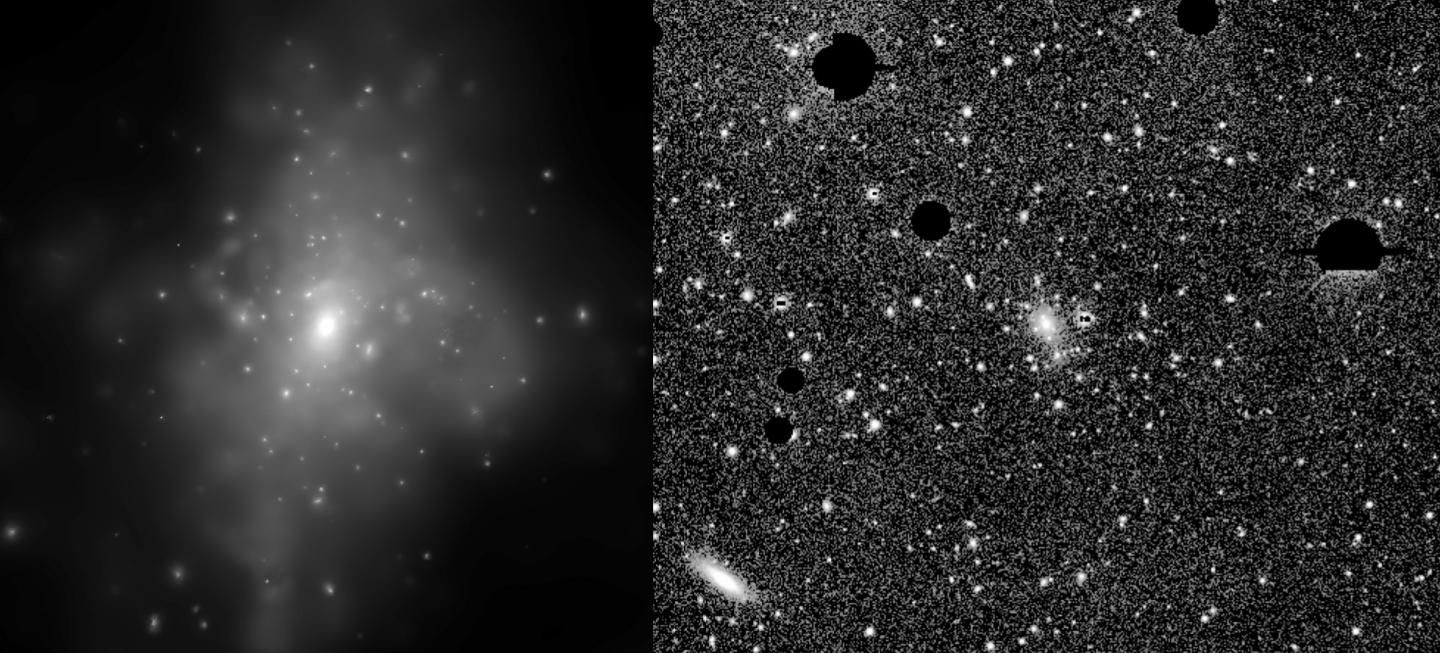
A combination of observational data and sophisticated computer simulations have yielded advances in a field of astrophysics that has languished for half a century. The Dark Energy Survey, which is hosted by the U.S. Department of Energy’s Fermi National Accelerator Laboratory, has published a burst of new results on what’s called intracluster light, or ICL, a faint type of light found inside galaxy clusters.
The first burst of new, precision ICL measurements appeared in a paper published in The Astrophysical Journal in April 2019. Another appeared more recently in Monthly Notices of the Royal Astronomical Society. In a surprise finding of the latter, DES physicists discovered new evidence that ICL might provide a new way to measure a mysterious substance called dark matter.
The source of ICL appears to be rogue stars, those not gravitationally bound to any galaxy. The ICL has long been suspected of possibly being a significant component of clusters of galaxies, but its faintness makes it difficult to measure. No one knows how much there is or to what extent it has spread through galaxy clusters.
“Observationally we discovered that intracluster light is a pretty good radial tracer of dark matter. That means that where intracluster light is relatively bright, the dark matter is relatively dense,” said Fermilab scientist Yuanyuan Zhang, who led both studies. “Just measuring the ICL itself is pretty exciting. The dark matter part is a serendipitous discovery. It’s not what we expected.”
Although invisible, dark matter accounts for most matter in the universe. What dark matter consists of stands as one of the major mysteries of modern cosmology. Scientists know only that it differs greatly from the normal matter consisting of the protons, neutrons and electrons that dominate everyday life.
But ICL, not dark matter, was initially on the research team’s agenda. Most astrophysicists measure intracluster light at the center of a galaxy cluster, where it is brightest and most abundant.
“We went very far away from the centers of the galaxy clusters, where the light is really faint,” Zhang said. “And the farther away from the center we went, the more difficult the measurement became.”
Nevertheless, the DES collaborators managed to come away with the most radially extended measurement of ICL ever.
The team used weak gravitational lensing to compare the radial distribution of the ICL — how it changes over distance from the center of a cluster — to the radial distribution of the mass of a galaxy cluster. Weak lensing is a dark-matter-sensitive method of measuring the mass of a galaxy or cluster. It occurs when the gravity of a foreground star or cluster bends the light from a more distant galaxy, distorting its apparent shape.
It turned out observationally that ICL reflects the distribution of both the total visible mass of a galaxy cluster and, possibly, the distribution of the invisible dark matter.
“We did not expect to find such a tight connection between these radial distributions, but we did,” said scientist Hillysson Sampaio-Santos, the lead author of the new paper.
Comparing observations with simulations
To gain more insight, the team used a sophisticated computer simulation to study the relationship between ICL and dark matter. They found that the radial profiles between the two phenomena in the simulation didn’t agree with the observational data. In the simulation, “the ICL radial profile was not the best component to trace dark matter,” said Sampaio-Santos, who is with the National Observatory in Rio de Janeiro, Brazil.
Zhang noted that it’s too soon to tell exactly what caused the conflict between observation and simulation.
“If the simulation didn’t get it right, it could mean that the simulated intracluster light is produced at a slightly different time than in observations. The simulated stars didn’t have enough time to wander around and start to trace dark matter,” she said.
Sampaio-Santos noted that further ICL studies could yield insights into the dynamics occurring inside galaxy clusters, including interactions that gravitationally release some of their stars, allowing them to wander around.
“I’m planning to study the intracluster light and the effects of relaxation,” or spreading out, he said. For example, some clusters have merged together. These merged clusters should have different properties of ICL compared to clusters that are relaxed.
Enhancing signals in noisy data sets
The ICL that the team measured is about a hundred to a thousand times fainter than what DES scientists normally attempt. That means the team had to deal with a lot of noise and contamination in the signal.
The technical aspect of the feat was challenging, Zhang said, “but because we had quite a bit of data from the Dark Energy Survey, we were able to cancel out a lot of noise to do this kind of measurement. It’s statistical averaging.”
Astrophysicists typically make ICL measurements using a handful of galaxy clusters at a time.
“That’s a great way to get information about the individual systems,” Zhang said.
To get the bigger picture and to beat down the noise, the DES team statistically averaged about 300 galaxy clusters in the first study and more than 500 clusters in the second. All of them are a couple of billion light-years from Earth.
Teasing the signal from the noise of each cluster takes a lot of data, which is exactly what the DES has generated. In early 2019, DES completed its six-year mission of observing hundreds of millions of distant galaxies in the southern skies and publicly issued its second data release in mid-January.
The ICL measurements probe clusters that are up to 3.3 billion light-years from Earth. In future studies, Zhang would like to study the redshift evolution of ICL — how it changes with cosmic time.
“My dream is to go all the way to redshift one — 10 billion light-years,” Zhang said. “Studies say that’s when the ICL has just started to evolve.”
Going that far would enable scientists to see ICL building over time.
“But that’s really hard because it’s three times as far as the distance of our latest measurements, so everything is going to be extremely faint there,” she said.
###
The Dark Energy Survey is a collaboration of more than 300 scientists from 25 institutions in six countries. For more information about the survey, please visit the experiment’s website.
Funding for the DES Projects has been provided by the U.S. Department of Energy, the U.S. National Science Foundation, the Ministry of Science and Education of Spain, the Science and Technology Facilities Council of the United Kingdom, the Higher Education Funding Council for England, the National Center for Supercomputing Applications at the University of Illinois at Urbana-Champaign, the Kavli Institute of Cosmological Physics at the University of Chicago, Funding Authority for Studies and Projects in Brazil, Carlos Chagas Filho Foundation for Research Support of the State of Rio de Janeiro, Brazilian National Council for Scientific and Technological Development and the Ministry of Science, Technology and Innovation, the German Research Foundation and the collaborating institutions in the Dark Energy Survey.
Fermilab is supported by the Office of Science of the U.S. Department of Energy. The Office of Science is the single largest supporter of basic research in the physical sciences in the United States and is working to address some of the most pressing challenges of our time. For more information, visit science.energy.gov.







