



The coronavirus outbreak brought with it a major shift to telework in many industries. Whatever their existing policies for telework may have been, some industries, such as the insurance, professional and technical services and information sectors, were better poised to shift to telework at the start of the pandemic.
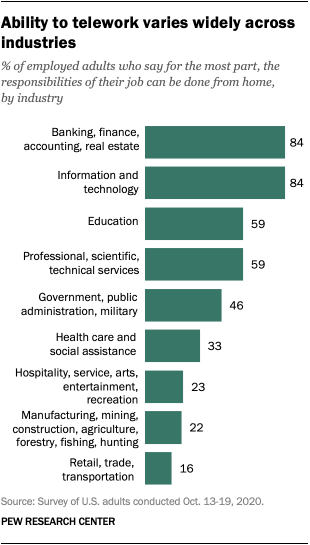
A majority of workers in only four out of the nine grouped industries studied say that, for the most part, the responsibilities of their job can be done from home, according to a Pew Research Center survey conducted in October. Within these sectors, based on definitions by the U.S. Census Bureau, those saying their job can be done from home include 84% in banking, finance, accounting and real estate, 84% in information and technology, 59% in education and 59% in professional, scientific and technical services.
Among workers in these four industries who say the responsibilities of their job can mainly be done from home, about half or more say they rarely or never teleworked before the pandemic, and this is especially the case among those in the education sector (75% say they rarely or never teleworked). But majorities in all of these industries who say their job can mostly be done from home report that they are now working from home all or most of the time. This includes 90% in the information and technology sector, 75% in professional, scientific and technical services, 74% in banking, finance, accounting and real estate and 61% in education.
Pew Research Center conducted this study to assess the increased reliance on telework as offices closed during the coronavirus pandemic. This analysis is based on 5,858 U.S. adults who are working part time or full time and who have only one job, or who have more than one job but consider one of them to be primary. The data was collected as a part of a larger survey conducted Oct. 13-19, 2020. Everyone who took part is a member of the Center’s American Trends Panel (ATP), an online survey panel that is recruited through national, random sampling of residential addresses. This way nearly all U.S. adults have a chance of selection. The survey is weighted to be representative of the U.S. adult population by gender, race, ethnicity, partisan affiliation, education and other categories. Read more about the ATP’s methodology.
Here are the questions used for this report, along with responses, and its methodology.
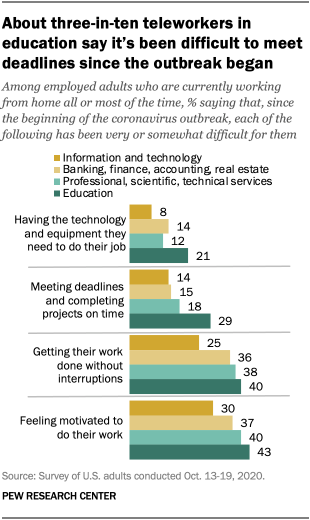
Adults employed in education who are working from home all or most of the time have had a harder time meeting deadlines and completing projects on time than those in other industries where working from home is common. About three-in-ten (29%) say this has been difficult, compared with 18% in professional, scientific and technical services, 15% in banking, finance, accounting and real estate, and 14% in information and technology.
And among teleworkers who are in the same job as before the pandemic, 38% of those in the education sector say it is now harder for them to balance work and family responsibilities than before the coronavirus outbreak – more than the shares in banking, finance, accounting and real estate (26%) and information and technology (24%) who say the same.
In turn, teleworkers in information and technology are less likely than those in the other three industries to say it’s been hard for them to get their work done without interruptions while working from home: A quarter in this sector say this, compared with 40% of teleworkers in education, 38% in professional, scientific and technical services and 36% of those in banking, finance, accounting and real estate.
Among those who use video calling or online conferencing at least some while teleworking, workers in education (44%) are more likely than those in banking, finance, accounting and real estate (29%) and information and technology (25%) to say they are worn out by the amount of time they spend on video calls; a third of workers in professional, scientific and technical services say this. Despite the drain of video calls for some, more than half of workers in each of these industries say online tools are a good substitute for in-person contact.
While online tools may help substitute for in-person contact, many workers teleworking all or most of the time feel more disconnected from their colleagues. Among teleworkers in the same job they had before the outbreak, those in the field of education, as well as those in the professional, scientific and technical services industry, are particularly likely to say they feel less connected to their co-workers than before the pandemic (66% each). About half of those employed in information and technology (50%) and banking, finance, accounting and real estate (49%) say the same.
About half or more of workers in these industries who are in the same job as they were before the pandemic say they have seen no change in their productivity, opportunities for advancement or job security.
Note: Here are the questions used for this report, along with responses, and its methodology.







