

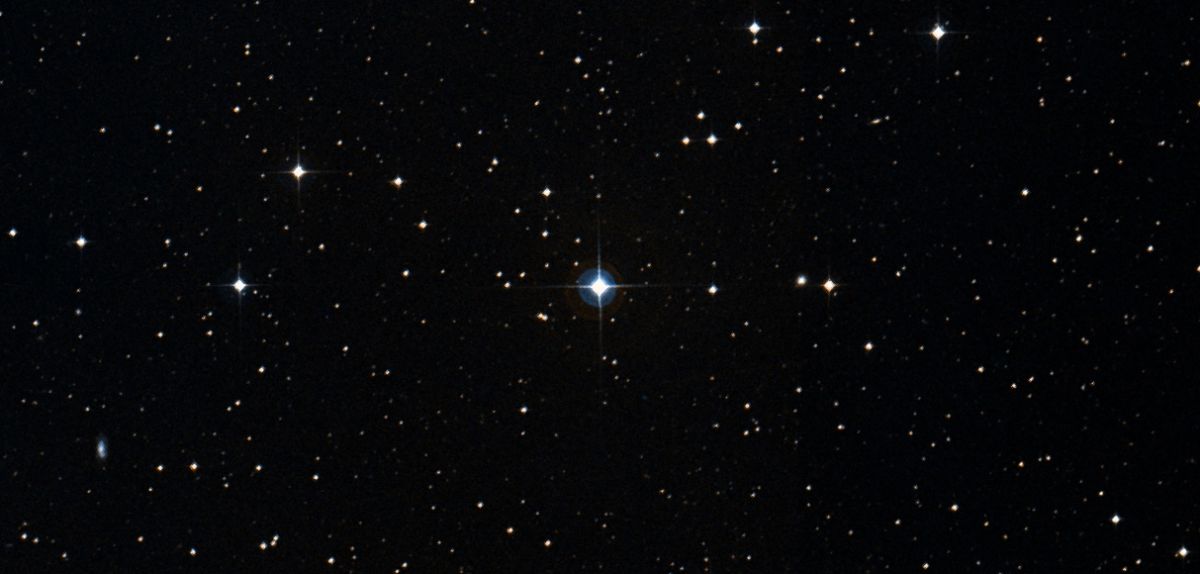
Scientists have combined modern spacecraft data with vintage observations to piece together a 125-year-long story of the antics of a nearby triple-star system dubbed HS Hydra — and predict its future.
When the first of those observations were made, in 1893, HS Hydra was just another star twinkling in the heavens. Now, it’s a strange, dynamic system — and one that may have a few more surprises in store.
Astronomers may soon unearth those surprises, thanks to NASA’s Transiting Exoplanet Survey Satellite (TESS). And scientists think this spacecraft, better known for discovering alien worlds, could unveil similar mysteries in bright but seemingly humdrum binary star systems, according to research presented at the 237th meeting of the American Astronomical Society, held virtually this week due to the coronavirus pandemic.
Related: NASA’s TESS exoplanet-hunting mission in pictures
“It’s just been one of those topics that we knew was going to be really exciting, that TESS was going to be really powerful for,” James Davenport, an astronomer at the University of Washington, told Space.com of bright, binary star systems. But it isn’t the first time astronomers have turned to these objects, he said. “This was like your grandfather’s astrophysics or whatever; binary stars were really hot 60 or 70 years ago because that was the really dynamic thing they could study.”
TESS isn’t technically an astrophysics mission: The spacecraft was designed to spot exoplanets by looking for small, regular dips in the light of a bright star — the shadows of an alien world coming between its star and the spacecraft.
But a dip doesn’t necessarily mean a planet. Sometimes, for instance, it means that the star is actually two stars, which are circling each other edge-on to Earth. And when the stars overlap in the spacecraft’s view, the light dips: ta-da, a binary star system in an exoplanet mission’s data.
So Davenport read up on binary stars, tracking down an old article for amateur astronomers that profiled intriguing binary stars. “It was one of those great moments, like, … ‘I bet TESS observed a bunch of these,'” he said. “It was one of those late-night, ‘Gosh, what if I just dig into this for an hour’ — and then it was two in the morning and I was up too late.”
Of these binaries, HS Hydra was the system that particularly caught his attention. That’s because in 2012, astronomers took a new look at the system, which is about 342 light-years away from Earth, and realized it wasn’t just two stars circling each other every day and a half or so: There was a third, more distant and much smaller star tugging at the main pair. This companion was slowly pulling their dance out of humans’ edge-on view, the researchers realized.
Given the observations, the scientists predicted that the eclipses as seen from Earth would end around 2022. And Davenport was looking at 2019 TESS data that still showed small eclipses. “The prediction that they should end in 2022 wasn’t obviously wrong,” he said.
Using the new TESS data, Davenport and his student co-authors have predicted that HS Hydra’s eclipses will end not in 2022, but early this year, perhaps in February — just in time for the spacecraft to check back in on the system. And whenever the two main stars do stop eclipsing, TESS will still be able to see their interactions as each stretches the other into a slight teardrop shape.
HS Hydra through the ages
But as excited as Davenport is about TESS, he said that the most compelling aspect of the HS Hydra research is being able to pull in data from more than a century before scientists even dreamed up the mission. The earliest observations the researchers tracked down are from 1893, when the Wright brothers were still focused on selling bicycles. In these records, the stars are immortalized on glass plates in an early form of photography.
“Astronomers would have to ride on the telescope in the dark and change the glass plates out at night,” Davenport said. “It was a wild time to be an observational astronomer, which, I guess thankfully, I was not around for.”
But those plates are still around, many of them put online by the Digital Access to a Sky Century at Harvard project, where archivists have also calibrated the data and included logbook notes from the original observers. Davenport and his colleagues ignored plates that seemed worse for wear and still had more than 1,000 observations ready to analyze.
“It was as if somebody had just created a telescope that was a time machine,” he said. “We just went and downloaded the data in the same way that we would download the data from a modern space-based archive.”
With that time machine, Davenport and his colleagues can paint a 125-year narrative with peculiar echoes of humans’ history with space.
Related: ‘The Glass Universe’: How women ‘computers’ measured the stars

For decades, as humans developed first airplanes and then rockets, HS Hydra was just a star. In 1959, its eclipse was at its most dramatic as seen from Earth, and scientists realized its binary nature five years later.
“Right at the dawn of the space era, right after Sputnik has launched and we’re getting ready to go to the moon and all these things are getting ready to happen, that’s when the system is at its maximum,” Davenport said.
Over the next decades, the unseen third star in the system gradually spun the binary, tilting the eclipse so that it became more difficult to detect. But scientists have kept up. “As it’s gotten harder and harder to study, our tools have gotten better and better,” Davenport said.
But their interest? Maybe not so much. “It was never an exciting system,” he said. By the early 2000s, scientists were bored of it. “They thought, eh, that’s just another eclipsing binary. There’s nothing particularly special about it.”
Then scientists realized the impact of the system’s third star, a special characteristic indeed, and in 2018, TESS began work. “Now we’re at this inflection point, where we have this new survey that is going to, I think, revolutionize studies of binary stars … and this system is now sort of bowing out,” Davenport said. The scientists’ new calculations predict that HS Hydra will begin eclipsing again around 2195.
But there’s always a chance scientists haven’t actually solved the puzzle of HS Hydra, he said, and that the system will continue to surprise astronomers as the data set becomes still longer. “We’ve only seen it for 100 years,” Davenport said. “It might not be a straight line through time: It might slowly curve or it might wiggle again, if there’s a fourth star out there dancing with them.”

Because what is an envy-inducing time frame for an observational astronomer is just a snap for an astronomical object. And that means that scientists would do well to look both backward and forward, Davenport said — to both salvage the field’s earliest data and think carefully about how to ensure today’s observations remain accessible.
“The images we take now will be these photographic plates a century from now; somebody will look back very quaintly and say, ‘Oh, they had this cute little telescope they called TESS,'” he said. “Someday, they’ll look back on this data and it will be the very rough, noisy building block of some other cool project.”
The research was presented on Thursday (Jan. 14) at the 237th conference of the American Astronomical Society and is being submitted to journals for publication.
Email Meghan Bartels at [email protected] or follow her on Twitter @meghanbartels. Follow us on Twitter @Spacedotcom and on Facebook.







