

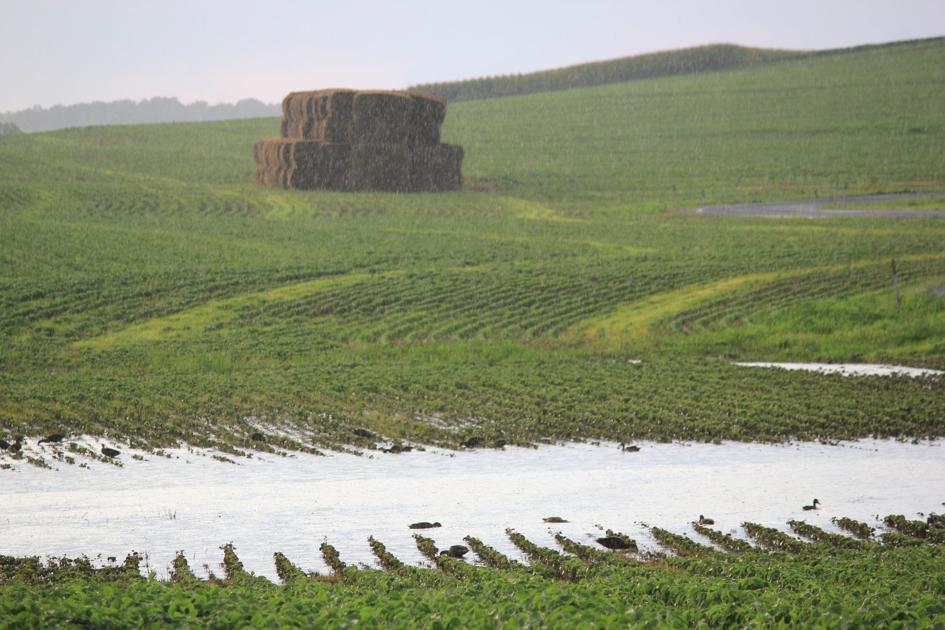
New research from Penn State could change how we manage runoff. It can help save the Chesapeake Bay but also other creeks and streams.
About 10 percent of Berks County is in the Bay watershed but ideas in the research could ultimately effect how runoff is regulated in general. The seven states in the Chesapeake’s watershed have been federally mandated since 2010 to continually reduce nutrient and sediment loads reaching the bay.
And, it turns out, the concept is not unfamiliar to those who work closely with protecting our waterways — the Berks County Conservation District.
The study determined the vast majority of nutrients and sediment washed into streams flowing into the Chesapeake Bay are picked up by deluges from severe storms that occur on relatively few days of the year, Penn State said in a news release. The study, which was published in Environmental Research Letters, offers clues for cleaning up the impaired estuary.
“A small percentage of locations and events contribute to the vast majority of total annual pollution loads entering the bay,” said researcher Heather Preisendanz, associate professor of agricultural and biological engineering, College of Agricultural Sciences, in the news release. “These findings stress the importance of concentrating our efforts on ‘hot moments’ — not just ‘hot spots’ — across impaired watersheds to achieve water-quality-restoration goals.”
In the study, researchers analyzed eight years of data from 108 sites in the Chesapeake Bay Program’s nontidal monitoring network. They looked at daily-scale records of flow and corresponding loads of total nitrogen, total phosphorus and total suspended sediment at each gauging station from 2010 through 2018. Then, in an innovative move, they applied a formula normally used in economics to the data to determine the distribution of pollution loads throughout the years.
“Using Lorenz Inequality and the Gini Coefficient, both of which first were used in the early 1900s to quantify inequity in wealth distribution, we were able to measure the degree of inequality of nutrient and sediment loads across the study years,” Preisendanz said. “This approach allowed us to identify periods of time and corresponding flow conditions that must be targeted to achieve needed load-reduction goals across the watershed.”
The study’s conclusions make a strong case for watershed planners and managers to use a temporal framework to develop low- and high-flow targets for nitrogen, phosphorus and sediment loads specific to each watershed within the bay’s 64,000-square-mile basin.
It’s an idea familiar to Dean Druckenmiller, executive director of the Berks County Conservation District.
A few years ago in a meeting with the National Resource Conservation Service, he brought up high storm intensity and the need to adjust best management practices to handle higher volumes of water. As the climate changes, storms have intensified.
“Our storms are becoming more intense and dropping higher amounts of precipitation in shorter periods of time,” Druckenmiller said in an email. “Not a good combination and these volumes of water are overwhelming the BMPs that are in place. I have especially seen this with the construction and development industries. Not so much with AG BMPs, but on the development side, most BMPs are rated for a 2-year storm event.”
For one thing, we are getting storm events like that more frequently. And, he said, stronger events are becoming more common. All of that leads to sediment pollution overwhelming the systems we put in place to protect our streams and creeks.
The study portends a change for the bay, Preisendanz said, because until now, processes for determining how to reduce total annual pollution loads at a watershed scale have targeted spatial, but not temporal, components of inequality — hot spots but not hot moments.
“I think this offers some insight as to why we haven’t met goals for restoring the bay’s water quality,” she said in the news release. “There’s been a lot of frustration around how much time and money has been spent and the number of best-management practices that have been adopted. We’re still significantly behind where we need to be — especially in Pennsylvania.”
Preisendanz also suggested the research may inject a badly needed dose of pragmatism into the debate about if and how the Chesapeake can be cleaned up, using best management practices such as stream-side buffers that function properly, stream-side fencing, nutrient management plans for farms, continuous no-till crop cultivation and cover crops.
“Now that we know the dynamics of nutrient and sediment transport across the bay watershed, we may need to think differently about how we approach our goals,” she said. “If the reality is that we can’t deal with the highest flows from severe storms — which, by the way, are becoming more intense due to climate change — then we need to design a system that is more efficient at achieving load-reduction goals during low flows.”
One of the team’s hopes is that because its analysis was based on an approach that is easily understandable to a broad audience — using the analogy of temporal inequality to income inequality — the temporal targeting framework will be widely adopted by regulators, Preisendanz explained. People understand that inequality is ubiquitous not only in human-impacted systems, but also in natural systems, she pointed out.
“I like to ask people how unequally the number of strawberries produced in their garden was spread across their strawberry plants, because everyone has a super-productive and super-unproductive plant,” she said “That analogy is exactly transferable to understanding hot spots and hot moments, and why it is so important to manage them both. The team embraces the notion that in every challenge, there lies an opportunity.”
These findings show what successfully reducing pollution loads in waterways feeding the bay would look like in the real world, Preisendanz noted.
“Rather than an ‘everything, everywhere, all-the-time’ approach, focusing on hot spots and hot moments reduces the problem to finding ‘the right solutions in the right places that work at the right time’ approach,” she said.







