

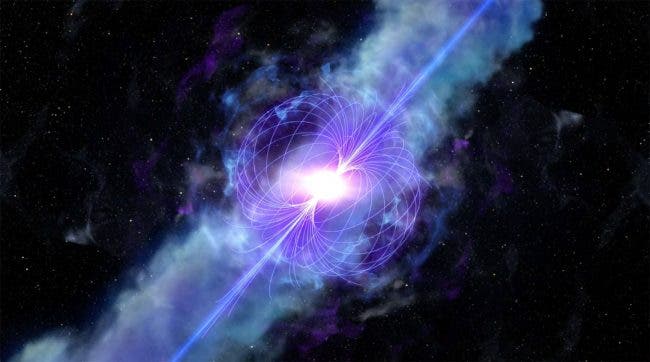

When stars thirty times bigger than our sun explode, they produce a type of young neutron star called a magnetar –the most magnetic objects in the universe, with gravity a billion times Earth’s and a magnetic field one-thousand-trillion times stronger than our Sun’s. A blast from magnetar could blow our atmosphere into space, leaving Earth a lifeless rock. Astronomer Phil Plait describes death by a magnetar should you venture too close as “the tides tearing you to pieces, the fierce heat vaporizing you, the magnetic field tearing your atoms apart, or the intense gravity crushing you into a thin paste an atom high.”
Biggest Stars Become the Strongest Magnets
In 2005, astrophysicist Bryan Gaensler in a study with Harvard-Smithsonian Center for Astrophysics and colleagues announced that they linked two of astronomy’s extremes, showing that some of the biggest stars in the cosmos “become the strongest magnets when they die.” The source of these very powerful magnetic objects –a city-sized ball of neutrons created when a massive star’s core collapses which forms from the collapsed core of a massive star during a supernova at the end of its lifetime–was a mystery since the first one was discovered in 1998.
A magnetar, typically less than nine hundred years old, possesses a magnetic field more than one quadrillion times (one followed by 15 zeroes) stronger than the earth’s magnetic field. If a magnetar were located a sixth of the way to the Moon –about 40,000 miles– it could wipe the data from every credit card on earth.
Extreme Gauss
One of the most exotic objects in the universe, magnetars have the most powerful known magnetic fields in the universe. For context, reports the Harvard-Smithsonian Center of Astrophysics, “the strength of Earth’s magnetic field has a value of about one Gauss, while a refrigerator magnet measures about 100 Gauss. Magnetars, on the other hand, have magnetic fields of about a million billion Gauss.
“Magnetars are the rare, short-lived `white tigers’ of stellar astrophysics,” observed Gaensler, who specializes in exotic objects that change, flicker and explode. “We estimate that the magnetar birth rate will be only about a tenth that of normal pulsars.”
Same Regions of the Milky Way
“Both radio pulsars and magnetars tend to be found in the same regions of the Milky Way, in areas where stars have recently exploded as supernovae,” explained Gaensler in 2005. “The question has been: if they are located in similar places and are born in similar ways, then why are they so different?” Magnetars spit out bursts of high-energy X-rays or gamma rays. Normal pulsars emit beams of low-energy radio waves.
A clue to the pulsar/magnetar difference may lie in how fast neutron stars are spinning when they form –heavy stars will form neutron stars spinning at up to 500-1000 times per second. Such rapid rotation should power a dynamo and generate superstrong magnetic fields. `Normal’ neutron stars are born spinning at only 50-100 times per second, preventing the dynamo from working and leaving them with a magnetic field 1000 times weaker.
“A magnetar goes through a cosmic extreme makeover and ends up very different from its less exotic radio pulsar cousins,” Gaensler says.
“Astronomers used to think that really massive stars formed black holes when they died,” said Gaensler colleague Simon Johnston (CSIRO Australia Telescope National Facility). “But in the past few years we’ve realized that some of these stars could form pulsars, because they go on a rapid weight-loss program before they explode as supernovae.”
Fast forward 2020, astronomers added a new member to an exclusive family of exotic objects with the discovery of a magnetar with new observations from NASA’s Chandra X-ray Observatory help support the idea that it is also a pulsar, meaning it emits regular pulses of light.
Youngest Known Magnetar
The image below shows an exceptional magnetar, a type of neutron star with very powerful magnetic fields. CfA astronomers have found evidence that this object may be the youngest known magnetar–about 500 years old in Earth’s timeframe. It is also the fastest rotating one yet discovered (spinning about 1.4 times per second). This image shows the magnetar in X-rays from Chandra (purple) at the center of the image in combination with Spitzer and WISE infrared data showing the wider field of view. Magnetars form when a massive star runs out of nuclear fuel and its core collapses onto itself.

A Million Billion Gauss
What sets magnetars apart from other neutron stars is their magnetic fields. For context, the strength of our planet’s magnetic field has a value of about one Gauss, while a refrigerator magnet measures about 100 Gauss. Magnetars, on the other hand, have magnetic fields of about a million billion Gauss. If a magnetar was located a sixth of the way to the Moon (about 40,000 miles), it would wipe the data from all of the credit cards on Earth.
On March 12, 2020, astronomers detected a new magnetar with NASA’s Neil Gehrels Swift Telescope. This is only the 31st known magnetar, out of the approximately 3,000 known neutron stars.
After follow-up observations, researchers determined that this object, dubbed J1818.0-1607, was special for other reasons. First, it may be the youngest known magnetar, with an age estimated to be about 500 years old. This is based on how quickly the rotation rate is slowing and the assumption that it was born spinning much faster. Secondly, it also spins faster than any previously discovered magnetar, rotating once around every 1.4 seconds.
Chandra’s observations of J1818.0-1607 obtained less than a month after the discovery with Swift gave astronomers the first high-resolution view of this object in X-rays. The Chandra data revealed a point source where the magnetar was located, which is surrounded by diffuse X-ray emission, likely caused by X-rays reflecting off dust located in its vicinity. (Some of this diffuse X-ray emission may also be from winds blowing away from the neutron star.)
Close to the Milky Way’s Plane
This composite image above contains a wide field of view in the infrared from two NASA missions, the Spitzer Space Telescope and the Wide-Field Infrared Survey Explorer (WISE), taken before the magnetar’s discovery. X-rays from Chandra show the magnetar in purple. The magnetar is located close to the plane of the Milky Way galaxy at a distance of about 21,000 light-years from Earth.
Other astronomers have also observed J1818.0-1607 with radio telescopes, such as the NSF’s Karl Jansky Very Large Array (VLA), and determined that it gives off radio waves. This implies that it also has properties similar to that of a typical “rotation-powered pulsar,” a type of neutron star that gives off beams of radiation that are detected as repeating pulses of emission as it rotates and slows down. Only five magnetars including this one have been recorded to also act like pulsars, constituting less than 0.2% of the known neutron star population.
The Chandra observations may also provide support for this general idea. Safi-Harb and Blumer studied how efficiently J1818.0-1607 is converting energy from its decreasing rate of spin into X-rays. They concluded this efficiency is lower than that typically found for magnetars, and likely within the range found for other rotation-powered pulsars.
Searching for a Detectable Supernova Debris Field
The explosion that created a magnetar of this age would be expected to have left behind a detectable debris field. To search for this supernova remnant, Safi-Harb and Blumer looked at the X-rays from Chandra, infrared data from Spitzer, and the radio data from the VLA. Based on the Spitzer and VLA data they found possible evidence for a remnant, but at a relatively large distance away from the magnetar. In order to cover this distance the magnetar would need to have traveled at speeds far exceeding those of the fastest known neutron stars, even assuming it is much older than expected, which would allow more travel time.
Harsha Blumer of West Virginia University and Samar Safi-Harb of the University of Manitoba in Canada recently published results from the Chandra observations of J1818.0-1607 in The Astrophysical Journal Letters.
The Daily Galaxy, Max Goldberg, via Harvard CfA and Chandra Observatory
Image credit: X-ray: NASA/CXC/Univ. of West Virginia/H. Blumer; Infrared (Spitzer and Wise). Image top of page, is an artists illustration showing the birth of a magnetar with the field lines depicted. If it forms from two neutron stars merging, twin beams of material get blasted away as well. Credit: NASA, ESA, and D. Player (STScI)







