

ATHENS — A newly published study led by researchers from the University of Georgia and several partner institutions reveals a discovery that could lead to new control strategies for a tiny-but-persistent agricultural pest that causes enormous soybean losses.
Microscopic soybean cyst nematodes (SCN) live in soil and are attracted to the root systems of soybeans. Once a field is infested, it is nearly impossible to root them out, according to lead study investigator Melissa Mitchum, professor of plant nematology in UGA’s Department of Plant Pathology and Institute of Plant Breeding, Genetics and Genomics in the College of Agricultural and Environmental Sciences and Center for Applied Genetic Technologies.
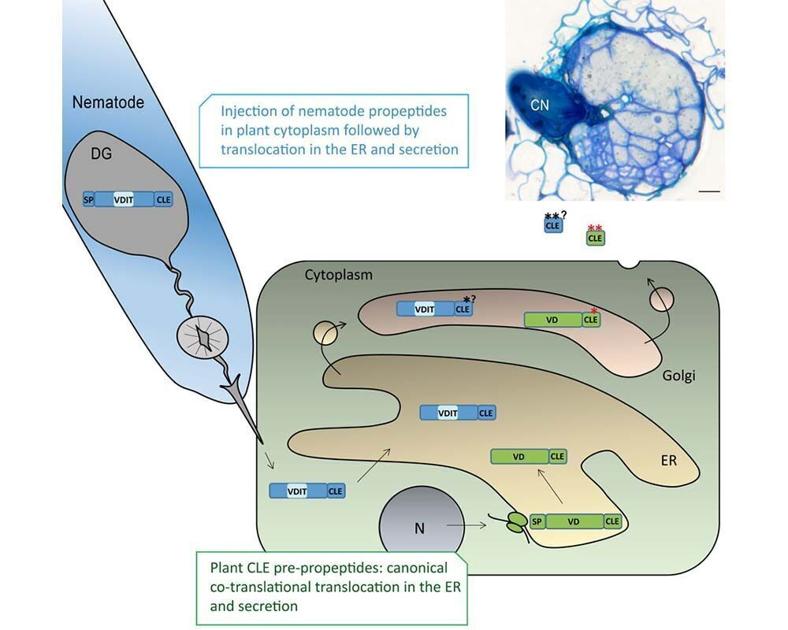
Invisible to the naked eye, SCN have unique hollow, protrudable mouth spears — called stylets — that they use to pierce through the root of a plant, injecting peptide effectors, which mimic the soybean’s naturally present CLAVATA3/embryo (CLE) surrounding region peptides to hijack the plant.
After hatching from an egg in the soil, the juvenile nematode migrates into the root, where it sets up a feeding site and makes its way toward the circulatory system that the plant uses to transport nutrients to the rest of the plant.
Once a root cell is chosen for feeding, the nematodes transform it into a syncytium, a mass comprising hundreds of metabolically active cells that continue to secrete CLE, taking over the plant’s natural cellular processes to export the peptides back out of the cell to function as external signaling molecules to distant cells.
This process diverts resources away from the plant in support of the nutrient demands of the developing nematode. At this point, nematodes change their morphology, turning from wormlike forms into sedentary, lemon-shaped bodies that pop out of the roots, becoming visible to the eye.
Using knowledge that has been developed over the past two decades on how nematode CLEs function, the study, published in the journal New Phytologist, uncovered a new pathway that allows the nematode to disrupt the plant’s natural growth processes to divert resources for its own benefit. The study also was highlighted in commentary by the editors of New Phytologist.
“We’ve discovered that early on, when the nematode delivers the CLE peptide to a root cell, the peptide has to reach a plant receptor that binds it so that you get a response in the plant,” Mitchum said. “We knew that the nematode delivered the peptide into the cytoplasm of the cell, but the receptor is on the outside of the cell.”
The study shows that the nematode CLEs provide a way for the nematode peptide to get outside of the cell to interact with the plant protein receptor through the plant’s secretion system, a process that is not well-studied in plants.
“To me it is fascinating because the nematodes have discovered how to co-opt that part of the plant — its own secretion system — but we don’t understand the secretion system they are taking advantage of,” Mitchum said. “If we can understand how they are doing it, we will likely uncover some novel aspect of plant biology that could have importance to other plant pathosystems. This effector protein is helping us understand plant biology, not just plant pathology.”
Normally occurring plant CLE peptides regulate aspects of cell differentiation in the plant, communicating to the plant’s stem cells, which are constantly regenerating, whether to develop into a root cell, a leaf cell or a cell in another part of the plant.
The next step is to find novel methods to block the nematode peptides from getting out of the feeding cells.
“We are trying to figure out how these nematode peptides function because we want to devise a way to interfere with that ability,” Mitchum said. “If we can block the nematode peptides from getting out of the feeding cells, they will not form properly, and the nematode loses its nutrient source and dies.”
Soybean cyst nematodes are the No. 1 yield-reducing pest of soybean producers, robbing seemingly healthy fields of up to 30% of their yields — and costing the industry up to $1 billion every year.
The primary management practice for soybean cyst nematodes is through developing genetic resistance in soybean varieties. Because SCN has a specialized host range, producers can control nematode damage by rotating fields to a non-host crop plant to reduce the population of nematodes in the field. However, the bodies of dead female nematodes form a cyst around them, protecting hundreds of eggs. These cysts can remain in the ground for years, protecting the eggs until a host crop is planted again and the nematodes reemerge.
While creating genetically resistant crops is an effective tool, SCN have adapted to overcome the source of resistance in the commonly used breeding line PI 88788, which is used in more than 90% of resistant varieties currently planted by producers. As a result, yields in resistant varieties can be reduced by up to 14 bushels per acre, according to The SCN Coalition, a public/private partnership of university researchers, national extension specialists and agriculture company representatives who are concerned about the evolving threat from soybean cyst nematodes.
“We need to bring awareness to the increased resistance of SCN to the (PI 88788) resistance and come up with novel approaches to combat it,” Mitchum said. “Targeting the mechanism we have found in this study would be a novel way of addressing this resistance.”
Because soybean cyst nematodes are such a widespread pest, Mitchum and UGA Extension plant pathologist Bob Kemerait, with the help of county agents, will launch a statewide survey in 2021 of all soybean-producing counties in Georgia to determine current SCN levels and whether SCN-resistant crops are suffering greater losses due to the nematode’s adaptations against resistant varieties.
While Georgia is not a major producer of soybeans — with 100,000 acres planted in 2019 at a value of about $240,000 — more than 80 million acres were planted nationwide in 2019, with a production value of $31.2 billion, according to the U.S. Department of Agriculture’s National Agriculture Statistics Service.
“From a genetic standpoint, we are working with soybean breeders to diversify the germplasm and working with companies to get new SCN-resistant varieties out to producers while, in parallel, we are doing this kind of basic science research to understand the mechanisms used by the nematode to cause disease so we can interfere with them in a novel way,” Mitchum said.
Bringing awareness to the importance of basic science and basic research is a message that needs to come through when discoveries like this are made, she noted.
“A lot of times the return on research investment is not as immediate or apparent as it is if you go out and do a field trial and get immediate results,” Mitchum said. “There has to be a balance — we need to invest in research that will have an immediate impact, but if we are going to come up with breakthrough technologies, it is going to be from an investment in this kind of long-term research.”
Lead study author Jianying Wang was a former research associate in Mitchum’s lab. Research partners in the multi-institutional study included Richard S. Hussey, Emeritus Distinguished Research Professor of Nematology at CAES; and CAGT post-doctoral researcher Xunliang Liu; as well as colleagues from University of Missouri, Worcester Polytechnic Institute, Iowa State University, North Carolina State University and Cornell University. Mitchum joined UGA in 2019 from the University of Missouri’s Division of Plant Sciences and Bond Life Sciences Center.
Funding for this work was from the National Science Foundation and the USDA National Institute of Agriculture’s Agriculture and Food Research Initiative.
For more information on research being performed at CAES, visit caes.uga.edu/research.







