
GLOBAL RESEARCH SYNDICATE
No Result
View All Result
  • Login
  • Latest News
  • Consumer Research
  • Survey Research
  • Marketing Research
  • Industry Research
  • Data Collection
  • More
    • Data Analysis
    • Market Insights
  • Latest News
  • Consumer Research
  • Survey Research
  • Marketing Research
  • Industry Research
  • Data Collection
  • More
    • Data Analysis
    • Market Insights
No Result
View All Result
globalresearchsyndicate
No Result
View All Result
Home Data Collection

Platypus: Why Some Mammals Lay Eggs

globalresearchsyndicate by globalresearchsyndicate
January 7, 2021
in Data Collection
0
Platypus: Why Some Mammals Lay Eggs
0
SHARES
10
VIEWS
Share on FacebookShare on Twitter

The not so popular Australian mammal, the platypus, has been a mystery to scientists since its discovery. New research may finally hold the key to understanding one of the few mammals that lay eggs.

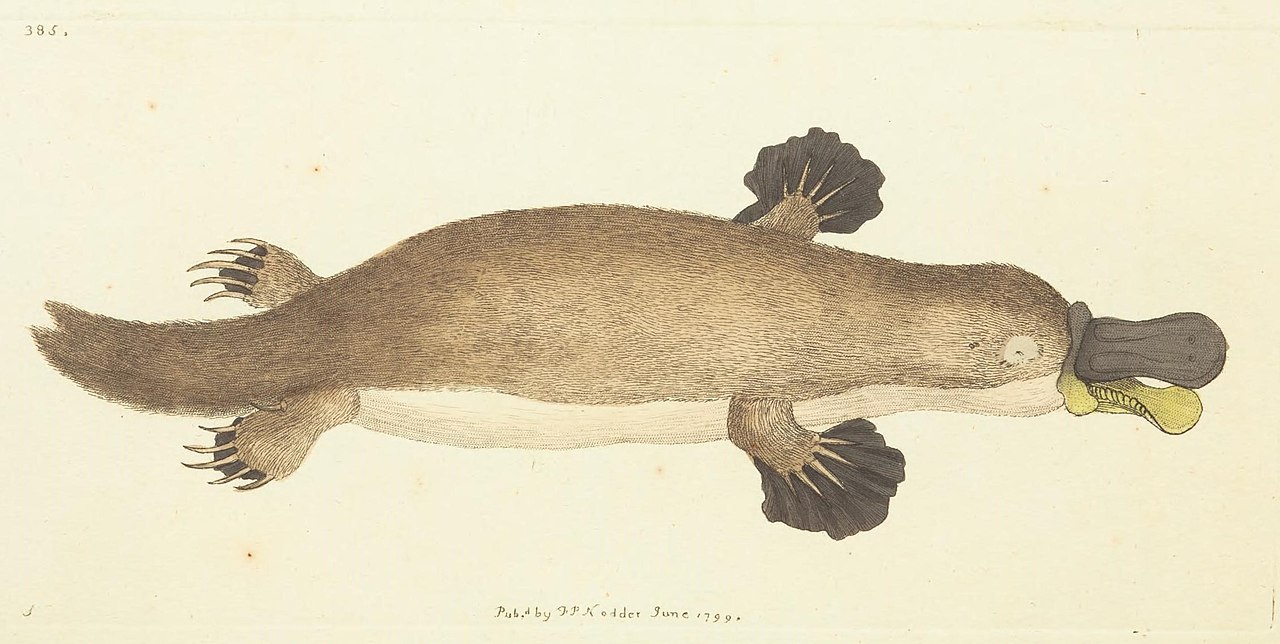
Platypus (Ornithorhynchus anatinus) First Description 1799

(Photo : Frederick Polydore Nodder / Wikimedia Commons)
This illustration by Frederick Polydore Nodder is the first published illustration of a platypus. It accompanied George Shaw’s 1799 description of the animal in the Naturalist’s Miscellany, or Coloured figures of natural objects”. London:Nodder & Co.

Can Mammals Lay Eggs?

Commonly called platypus, the  Ornithorhynchus anatinus is a carnivorous mammal with a swiftly decreasing population. 

It is among the most unlikely animals leading scientists who first discovered the animal to doubt its authenticity. The mammalian specimen can only be described as an assortment of familiar species: it has a duck-like bill and webbed feet, a beaver’s tail, an otter’s fur, and body males carry sharp venomous stingers on the heels of their feet.

Truly a remarkable specimen, platypus can live, hunt, and thrive in both land and water.

It is classified under the mammalian group monotremes, which include echidnas. It is a specialized egg-laying predatory group that has been the center of research for decades.

Check out: 503 New Species Identified by Scientists in 2020

How Platypus Genomes Could Reveal New Evolutionary Information

A recent study published in the journal Nature, gives a first look at the complete overview of the platypus’ genome revealing new evolutionary information about the mysterious mammalian group and insight on human DNA. 

Monotremes, which only include the semi-aquatic platypus and echidnas, share a unique trait: egg-laying.

For the first time since its discovery, scientists are able to provide a complete chromosomal map of the platypus and a lee-complete echidna genome-map.

Using genetic data, scientists analyzed the species habits, from eating habits to swimming routines. One of the discoveries pertains to the mammals’ olfactory, which has far fewer genes than the terrestrial counterpart: the echidnas.

The genetic data gathered also reveals that when platypus are submerged, their nasal cavity and eyes are closed solely relying on other senses suck as electric stimuli for prey detection.

Unique Reproductive Strategy

Egg-laying is by far the most unique in the species. Hence scientists focused explicitly on sex chromosomes. The monotreme has 5 X chromosomes and 5 Y chromosomes, for a total of 10 sex chromosomes. 

Humans, on the other hand, have only 2 sex chromosomes.

Researchers have discovered more significant similarities between birds and platypus than between humans and platypus through careful analysis.

Guojie Zhang, the author and a biology professor at the University of Copenhagen, tells in an interview, “Genome sequencing, we found 10 sex chromosomes do  not have any homolog with the X/Y chromosomes in humans.”

The complex structure of the platypus’ sex chromosomes displays unusual interaction during cell division (meiosis). Due to the interaction and pairing of chromosomes during meiosis in monotremes, the sex chromosomes can form ring structures, according to Zhang.

The study’s most intriguing findings are regarding the ring structure since the chromosomal structure is often seen in plants but never in animals, making it a groundbreaking discovery.

Comparing platypus genomes to other ancient animals, scientists could map out the ancient mammal’s chromosomes. The research was also able to trace the last common ancestors of humans and platypus dating back to 163 to 191 million years ago.

Also Read: Tapanuli Orangutan: Rarest Great Ape is in Greater Danger than Previously Known

Check out more news and information on Endangered Species on Science Times.

Related Posts

How Machine Learning has impacted Consumer Behaviour and Analysis
Consumer Research

How Machine Learning has impacted Consumer Behaviour and Analysis

January 4, 2024
Market Research The Ultimate Weapon for Business Success
Consumer Research

Market Research: The Ultimate Weapon for Business Success

June 22, 2023
Unveiling the Hidden Power of Market Research A Game Changer
Consumer Research

Unveiling the Hidden Power of Market Research: A Game Changer

June 2, 2023
7 Secrets of Market Research Gurus That Will Blow Your Mind
Consumer Research

7 Secrets of Market Research Gurus That Will Blow Your Mind

May 8, 2023
The Shocking Truth About Market Research Revealed!
Consumer Research

The Shocking Truth About Market Research: Revealed!

April 25, 2023
market research, primary research, secondary research, market research trends, market research news,
Consumer Research

Quantitative vs. Qualitative Research. How to choose the Right Research Method for Your Business Needs

March 14, 2023
Next Post
Optical Coatings Market Size to Hit US$ 20.43 Billion by 2027

Nutraceutical Ingredients Market Size to Surpass US$ 225.7 Bn by 2027

Categories

  • Consumer Research
  • Data Analysis
  • Data Collection
  • Industry Research
  • Latest News
  • Market Insights
  • Marketing Research
  • Survey Research
  • Uncategorized

Recent Posts

  • Ipsos Revolutionizes the Global Market Research Landscape
  • How Machine Learning has impacted Consumer Behaviour and Analysis
  • Market Research: The Ultimate Weapon for Business Success
  • Privacy Policy
  • Terms of Use
  • Antispam
  • DMCA

Copyright © 2024 Globalresearchsyndicate.com

Welcome Back!

Login to your account below

Forgotten Password?

Retrieve your password

Please enter your username or email address to reset your password.

Log In
This website uses cookies to improve your experience. We'll assume you're ok with this, but you can opt-out if you wish. Cookie settingsACCEPT
Privacy & Cookies Policy

Privacy Overview

This website uses cookies to improve your experience while you navigate through the website. Out of these cookies, the cookies that are categorized as necessary are stored on your browser as they are essential for the working of basic functionalities of the website. We also use third-party cookies that help us analyze and understand how you use this website. These cookies will be stored in your browser only with your consent. You also have the option to opt-out of these cookies. But opting out of some of these cookies may have an effect on your browsing experience.
Necessary
Always Enabled
Necessary cookies are absolutely essential for the website to function properly. This category only includes cookies that ensures basic functionalities and security features of the website. These cookies do not store any personal information.
Non-necessary
Any cookies that may not be particularly necessary for the website to function and is used specifically to collect user personal data via analytics, ads, other embedded contents are termed as non-necessary cookies. It is mandatory to procure user consent prior to running these cookies on your website.
SAVE & ACCEPT
No Result
View All Result
  • Latest News
  • Consumer Research
  • Survey Research
  • Marketing Research
  • Industry Research
  • Data Collection
  • More
    • Data Analysis
    • Market Insights

Copyright © 2024 Globalresearchsyndicate.com




