


Professional food developers rely heavily on R&D and innovation centers outfitted with lab benches, pilot plant equipment, consumer research facilities (i.e. for focus groups), and a wealth of other physical resources. But that’s not all. Multidisciplinary teams also frequently huddle over a lab bench to review product iterations and brainstorm ideas. All of this changed with COVID.
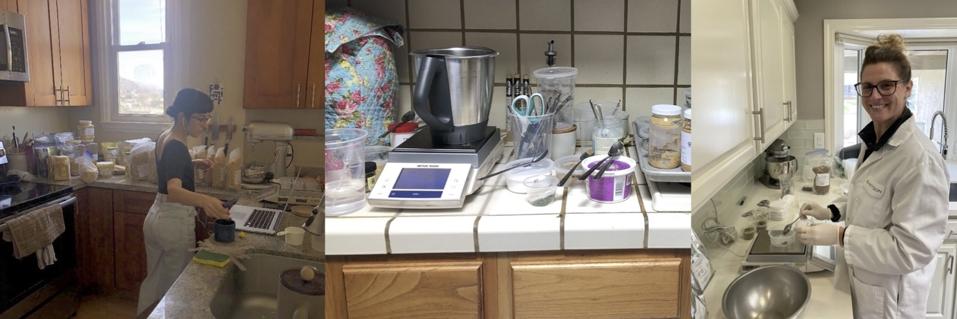
Food scientists were forced to work differently–from home– to keep innovation projects going.
Mattson
DISTRIBUTED DEVELOPMENT
With quarantine orders in place, many food scientists had to pivot to developing products from home. This means food scientists were designing and tweaking formulations in their own kitchens, washing their own dishes, and running individual shipping and receiving operations to get input from colleagues. These home-developed products will soon be on grocery store shelves.
Having a communal innovation space is ideal (ours is open again, with strict COVID protocols in place). But we learned that a distributed model isn’t so bad. Instead of commiserating on the downsides of DFH (Development From Home) we used it as an opportunity to experiment with process. As COVID-19 restrictions continue, we’re thinking about what this means in terms of keeping innovation projects chugging along.
PERFECTLY IMPERFECT FORMULATION FOR THAT HOMEMADE FEELING
During the past 10 months, people have been cooking from home more than ever. Even seasoned cooks have realized that delicious homemade doesn’t have to be perfect, especially when reluctantly throwing something together between Zoom calls. Imperfect doesn’t mean bad. In fact, it can be delicious, nourishing, and healthy. Best of all, we know exactly what went into our own meals.
As such, we’ve become more accepting of lumpy sauces or misshapen loaves of bread. We anticipate that “perfectly imperfect” products will rise to duplicate this more authentic homemade experience. That will translate to more products carrying instructions like “shake well, separation is natural” or “stir with knife before using.”
If consumers are willing to accept less-than-perfection in exchange for better flavor, more nutrition, or fewer additives, the question is no longer whether to formulate for flawless emulsification or long lasting stability, but whether either is necessary. The challenge becomes navigating the fine balance between how much imperfection the user is willing to accept and how much food science and high-tech ingredients to formulate with.
This is a new COVID-driven manifestation of the label-reading and natural food trends that have grown over the past years as consumers have demanded cleaner, fewer, and more familiar ingredients in their packaged foods. In other words, more like homemade.
UPCYCLING: IT’S MORE THAN USING FOOD SCRAPS
At some point, while sheltering in place, most people have had a moment of horror seeing the amount of food and packaging we throw away when cooking 3 meals a day, 30 days a month. It’s eye-opening and behavior changing.
Upcycling food is one solution. This refers to reducing food waste by transforming under-utilized, less-than-perfect, and often waste stream ingredients into high quality, value-added ingredients and products.
Formulating with upcycled ingredients allows food and beverage brands to differentiate, but it also comes with significant challenges: lack of traceability of the starting material, the absence of GRAS (Generally Recognized As Safe) status, consumer misunderstanding (that this is not “eating trash”), unreliable ingredient supply, and high batch-to-batch variation (see previous trend: color/shape/flavor may vary!).
In order to address some of these challenges, enthusiastic upcycled food and beverage companies have formed the Upcycled Food Association, in support of developing an Upcycled Certification standard and promoting upcycled food development.
A new standard will certify and explain what upcycled foods are.
Upcycled Food Association
DOLE Packaged Foods joined UFA with a big plan to eliminate their food waste by 2025. Mattson has partnered with brands such as Cacique® Inc., a traditional Mexican-style cheese producer, to help transform trim from their cheese production into delicious, fresh Queso Dips. But also with upcycled, mission-driven brands such as Kazoo, whose line of tortilla chips are made from upcycled corn germ.
While not everyone is thrilled with the idea of consuming byproducts, brands need to remind consumers that many iconic products utilize upcycled waste streams, like the buttermilk in ranch dressing, a natural byproduct of butter production, and the whey in protein drinks, a (sometime) byproduct of dairy processing. Even more impactful would be to remind consumers of how creative they got during CFH (Cooking From Home) while sheltering in place. Banana bread, anyone?
The goal in 2021 will be to get consumers as interested in buying products made with upcycled ingredients as the industry is about making them. This is a delicate proposition, as the thought of eating recycled food isn’t quite as aspirational as rolling your recycling—or better yet, compost—bin to the curb. Yet.
ALTERNATIVE STRATEGIES FOR PLANT-BASED MEAT ALTERNATIVES 3.0
At the turn of the century, meat alternative (specifically burger) brands such as Gardenburger, Morningstar Farms and Boca hit the market. Consider this Plant-Based Consumer Products 1.0. In the late 20-tens, Beyond Meat
BYND
One thing that started bubbling up in the media in 2020 was the highly processed nature of these 2.0 foods. Products that offer up a less processed option will thrive, such as Atlast™ Food Co. which has launched MyBacon, made from whole slabs of “mushroom belly.” Their simply sliced mycelium is a desirable feature of the product, rather than something they’re trying to camouflage or hide in a long ingredient statement.
We believe soybeans are beginning to shed their baggage. In 2020, a tofu company we worked with was so proud of their organic, non-GMO soybean-based product they made a conscious decision to celebrate tofu rather than try to pass it off as chick’n, which might have been a 2019 or 2020 strategy. Their new product line will launch in 2021.
We’re also watching how Big Food has benefitted from retailers trimming the number of products on store shelves, focusing on their high-volume, broadly appealing, and profitable varieties. Companies such as Coca-cola have proudly announced the shedding of smaller brands in order to streamline “growth and scale.”
In 2020 we saw prominent Big Food processors launch their own line of Plant-Based 2.0 meat alternatives: Hormel’s
HRL
K
And what if they don’t make it? There’s still a way for big brands to play. In fact, Hormel is already tapping into both scenarios with their Aidell’s Whole Blends sub-brand. This line of chicken sausages is made with less chicken, that’s been replaced with whole grains (like quinoa, barley) and vegetables to add plant nutrition and sustainability. We predict other animal meat brands will tap into this trend of “lotsa meat, little plants.”
It’s a new strategy for a new year.
Many thanks to Melanie Lai, Caroline LaFleur, and Brenda Fong for their assistance with this article.







