

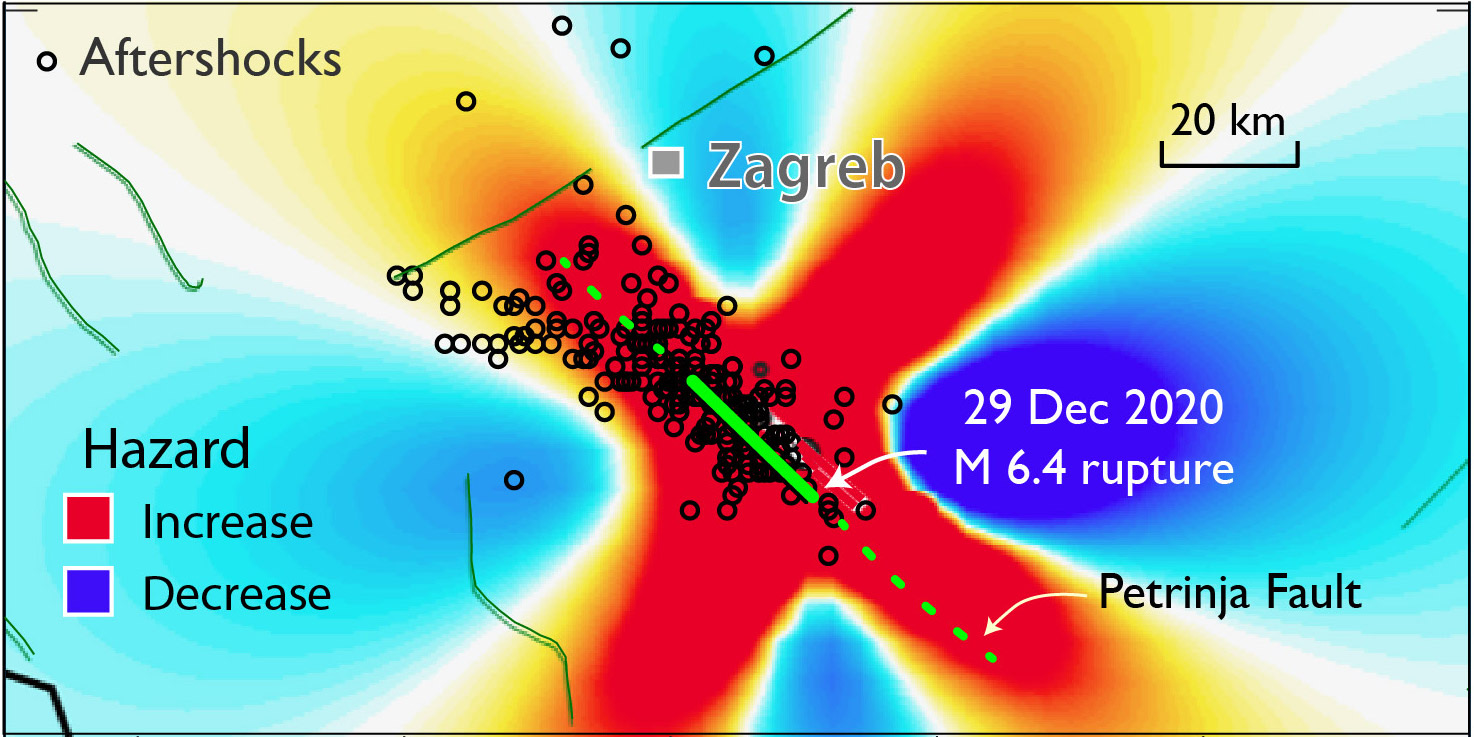
We find that the Petrinja earthquake raised the chances of another large, damaging shock nearer to Zagreb by a factor of three, but the probability is still low, at about a 1% chance over the next year.
By Ross S. Stein, Ph.D., Temblor, Inc., and Shinji Toda, Ph.D., IRIDeS, Tohoku University
On Dec. 29, 2020, a magnitude-6.4 quake struck Central Croatia, near Petrinja. Aftershocks are ongoing, and so far, have occurred along a trend that extends for 20 kilometers to the northwest of the likely fault rupture.
Which fault ruptured, and are any faults primed for future rupture?

Aftershocks located in the Seismological Survey of Croatia seismic network appear concentrated along a 30-kilometer-long trend, and are more tightly concentrated than those in the European Mediterranean Seismic Centre (EMSC) catalog shown in the map below. So, the Seismological Survey of Croatia map is probably more reliable. Somewhere within this band of aftershocks lies the 15-25-kilometer-long extent of the fault that ruptured in the magnitude-6.4 mainshock.
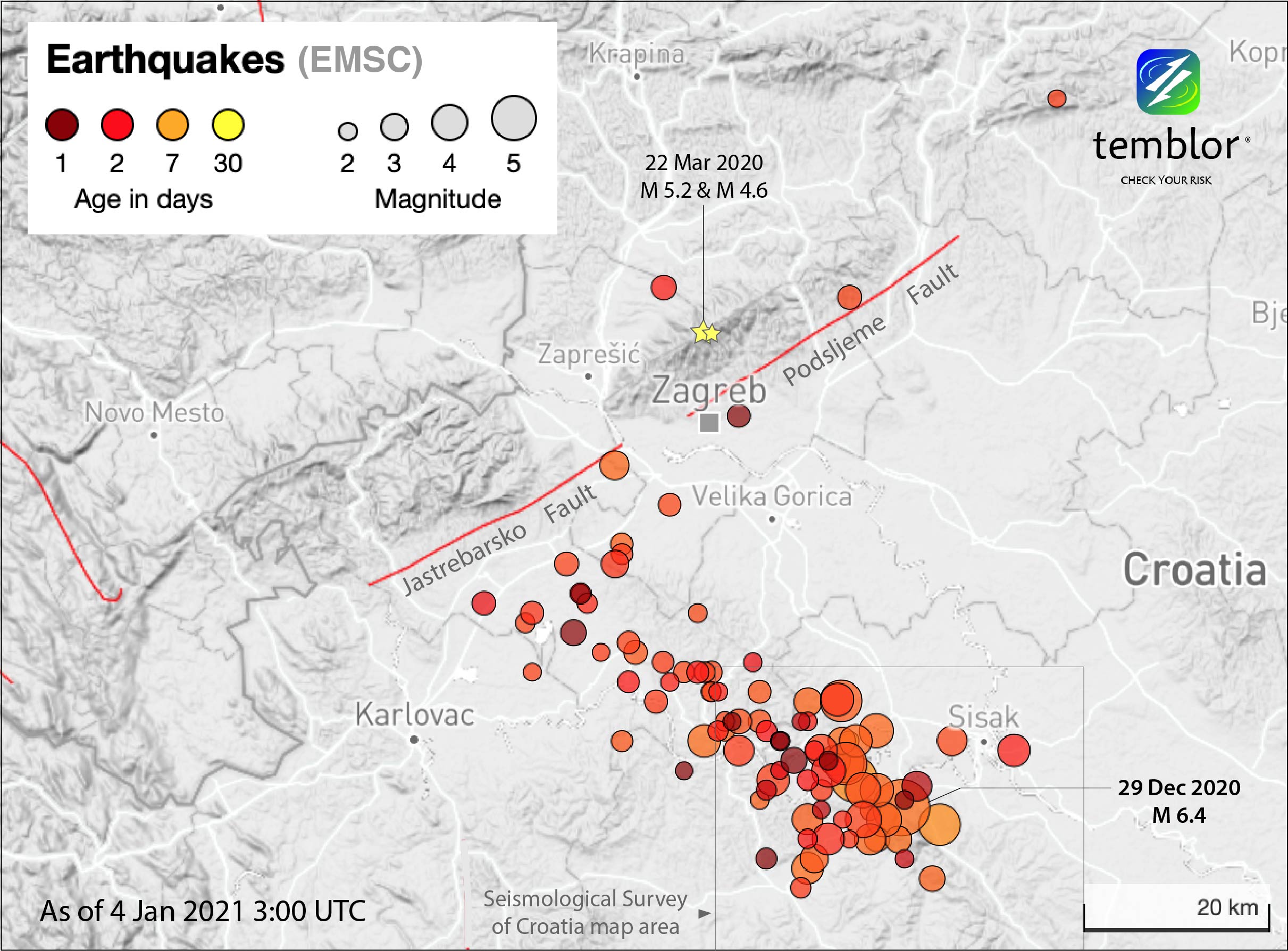
When we consider recent quakes over a larger area — using the EMSC real time catalog — a half-dozen more shocks appear after the magnitude-6.4 mainshock. These quakes occurred near the Jastrebarkso and Podsljeme Faults closer to Zagreb, and closer to the site of the magnitude-5.2 shock on 22 Mar 2020. Are these remote aftershocks of the magnitude-6.4 event? It’s unlikely that they have been mislocated by 30-40 kilometer, but this is possible. Further, there have been 5-6 shocks in the past four days, and none in the preceding 30 days (evident from the quake colors). So, if these were aftershocks of the much smaller Mar. 22, 2020 shocks, why were there none in the month before the magnitude-6.4? It seems more likely that these are aftershocks of the 29 Dec. 29 quake.
Within this region, the 2012 Database of Seismogenic Faults, part of the European Database of Seismogenic Faults (EDSF), identifies three northwest-striking ‘sources’ with components of right-lateral and thrust slip, and six sources that strike to the east-northeast, with components of left-lateral and thrust slip. In other words, neither pure strike-slip nor pure thrust slip is expected on faults in this area. (“Right-lateral” simply means that whatever side of the fault you are on, the other side moves to the right, in response to shear. “Thrust” faults stack up one side of the fault over the other in response to compression.)
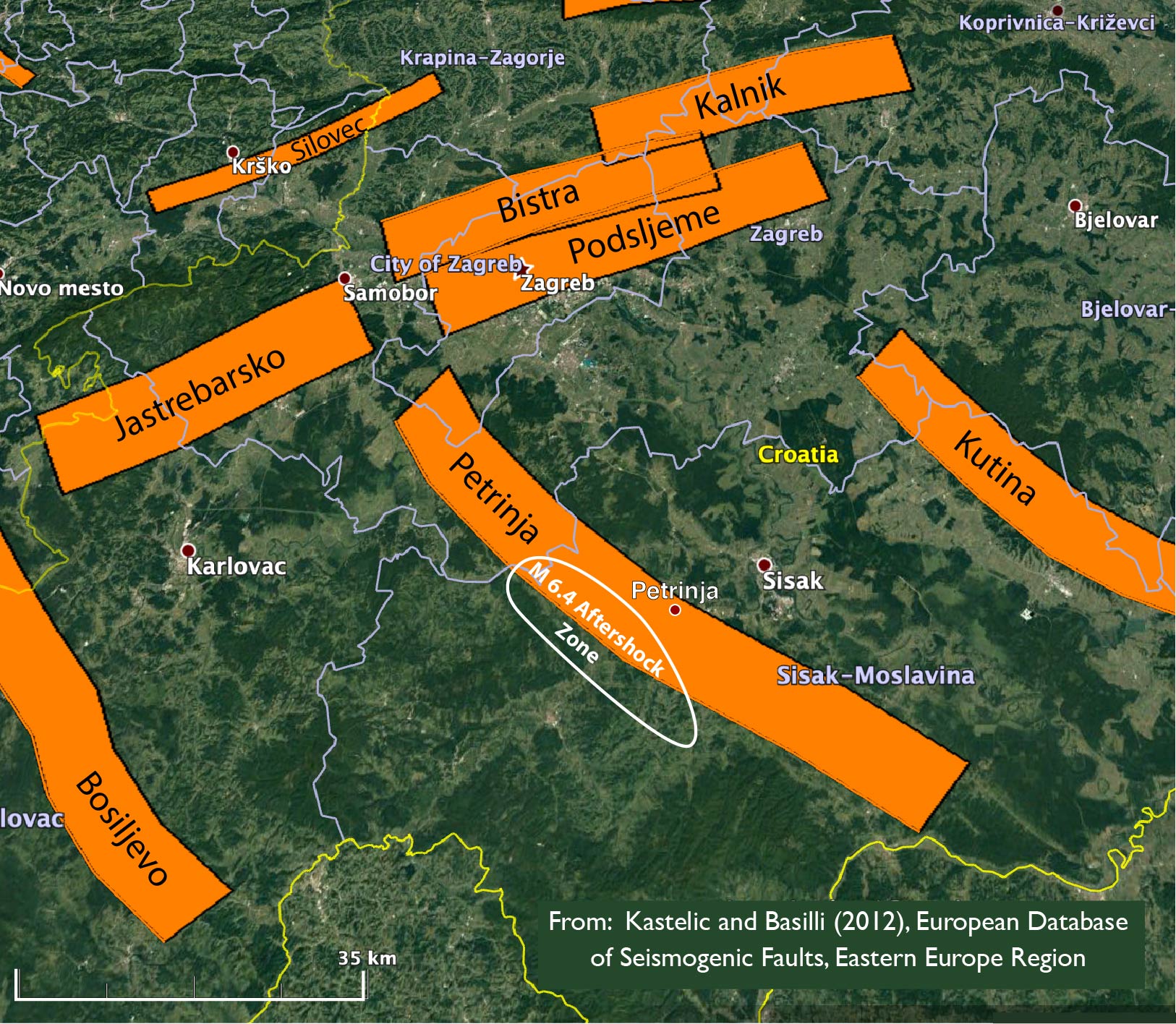
So, how did the database fare in comparison to the March 2020 Zagreb and December 2020 Petrinja earthquakes? Ironically, the March events were pure thrust, and the December event was pure right-lateral. The March events can perhaps be associated with the Bistra Fault, identified as left-lateral oblique in the database, although Markušic et al. (2020) propose a Medvednica Mountains Thrust Fault in the same location. On the basis of the magnitude-6.4 aftershocks, the December event lies close to the Petrinja Fault, and so the database performed well.
“The Petrinja fault is actually a composite seismogenic source, meaning that it may comprise different fault surfaces, especially in terms of its surface and subsurface area,” said Vanja Kastelic, a researcher at the Istituto Nazionale di Geofisica e Vulcanologia (INGV), who mapped these features for the database. “It is difficult to map or predict possible ruptures of secondary splays and accompanying structures, so in this sense the composite source possibly includes also those that just ruptured,” she said.

A ‘hiccup’ in the life of a fault
Kastelic says that an individual earthquake is not the whole story of a fault, which is a long-lived structure that slips in countless quakes. She said: “The Petrinja Fault in the database ranges from right-lateral to oblique slip to match the geomorphologic imprint and the regional stress direction. Given that an earthquake is a ‘hiccup’ in the life of its fault, its symptoms are of course important, but understanding the fault long-term behavior and its deformation state, together with its accompanying rock volume, is just as important. Given all these, my best ‘bet’ is that the Petrinja fault is the culprit of the magnitude-6.4 quake.”
Was there surface fault rupture in the M 6.4 earthquake?
Kastelic said: “There are reports of surface deformation, definitely liquefaction and ruptures, but for now, I cannot express my opinion of those being the primary coseismic faulting or effects of shaking due to differential compaction, gravity etc. A thorough field investigation will be able to give more precise answers.”
Changes in seismic hazard
We use Coulomb stress transfer and rate-and-state friction theory to assess how the magnitude-6.4 quake changed seismic hazard in the region. Essentially, the earth is treated as a slab of stiff slab of rubber. The fault slip distorts the rubber and we calculate the resulting strains and stresses on surrounding ‘receiver’ faults. Faults are brought closer to failure when they are sheared in their expected slip direction, when they are unclamped, or when both occur (Stein, 1999).
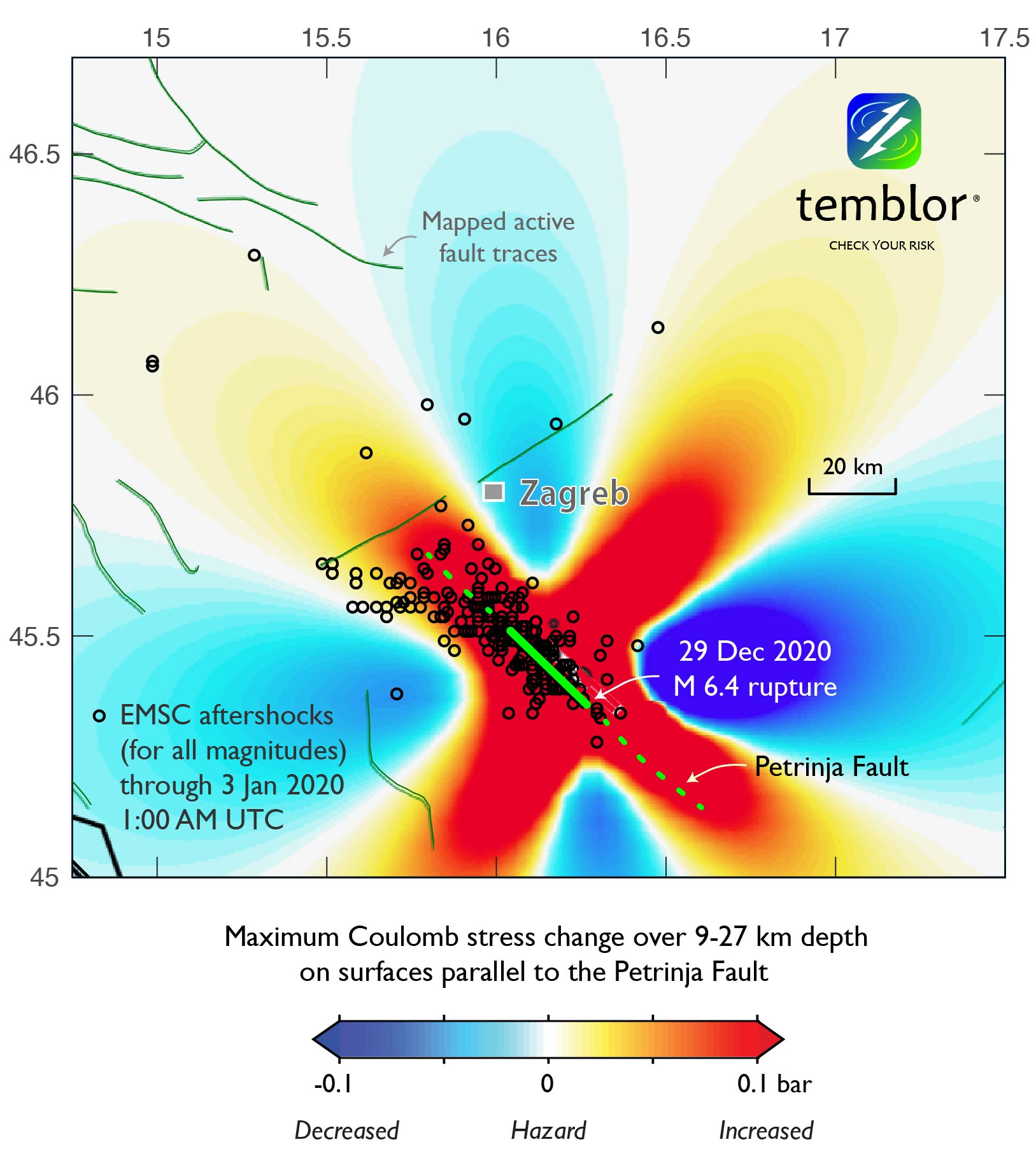
In this first calculation, we looked to see if the aftershock locations are consistent with a simple stress transfer model, by assuming that they struck on faults parallel to the mainshock. We see a good correspondence that suggests that the fault or faults extend to the northwest, as does the seismogenic source in the European database. Stresses 10 kilometers northwest of the rupture reach about 1 bar, making this the most likely candidate for another large earthquake.

Next, we consider a region populated by oblique left-lateral thrust faults that strike east-northeast (strike/dip/rake = 60°/60°/35°), with a fault friction of 0.4. Lower values of friction, corresponding to more slippery flat-lying faults, may be appropriate, as inferred by Kastelic and Carafa (2012). We find that the eastern portion of the Jastrebarsko Fault is brought about 0.15 bars closer to failure by the magnitude-6.4 rupture, but the Podsljeme Fault is brought 0.05 bars farther from failure. These are small but significant stress changes.

Next, we zero in on the receiver faults thought by Kastelic and Markušić to best represent the faults near Zagreb. Again, we see that the eastern Jastrebarsko Fault is brought closer to failure, but failure is inhibited on the Podsljeme Fault and the Medvednica Mountains Thrust.
Chance of another large shock is low — but three times higher than normal
When we combine the Coulomb stress transfer results with the theory of rate-and-state friction, which describes how seismicity responds to small, sudden changes in stress (Toda and Stein, 2020), we find that the chance of another shock of magnitude-5.0 or greater over the next year is about 15%, the chance of a magnitiude-6.0 or greater shock is about 1.5%, and the chance of another magnitude-6.4 event is about 0.6%. These probabilities are, fortunately, low. However, they are about three times higher than the long-term averages, and so while the hazard is small, it has increased.
Our results suggest that the chances of a large shock on the Petrinja Fault, Jastrebarsko Fault or other fault near Zagreb in the next year are low — on the order of 1 in 100. Of these, the most likely candidate is the section of the Petrinja immediately northwest of the Dec. 29 rupture. If one of those faults were to rupture, the consequences could be grave, and so we believe it important to assess this possibility and present it to the public and our colleagues.
Could the magnitude-6.4 quake be followed in short order by another large, damaging quake on an orthogonal or adjacent fault? It happened in Ridgecrest, California in 2019 when a magnitude-6.4 quake was followed 34 hours later by a magnitude-7.1 shock on an orthogonal fault that was brought closer to failure by the first shock (Toda and Stein, 2020). It happened in Kumamoto, Japan, in 2016 when a magnitude-6.0 shock was followed 28 hours later by a magnitude-7.0 quake on an adjacent fault section that was also brought closer to failure (Kato et al., 2016; Stein and Sevilgen, 2016). These are only recent examples; there are many others in which a second shock occurred days to years after the first shock.
A key outcome of our calculations is that the earthquake rate is forecast to be about three times higher over the next year than in a typical 12-month period. So, the benefits of seismic retrofit and earthquake insurance are now three times greater than they were before Dec. 29.
References
Vanja Kastelic and Roberto Basilli (2012), European Database of Seismogenic Faults, Eastern Europe Region, http://diss.rm.ingv.it/share-edsf/index.html
Vanja Kastelic and Michele M. C. Carafa (2012), Fault slip rates for the active External Dinarides thrust‐and‐fold belt, Tectonics, 31, TC3019, doi:10.1029/2011TC003022.
Kato, A., Fukuda, J., Nakagawa, S., and Obara, K. (2016), Foreshock migration preceding the 2016 Mw 7.0 Kumamoto earthquake, Japan, Geophys. Res. Lett., 43,8945– 8953, doi:10.1002/2016GL070079.
Snježana Markušic, Davor Stanko, Tvrtko Korbar, Nikola Belic, Davorin Penava and Branko Kordic (2020), The Zagreb (Croatia) M5.5 Earthquake on 22 March 2020, Geosciences, 10, 252; doi:10.3390/geosciences10070252
Seismological Survey of Croatia, Department of Geophysics, Faculty of Science, University of Zagreb (2020), Petrinja earthquake sequence – December 28th and 29th, 2020, https://youtu.be/OSvZhrpIVng
Shinji Toda, Ross S. Stein (2020), Long‐ and Short‐Term Stress Interaction of the 2019 Ridgecrest Sequence and Coulomb‐Based Earthquake Forecasts. Bulletin of the Seismological Society of America; 110 (4): 1765–1780. doi: https://doi.org/10.1785/0120200169
Shinji Toda, Ross S. Stein, R.S., Volkan Sevilgen, and Jian Lin (2011), Coulomb 3.3 Graphic-rich deformation and stress- change software for earthquake, tectonic, and volcano research and teaching-user guide. U.S. Geological Survey Open-File Report 2011-1060. pp. 63. http://pubs.usgs.gov/of/2011/1060/.
Ross S. Stein (1999), The role of stress transfer in earthquake occurrence, Nature 402, 605–609 (1999). https://doi.org/10.1038/45144
Ross S. Stein and Volkan Sevilgen (2016), The tail that wagged the dog: M=7.0 Kumamoto, Japan shock promoted by M=6.1 quake that struck 28 hr beforehand, Temblor, http://doi.org/10.32858/temblor.008








