

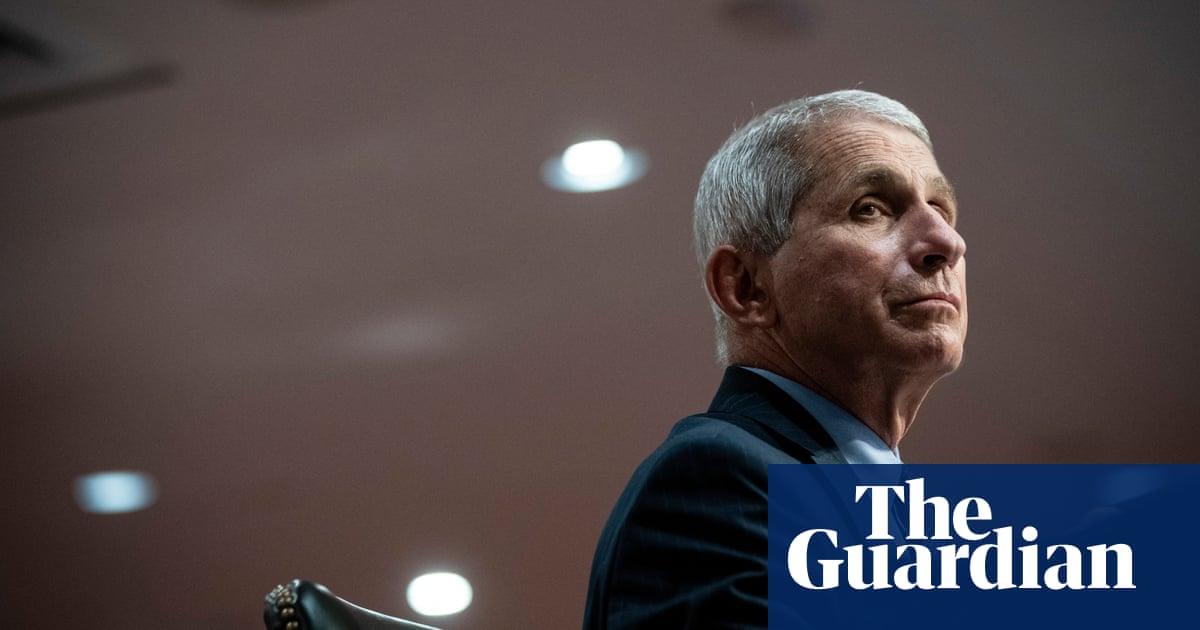
On the morning of 9 November, as the world awoke to the game-changing news that Pfizer’s coronavirus vaccine was more than 90% effective, Anthony Fauci sat for a triumphant 9am press conference. But he was not there to discuss Covid-19.
As head of the National Institute of Allergy and Infectious Diseases (NIAID) for 36 years, Fauci had been a major force behind a trial that had just proved that a long-acting injectable drug, cabotegravir, was highly effective at preventing women from contracting HIV.
“I wanted the world to see that with all due respect to the extraordinary stress and strain that we’re going through with Covid, HIV is still a very important disease,” Fauci told the Guardian.
In an interview to mark his 80th birthday on 24 December and the HIV epidemic’s official 40-year mark in the coming year, Fauci reflected on the fight that, likely unknown to much of the public, has dominated exactly half his life.
“My career and my identity has really been defined by HIV,” said Fauci, who oversees a $1.8bn HIV budget at NIAID and is a leader of the global HIV research response. “Because I’ve been in a very unique position of now being one of the very, very few people who were there from the very first day of HIV.”
Jennifer Kates, director of global health and HIV policy at Kaiser Family Foundation, said: “Tony is the lodestar of HIV. And now of Covid.”
Along with more than a dozen other HIV leaders interviewed about Fauci, she praised his talent for communicating arcane science to the masses.
“What people are seeing of him in the context of Covid,” she said, “is what he has been and continues to be for HIV.”
The crisis years
In the 1970s, a thirtysomething Fauci, armed with dual training in immunology and infectious disease, rose quickly to prominence at NIAID, a division of the National Institutes of Health (NIH) in Bethesda, Maryland.
“In a combination of a great mentor who put me on a great project, and luck, add some talent,” he recalled, with a modest chuckle, “we developed therapies for diseases that were formally fatal diseases that all of a sudden now had a 93% to 95% remission, if not cure.”
Thanks in particular to developing an effective treatment for an often fatal auto-inflammatory disease of the blood vessels called vasculitis, Fauci was showered with accolades, handed plum posts, and earned the gratitude of many patients whose lives he saved.

“If he did nothing more in his career, that would be a great career,” said Myron Cohen, a professor of medicine at the University of North Carolina who in partnership with NIAID led the landmark study that in 2011 was the first to prove that antiretroviral treatment for HIV prevents transmission of the virus.
But Fauci’s life changed forever in the early summer of 1981, when the Centers for Disease Control and Prevention (CDC) issued the first ominous reports on what became known as Aids.
“I said, ‘Holy mackerel! This is gonna explode into something that we haven’t seen,’” Fauci recalled of his prescient outlook regarding the emerging clusters of gay men suffering often fatal cases of Pneumocystis pneumonia and a rare cancer, Kaposi sarcoma. Fauci soon presumed, correctly, that these diseases were driven by a sexually transmitted virus that struck the immune system. And he knew he had the ideal training to tackle the burgeoning crisis.
To the shock and dismay of his mentors, he abandoned his fruitful career path and went all-in studying Aids and caring for people with the condition.
In a 2016 interview, Fauci said the 15 years it then took researchers, many working in partnership with the NIH, to develop highly effective treatments for HIV “were the dark years of my life and my career, because almost every single one of my patients died. And that was a terrible feeling.”
H Clifford Lane, Fauci’s longtime top clinical director at NIAID, noted: “There are so many ways in which the experience of going through HIV/Aids has helped prepare him for what he’s dealing with now. Brand-new disease, no treatment, no cure.”
Fauci was just 43 when, in 1984, he was offered the top job at NIAID. He accepted on the condition that he could continue his laboratory research and clinical practice. Fiercely motivated by the deaths among his patients, Fauci, he said, “lobbied like a sonofabitch for resources” until, by the early 90s, 10% of the NIH budget was devoted to Aids.
Over time, Fauci established multiple HIV clinical trial networks. This year, as Pfizer and Moderna whisked their Covid-19 vaccines to emergency approval in part through those very channels, such work proved invaluable.
Activism – and its discontents
By the late 1980s, another force of nature changed Fauci’s life and career. As chronicled by David France in his Oscar-nominated documentary How to Survive a Plague, and the book of the same title, Aids activists used increasingly aggressive tactics as they pushed Fauci and the medical research establishment into establishing more humane and equitable treatment protocols.
“He quickly realized that it was more important to bring the activists in than to have them on the outside banging at the doors,” said Gregg Gonsalves, a veteran of the HIV activist group Act Up and a Yale epidemiologist. “It was politically astute, but it was also tactically useful.”
By the early 1990s, what began as a fiercely adversarial relationship between Fauci and the activists had evolved into a working partnership. Lifelong friendships formed.
Fauci would help put into practice the activist brainchild of a “parallel track” system in which people with Aids who could not enroll in clinical trials could nevertheless receive prompt access to experimental treatments deemed safe and potentially efficacious. Activists were eventually allowed into NIH committees and successfully pushed for an increase in the number of women and people of color in HIV clinical trials.

France and Act Up veteran Mark Harrington insist Fauci still deserves harsh criticism for what they characterized as his failure in the 1980s to promptly heed activist calls for NIAID to more aggressively address the opportunistic infections that were killing people with Aids in droves.
“History,” France said, “will recall that he’s a good man and he was a key an indispensable figure in HIV/Aids, but that he made mistakes.”
Now, steady improvements in the care and treatment of people with HIV have expanded life expectancy of newly diagnosed 21-year-olds from an additional 12 years in the late 1980s to 56 years today.
Asked in 2016 how pivotal the NIH had been in addressing the global HIV epidemic, Fauci said NIAID in particular “has been the major force in the development of drugs, in work toward the vaccine, in understanding the pathogenesis and the development of prevention modalities.”
“And, of course, we’ve had all those innovations at a pace far faster than for any other medical condition, because his urgency matches his rigor,” said Jared Baeten, who leads the HIV treatment and prevention arm of Gilead Sciences, and who led a major study funded by the NIH (including NIAID) that proved that a monthly antiretroviral-infused vaginal ring mitigates HIV risk among women.
Larry Corey, a leading producer of vaccines, including for HIV and SARS-CoV-2, at the Fred Hutchinson Cancer Research Center in Seattle, praised Fauci as “the ultimate point guard” of infectious disease research.
“He is the Michael Jordan of our field,” he said.
George W Bush called on Fauci to establish what became known as the President’s Emergency Plan for Aids Relief, or Pepfar, which launched in 2004 and spends more than $5bn annually providing life-saving HIV care and treatment to developing nations. To date it has saved some 20 million lives.
“Regardless of what happens with Covid,” Fauci said, “I think my involvement in the development of the Pepfar program probably will loom as large or larger than anything else I’ve ever done.”
Uncommon friendship
During the Covid-19 crisis, Fauci’s longtime friendship with prominent HIV activist Peter Staley has deepened, providing comfort and counsel in a time of extraordinary stress.
Staley and other activist friends have been deeply concerned about the toll that the Covid-19 pandemic has taken on Fauci. During the early days of the crisis, the NIAID head suffered from physical and mental exhaustion, as well as insomnia, from working so hard. Staley said this baffled his typically resilient friend. Not that Staley feels he always has to use kid gloves with Fauci.
“The unusual thing about our friendship is that I don’t think he has a lot of friends that are so tough with him,” Staley said. “I tell him often that I think he has faults; I tell him how they play out; and I tell him that they infuriate me. And to his credit he seems to really appreciate it.”
“He monitors me,” Fauci said fondly, praising Staley as “a good radar screen”.

Chief among Staley’s concerns is that Fauci is a “control freak”– which, the activist said, makes the NIAID chief a “miserable manager” who lacks savvy at delegating. Referring to Fauci’s complicated relationship with Donald Trump, Staley said: “Initially they were buddy-buddy. They bonded over their New York City roots and love of sports. That all fell apart over time.”
Staley further said that Fauci can be open-hearted to a fault and that particularly in dealing with the current president, this left him compromised by naïveté.
Fauci’s friend has provided political counsel throughout 2020 on, in Staley’s words, “navigating all these horrifying personalities at the White House”. Staley said Fauci’s wife of 35 years, top NIH bioethicist Christine Grady, provides similar advice.
“Chris and I have come in time and time again, setting off alarm bells,” Staley said of the pair’s interventions where Fauci’s dealings with the Trump administration are concerned.
Another friend recently spoke to Fauci about a future in which he has indeed been instrumental in vanquishing Covid-19.
“What’s left for you to do?” the friend asked.
Referring to HIV, Fauci replied: “The one thing that I still have left that I want to do is put an end to this epidemic.”
Speaking to the Guardian, Fauci said he did not want to retire until that day comes, preferably thanks to an HIV vaccine. Should he then finally transition to his emeritus years, he said, he longs to write a memoir.
“No one has ever had the situation of being an adviser to seven different presidents,” he said. “So that is something that I really want to get down in a way that younger people might benefit from the experience that I chronicle.”
Then he stated the abundantly obvious: “I’ve just been so damn busy, I haven’t had a chance to do it.”







