

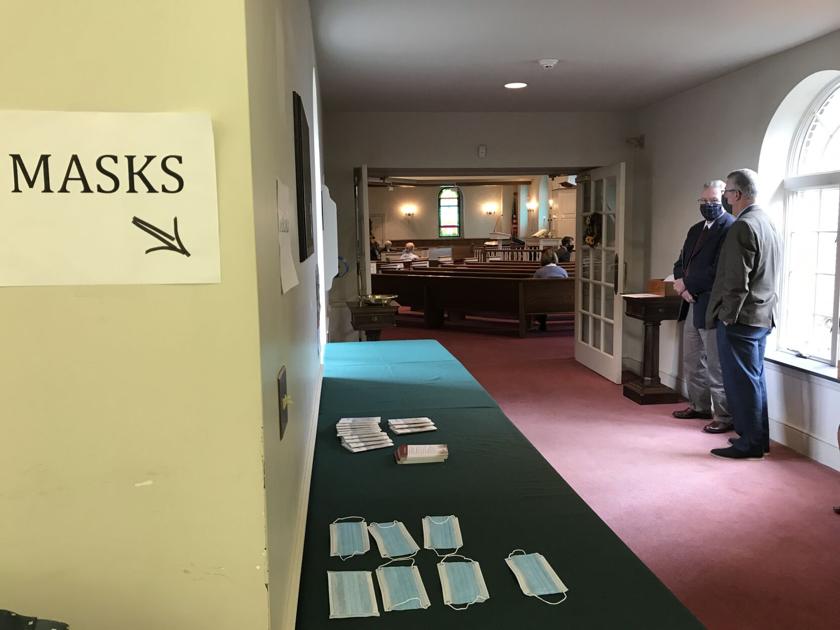
As COVID-19 cases in Lancaster County surged unabated into December, a number of church leaders persisted with in-person gatherings — some publicizing mask-less services — despite public health warnings.
While Pennsylvania health officials have put limits on gatherings, required masks and imposed 14-day quarantines on travelers to stem the rapid spread of COVID-19, church leaders have straddled the fine line between shepherding those in their flock who scoff at the mitigation strategies and the vulnerable who need protection.
State health department limits on gatherings have never applied to houses of worship. Instead, Gov. Tom Wolf has relied on religious leaders to voluntarily “embrace alternative forms of worship.”
Many Lancaster County churches have done this — to varying degrees — while others have created separate services to cater to parishioners less concerned with mask wearing.
“Unfortunately, it’s become more of a political statement,” the Rev. Chris Rankin, pastor of Trinity United Church of Christ in East Petersburg Borough, said of face masks.
Rankin has been holding abbreviated, in-person services that require congregants to wear face masks. Most, however, participate virtually, Rankin said.
While some churches are opting for online holiday services, Rankin intends to hold an in-person Christmas Eve service. The Catholic Diocese of Harrisburg, which covers 15 counties including Lancaster, too, will offer in-person Masses for Christmas.
“It’s just so that people can have a little bit of a normal Christmas,” Rankin said.
‘A no-win situation’
At least two churches that once offered mask-less services — St. Stephen Reformed Church and LCBC — recently announced changes to their in-person worship services. Both had promoted mask-optional services where congregants could remove face coverings once they were seated.
“I think what we’re doing is trying to serve our congregation and maintain the balance between freedom of worship and recognizing choices,” the Rev. Timothy Witmer, who pastors St. Stephen in New Holland, said, noting masks are “a no-win situation.”
Three days later, Witmer told LNP | LancasterOnline that the church had revised its mitigation protocols and now requires masks at both services.
David Ashcraft, a senior pastor for one of the county’s largest congregations, Manheim-based LCBC, declined to speak with LNP | LancasterOnline. But in a Dec. 11 email to members, Ashcraft said in a video that the mega-church would suspend in-person services from Dec. 12 through mid-January.
“Like many of you, pausing our in-person gathering isn’t our preference, but we do believe it’s the right response in this moment as we focus on others and caring for our community,” Ashcraft said.
‘Fool’s test’

Rev. Melvin Baber, field education coordinator for Lancaster Theological Seminary and pastor of Friendship Baptist Church in York.
Very early in the pandemic health officials knew that the novel coronavirus thrives through close contact.
Citing a March outbreak at a rural Arkansas church that infected more than a third of the attendees and killed three, the Centers for Disease Control and Prevention has said faith-based organizations should modify activities in the pandemic.
“I believe as a faith community we have an obligation to be the leaders,” said the Rev. Melvin Baber, who is the field education coordinator for Lancaster Theological Seminary.
Baber, who also pastors Friendship Baptist Church in York, added, “Why put God to the fool’s test?”
Baber’s church has held virtual-only services since Dec. 1.
Certain religious activities such as singing can facilitate airborne transmission of the virus, heightening concerns about in-person gatherings.
Dozens of outbreaks across the United States, including CityReach Philly in Philadelphia, have been linked to religious gatherings. More than 50 people, for example, developed COVID-19 after a choir practice hospitalized three and killed two in Washington, and one of the first major outbreaks in Seoul, South Korea, was traced back to a church.
It’s unknown whether a Lancaster County church service is associated with any COVID-19 clusters.
The Pennsylvania Department of Health does not collect data on church outbreaks.
All of the religious leaders with whom LNP | LancasterOnline spoke said they have not had any COVID-19 cases associated with a service.

‘Different reasons’
Rachel Weaver was raised in church. Although the pandemic has led her to cancel “lots of plans,” including a trip to Disney, the way Weaver sees it, church isn’t something to skip.
“As long as I have the freedom to go, I will,” said the Strasburg Borough mother of four.
“I don’t think the church should ever close their doors to people who want to come.”
While Weaver is confident she can attend church without fear of spreading or catching the virus, a Barna Group survey this summer found roughly one in three practicing Christians in the United States have stopped attending services during the pandemic.
Not all who long to attend in-person services do so because of a misguided belief the virus is no more serious than the flu.

Rev. Carrie Call, conference minister for the Penn Central Conference United Church of Christ.
“The elderly want to meet in person,” said the Rev. Carrie Call, conference minister for the Penn Central Conference United Church of Christ. “It’s not because they’re anti-maskers. It’s because they don’t know how to do the technology. There’s different reasons for why people want to meet in person.”
Roughly 85% of United Church of Christ congregations in the 19 counties Call serves — which include Lancaster, Harrisburg, Adams and York counties — are observing state COVID-19 guidance and have moved online. Those that haven’t are mostly small, rural churches with limited internet access, Call said.

‘It’s not the same’
The overwhelming majority of Americans believe houses of worship should be required to follow public health guidance, according to a recent Pew Research Center survey.
Roughly 60% of church regular goers, though, expressed less support for the common mitigation strategies urged by health officials: social distancing (51%), masks (41%) and attendance restrictions (41%).
While the religious leaders with whom LNP | LancasterOnline spoke were largely supportive of the U.S. Supreme Court decision last month siding with religious organizations in a dispute over COVID-19 restrictions, most framed the public health argument for masking, social distancing and frequent handwashing in terms of concern for their neighbor.
“It’s not the same,” said Jack Paskoff, senior rabbi at Congregation Shaarai Shomayim. “Just because we can’t do everything doesn’t mean we can’t have something. So, how do we make that something meaningful?”
Congregation Shaarai Shomayim has met virtually since April, celebrating holidays, including Hanukkah, via Zoom.
“They want to be together and we’re finding ways to make that happen,” Paskoff said.







