

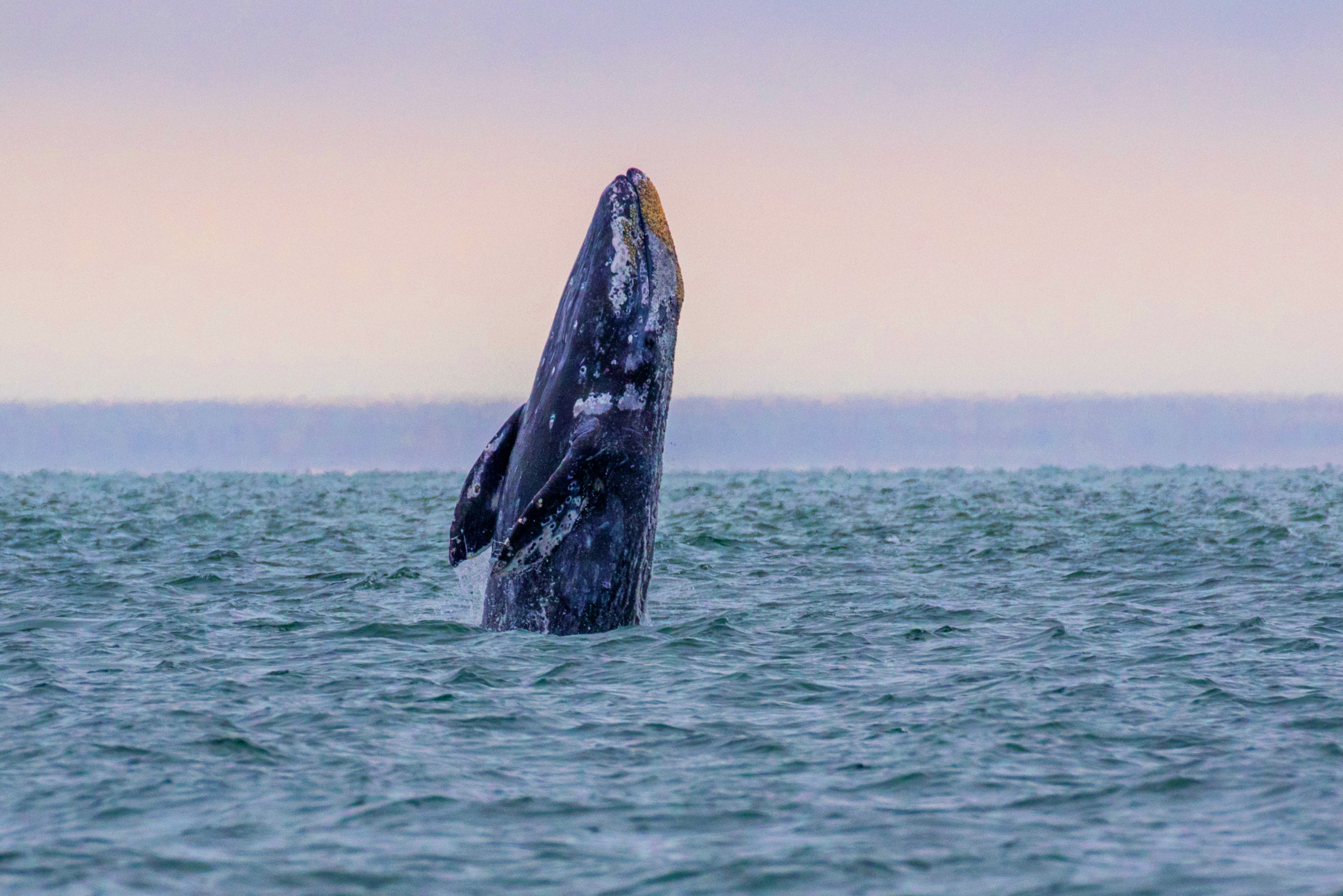
NEWPORT, Ore. (KTVZ) – Poop samples are an effective, non-invasive tool for monitoring gray whale reproduction, stress and other physiological responses, a new study from Oregon State University shows.
Researchers from OSU’s Geospatial Ecology of Marine Megafauna Laboratory collected 158 fecal, commonly known as poop, samples from Eastern North Pacific gray whales off the coast of Oregon between 2016 and 2018 and used the samples to assess endocrine levels and establish hormone baselines for stress and reproduction in the animals.
The study is believed to be the first to use fecal samples as an endocrine assessment tool in Eastern North Pacific gray whales. Fecal samples can provide a wide range of important information about whale health in a noninvasive way, said Leigh Torres, an associate professor in OSU’s Marine Mammal Institute and director of the GEMM Lab.
“Understanding whale physiology is really important to evaluate how human, activities impact whales,” Torres said. “But it is really, really hard to study whale physiology. You can’t observe most physiological responses. And you can’t just ask a whale: Are you stressed out? So we have to get creative.”
The findings were published this month in the journal Conservation Physiology. The paper’s lead author is Leila Soledade Lemos, who recently completed her doctorate in Oregon State’s Department of Fisheries and Wildlife and worked with Torres in the GEMM Lab. Lemos is now a postdoctoral associate at Florida International University.
Most gray whales migrate from breeding grounds in Mexico to feeding grounds in the Bering and Chukchi seas between Alaska and Russia, where they spend the summer. Torres and her team study a distinct population of gray whales known as the Pacific Coast Feeding Group, which spend the summer months feeding in coastal waters of Oregon, as well as northern California, Washington and southern Canada.
Torres and her research team have been observing and conducting annual “health check-ups” on this population since 2016. When they spot a defecating whale from a boat or via a drone, they follow in the animal’s wake and use nets to capture samples. The drones are also used to capture images of the whales, allowing researchers to monitor the animals’ body condition and behavior.
Researchers used the collected fecal samples to analyze four hormone metabolites: two reproductive hormones; a stress hormone; and thyroid, which can indicate nutrition-related stress.
With this data, the researchers were able to see how hormones fluctuated with a whale’s age and sex and establish baseline hormone levels for different cycles of a whale’s life, including during pregnancy.
“This was a first step to understanding how hormones vary through a whale’s life cycle and in times of stress,” Lemos said. “It helps us establish baselines and ranges of hormone levels.”
The researchers also were able to document a stressful event in a specific whale. They collected a fecal sample from a whale within 24 hours of a documented injury from a propeller or vessel strike. The fecal sample collected after the injury showed a spike in stress hormone levels, almost three times higher than this whale’s stress levels on previous days without the injury.
The researchers also captured a fecal sample from a mature male who was engaged in competitive reproductive behavior with another male whale. That whale’s testosterone level was very high and may reflect the typical hormone levels of adult breeding males. The researchers’ ability to connect fecal samples to specific individual whales adds important context to the data to help understand what drives hormone variation, Torres said.
Researchers have continued to collect fecal samples over the last two summers and will continue to analyze hormones as part of their broader work on whale health.
The researchers’ ultimate goal is to understand how variations in human-generated ocean noise impacts whale health, Torres said. Analysis of fecal samples is emerging as an important new tool for understanding how different stressors impact whale physiology. They also hope to use the endocrine information to better understand the role of nutrition and changes in diet on overall whale health.
“Our ability to link hormone variation to an individual’s condition is really a significant advance for the study of whale physiology,” Torres said. “All of our future work on impacts of disturbance events will build on this foundation. It’s super exciting to be able to use these tools to think about whale life in a holistic way.”
The research was supported in part by NOAA’s National Marine Fisheries Service Office of Science and Technology Ocean Acoustics Program; Oregon Sea Grant; and the OSU Marine Mammal Institute. Lemos received funding from Brazil’s Science Without Borders Program and its National Council for Scientific and Technological Development (CNPq).
Additional co-authors include Todd Chandler of Oregon State; Kathleen Hunt of the Smithsonian-Mason School of Conservation; and Amy Olsen, Angela Smith and Shawn Larson of the Seattle Aquarium.







