

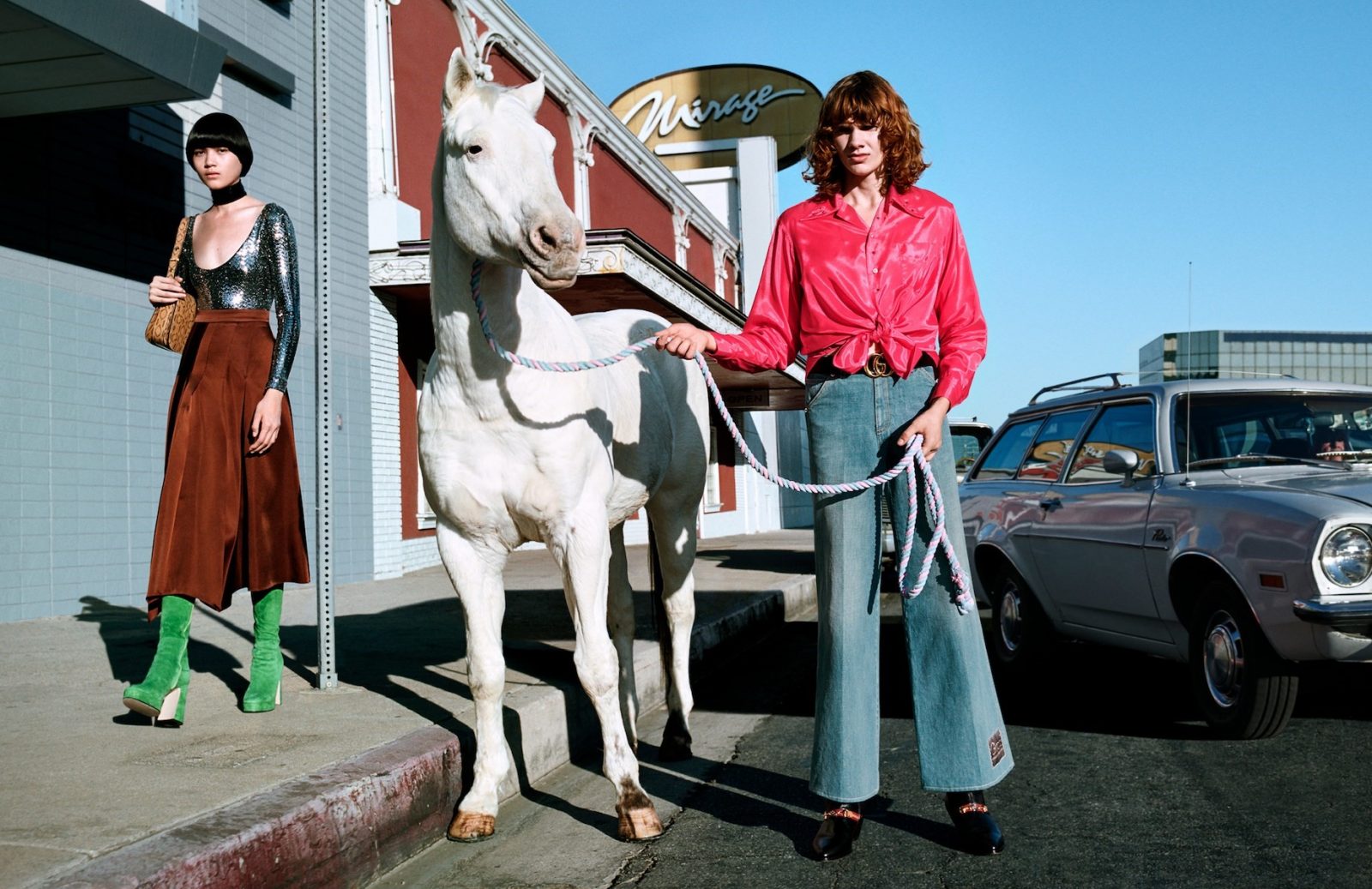
Gucci is launching not one but two flagship stores on Alibaba’s online luxury shopping platform, the Kering-owned brand and the Chinese e-commerce titan announced on Friday. The first of the two e-shops, which will give Chinese consumers access to the Italian fashion company’s coveted ready-to-wear and accessories offerings, is slated to formally open on Monday, followed by a second, beauty goods-centric web outpost to follow in February 2021 under the watch of Gucci beauty licensee Coty, Inc. According to a number of media reports, the debut of Kering’s marquee brand on Alibaba signals that “Alibaba’s struggle for legitimacy in the luxury world has now been fully realized.”
The Gucci-Alibaba tie-up news “underscores the importance of the Chinese market for high-end brands seeking to reverse a revenue slide due to the coronavirus pandemic,” Reuters reported on Friday, pointing to the fact that Chinese customers “represented around 35 percent of luxury goods purchases before the pandemic,” and are on track to account for a nearly half of all personal luxury goods sales by 2025, according to Bain & Co.’s estimations.
But beyond being a very-clear-indicator of where brands are focusing their energy post-pandemic, and where Alibaba currently stands in the often-rigid luxury fashion ecosystem, the newly-announced partnership is striking in that it comes just a few years after the back-to-back lawsuits that Gucci’s parent company Kering filed against Alibaba, accusing the Hangzhou, China-headquartered internet goliath of knowingly and actively enabling counterfeiters to sell their products on its sweeping platforms, and thereby, directly profiting from the sale of counterfeit goods.
Kering v. Alibaba x 2
The respective giants’ legal squabble got its start in July 2014 when Kering filed a headline-making lawsuit against Alibaba in a New York federal court, accusing the American arm of the Jack Ma-founded online group of being complicit in the sale of fake handbags, watches and other items on its marketplace sites in a manner that it said constituted “racketeering.” In addition to providing a marketplace for the sale of fakes, Alibaba was in the business of “selling keywords to counterfeiters that include the names of Kering brands, allowing the merchants to attract more customers to buy fake goods that bear the brands,” Kering alleged, the Wall Street Journal reported at the time.
Alibaba and Kering managed to settle the suit out of court in August 2014, with Alibaba insisting that it was enforcing a “zero tolerance policy” towards fakes, and agreeing to team up with Kering in an effort to keep counterfeit versions of the Paris-based luxury goods group’s brands’ offerings off its platforms.
The settlement did not last long, and less than a year later, Kering filed suit again. In the subsequently-filed lawsuit in May 2015, Kering argued that Alibaba was not holding up its end of the bargain, and again claimed that Alibaba “knowingly encourage[d], assist[ed], and profit[ed] from the sale of counterfeits on their online platforms … [and] made it possible for an army of counterfeiters to sell their illegal wares throughout the world.”
Alibaba denied the merit of Kering’s case from the outset (and vowed not the settle), arguing that it maintained a “strong track record” of helping brands fight counterfeits. “Unfortunately, Kering Group has chosen the path of wasteful litigation instead of the path of constructive cooperation. We believe this complaint has no basis and we will fight it vigorously,” an Alibaba spokesman said when Kering initiated the second suit.
Kering and Alibaba again settled their differences out of court, but this time, the settlement came after U.S. District Judge Kevin Castel of the U.S. District Court for the Southern District of New York dismissed Kering’s racketeering claims. Reflecting on the August 2017 settlement, which saw the two companies establish a joint task force with “the purpose of collaborating fully, exchanging useful information, and working closely with law enforcement bodies to take appropriate action against infringers of Kering’s brands identified with Alibaba’s advanced technology capabilities,” a representative for Kering called it “a milestone in both parties’ investment and efforts to protect brands’ intellectual property rights.”
Winning Over Luxury Brands
The migration of luxury and high fashion names onto Alibaba’s platform is noteworthy given the group’s public struggle with the sale of counterfeit goods on its various sites. Since the settlement of the Kering cases, Alibaba has found favor among a growing number of brand owners, luring no small number of luxury entities to list on its 3-year old Tmall-specific Luxury Pavilion – with the likes of Valentino and Versace, Burberry, Givenchy, Stella McCartney, and Chanel Beauty using the platform to reach high-spending Chinese consumers.
This is likely due, at least in part, to the fact that Alibaba has been widely regarded as making significant strides in recent years when it comes to intellectual property enforcement, which has likely alleviated some resistance by brands to partner with the Chinese behemoth.
In the midst of the Kering lawsuits, for instance, which coincided with Alibaba’s TaoBao platform repeatedly being named in the U.S. Trade Representative’s annual “Special 301” report, the global state of intellectual property rights and spotlights “bad actors” in the space, the group revealed that it had begun tightening controls on the sales of luxury goods, in particular, on its sites – from requiring sellers to show proof of authenticity for the products they list to engaging in what it called “productive and results-oriented relationships with brands, governments, and all industry partners.”
More recently, the group announced the launch of “a proprietary and patented suite of technologies such as artificial intelligence, cloud computing and block chain, to enhance the proactive monitoring of potential infringing activities on its platforms,” with such big data and artificial intelligence capabilities leading to “continued success” in the fight against fakes, according to Alibaba’s 2020 Intellectual Property Rights Report.
At the same time, in late 2015, the group enlisted former Apple director of Global Intellectual Property Enforcement, Matthew Bassiur to “advance [its] anti-counterfeiting and intellectual property rights protection efforts.” After four years on the job, Bassiur told TFL in 2019 that “no expense is being spared when it comes to putting the right technology in place,” and setting up dedicated teams to police Alibaba’s platforms for fakes.
Still yet, Bassiur pointed to increased levels of collaboration with external stakeholders, including by way of its Alibaba Anti-Counterfeiting Alliance, a group that was formed in 2017 to enable Alibaba to partner with brands, such as adidas, Burberry, Canada Goose, Estee Lauder, L’Oreal, Louis Vuitton, Luxottica, Ralph Lauren, and Valentino, among others, to combat counterfeits.
While the results of Alibaba’s IP-specific efforts are regularly touted in its annual reports (i.e., “96 percent of proactively removed listings were eliminated before a single sale took place” in 2019, and “there was a 57 percent year-over-year decrease in the number of listings removed in response to consumer reports of suspected counterfeits”), they are also seemingly being reflected in the big-name brands that Alibaba has been able to enlist for its Tmall platform. And Kering-owned Gucci is, of course, a striking example, having gone from back-to-back litigations to Alibaba’s newest luxury partner.
But beyond its resource-intensive efforts to clean up its sites, Alibaba likely has something else to thank for its ability to lure brands to its site, as well: its willingness to concede control to the brands, themselves, to dictate everything from the pricing to the marketing of their products on the Luxury Pavilion site.
Speaking about the Luxury Pavilion site this fall, Christina Fontana, who heads luxury and fashion for Tmall in the U.S. and Europe, said that the platform “is really unique worldwide because it is the only place and the only platform I know of where brands have 100 percent control over everything: They pick the price. They pick the merchandising strategy. They pick the communication strategy.”
More than giving brands like Gucci the ability to dictate the consumer experience on its luxury-specific site – which is notably separate from Alibaba’s more mainstream TaoBao marketplace and which Alibaba says is complete with a “rich set of technologies to create the look, feel and experience they want their consumers to have,” which is a critical element for image-conscious luxury brands, and one that is actively allowing Alibaba to make strides in the luxury space that would have been otherwise unimaginable just five years ago.
It will be interesting to see if Amazon follows suit with its own, recently-launched luxury venture.






![Southeast Asia Meat Product Market Expected To Surpass $117,259.2 Million by 2026 – Exclusive Report [176 Pages] by Research Dive](https://globalresearchsyndicate.com/wp-content/uploads/2020/10/855391-75x75.)
