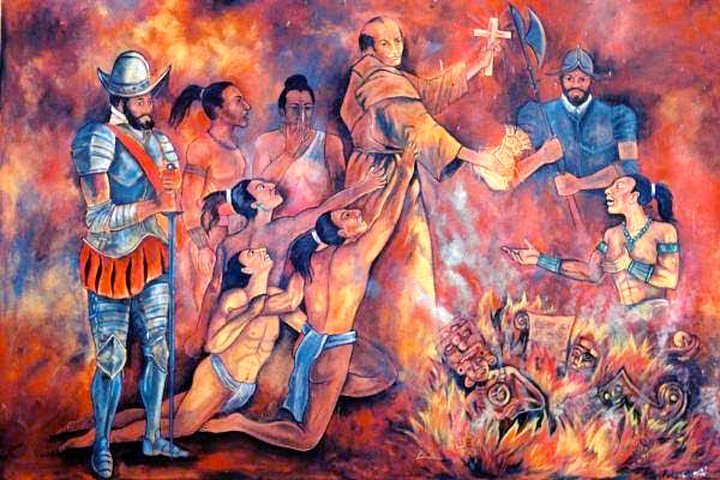
We found a large number of books in these
characters and, as they contained nothing in which were not to be
seen as superstition and lies of the devil, we burned them all, which
the Maya regretted to an amazing degree, and which caused them much
affliction.
— Diego de Landa Calderón
###
At sunrise on July 12,
1562, the Maya people of what is now Mexico’s Yucatán
peninsula possessed an extensive cultural history in the
form of dozens — perhaps hundreds — of handwritten books. By
nightfall, virtually all that heritage was gone, devoured in the
flames of an auto–da–fé ritual supervised
by Franciscan friar Diego de Landa Calderón. By his own account, 27
books, or codices, were burned, although historians suspect his claim
is a vast underestimate. All that are left today are three Mayan
codices, with perhaps parts of a fourth (historians debate its
authenticity), which somehow escaped Landa’s fanaticism.
No one, as far as we
know, died that day. No massacre, no torture (although Landa was
known to have used torture extensively, particularly on Mayan
nobility), no physical abuse. Just the books, and thousands of
figurines, died. But, because each of these was unique in its own
way, whole chapters in the history of a people were lost. Much of
what we do know about the Maya comes from the remaining
codices, such as the “Dresden Codex,” the oldest book we have
from the Americas, dating back to approximately 1200 AD (300 years
before the Spanish conquest). Like the other two (or three) surviving
Mayan codices, it’s written on amate, the inner bark of the
wild fig tree, and is folded, accordion-style. Opened out, it’s
about 12 feet long, 8 inches high, written on both sides. Only
recently fully deciphered, it consists of astronomical data
(particularly of the planet Venus, which the Mayans associated with
warfare) and a listing of ceremonial events.
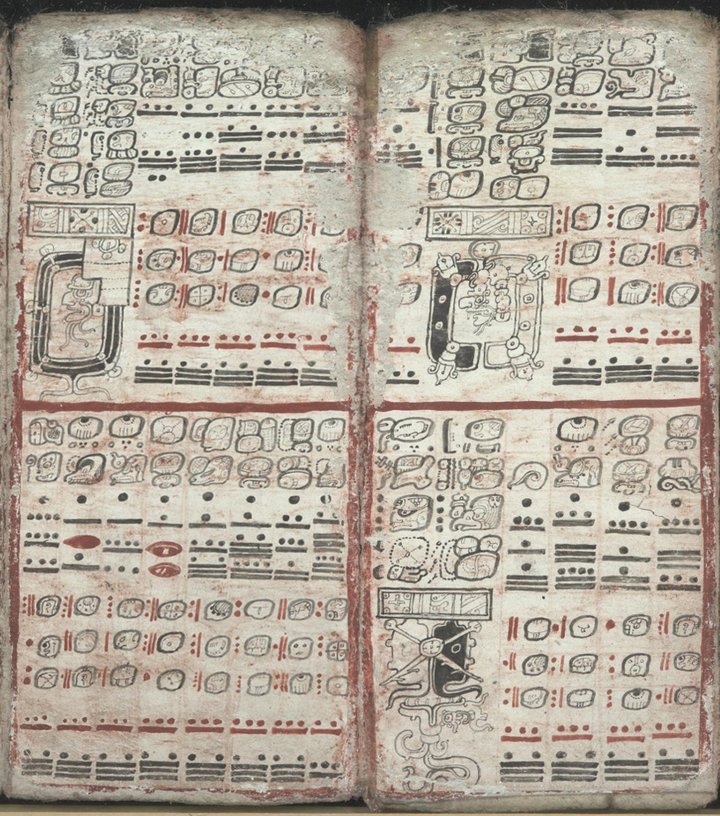
Two pages (of 78 in total) from the Dresden Codex, recording lunar eclipses. (Wikimedia)
So why did Landa pursue
his crusade against what he perceived as idolatry — he also burned
thousands of cult images — with such vehemence? According to
historians who study the era, he thought — in common with most other
Franciscans of the time — that the Second Coming was nigh (perhaps at
the turn of the century), and it was his duty to save as many souls
as possible. Which, of course, meant eliminating what he saw as pagan
practices and cult worship. Hence the destruction of books containing
“nothing in which were not seen and superstition and lies of the
devil.”
The Maya were the most
advanced people of the New World. In addition to writing, they built
hundreds of stone temples, pyramids and palaces. Their irrigation
works were as sophisticated as any in the Old World. Their
calendar was astonishingly precise, starting with a
creation date of August 11, 3114 BC, cycling every 18,980 days (i.e.
about a lifetime, 52 years). Their astronomical records allowed them
to figure out the synodic period of Venus as 584 days — it’s
actually about 583.92. And their civilization lasted for over 1,000
years. If you’re interested, I wrote about theories of their demise
here.
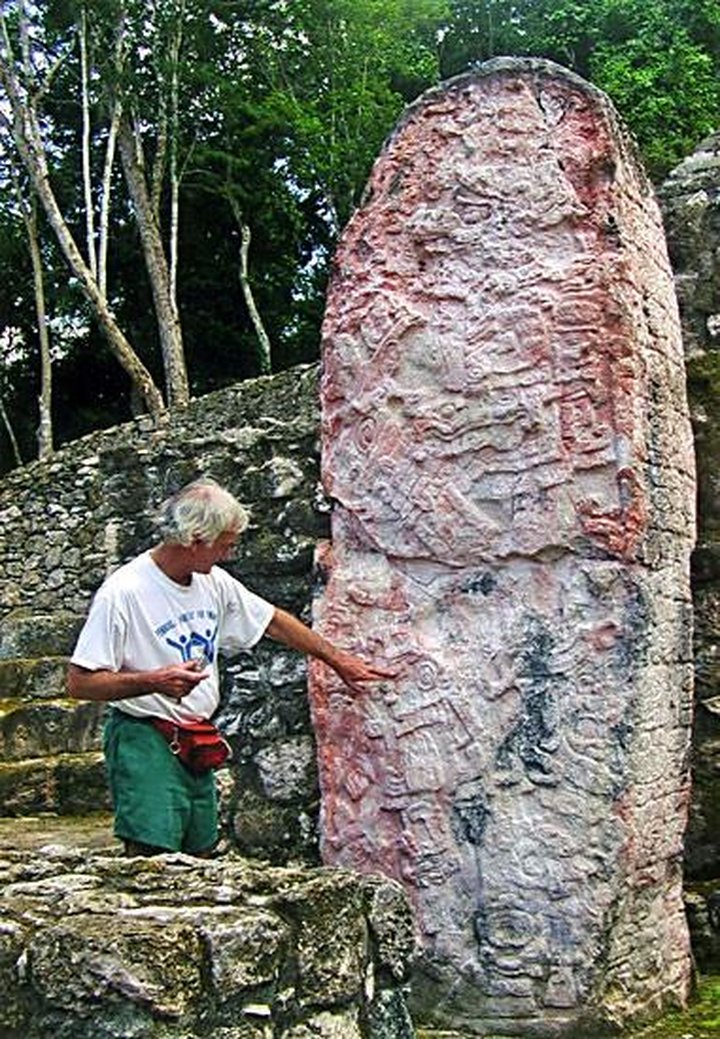
Author at Calakmul in the south of Mexico’s Yucatán peninsula, pretending to understand the glyphs on a 1200-year-old stela.
Ironically, we have to
thank Landa for preserving much of our knowledge about the Maya
people who lived at the same time as his 16th century Yucatán
crusade. Landa had two Mayan scribes show him how to read
their hieroglyphics (kind of — a Soviet linguist showed in the 1950s
that many of his conclusions were inaccurate) and his account of
pre-conquest Mayan social organization has been invaluable to future
historians. Still, for me, and apparently for the contemporary
descendants of the Mayan people (judging by this mural in Mérida’s
Governor’s Palace), Landa was and always will be an asshole.