

the District 65 School Board meeting on Nov. 16, Stacy Beardsley, Assistant
Superintendent of Curriculum and Instruction, summarized the results of a
survey of parents and teachers taken between Oct. 15 and 30.
Dr.
Beardsley said, “The goal ultimately was to understand the quality of learning
of our remote learning for the fall implementation, and to compare that back to
the spring implementation.”
She
said the survey was conducted entirely online and “so we would see an upward
bias in the results. … We do need to understand that there’s most likely an
upward bias in these results due to connectivity, and we’re getting input from
people that are currently engaged in our remote learning.”
Respondents and Demographics
A
total of 3,578 parents responded to the survey in English, and 213 in Spanish;
435 teachers responded.
Kylie
Klein, Director of Research, Accountability and Data, told the RoundTable that 58% of the parents who
responded were white, 18% Black, 15% Hispanic, 7% Asian, 9% multi-racial, and
the balance were other racial or ethnic groups or preferring not to provide
their race/ethnicity.
The
parents who responded were distributed across the K-8 grade levels. As expected,
there was a lower percentage of respondents who had students in the District’s
pre-K program.
Parents
Responses
Across
the board, parents gave higher marks to the remote learning program this fall
than to the program last spring. For simplicity sake, this article will
summarize parents’ views of the remote learning program for this fall, and
include some comparisons to the program last spring.
A
high percentage of parents said they “agreed” or “strongly agreed” with the
statements that “My child or I knows what school work they are expected to
complete each day/week (76%); “My child’s teacher is responsive to my/my
child’s questions about their school work” (86%); and “My child’s teachers care
about my child” (80%). Most of the parents who did not either agree or strongly
agree with these statement, fell into the “somewhat agree” category.
Parents
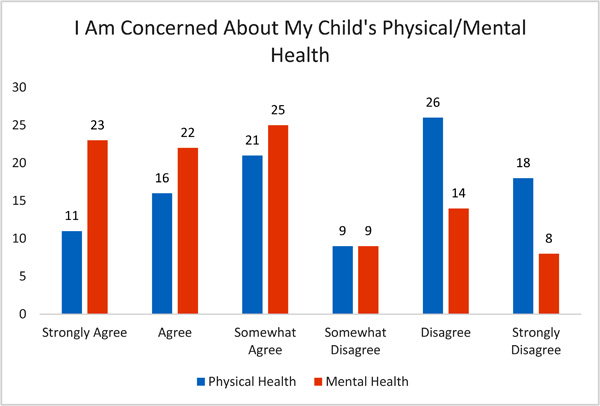
were more concerned about their child’s mental health and well-being than their
physical health. The chart below reflects the responses to the following questions:
“I am concerned with my child’s physical health,” and, “I am concerned with my
child’s mental health and well-being (e.g. stress).”

Dr.
Beardsley said, parents “continue to communicate that physical health is a
concern, a slight increase from the spring. And similarly, families continue to
communicate that their child’s mental health and well-being is also a concern,
up slightly from the spring.”
Before
school started many parents expressed concern about how they would be able to
provide support for their children during remote learning and at the same time
manage to do the work required for their employment. The survey did not ask
questions about parents’ ability to serve these two functions, the time they
are spending each day to do so, or their stress levels.
The
survey did ask parents to comment on the statement, “My child often requires
assistance from an adult or older sibling to complete their school work.” The
chart below provides their responses.

Dr. Beardsley said, “We do note that there
continues to be a need for support. Yet, we also note that families are
reporting a slight decline in the percent of parents agreeing and strongly
agreeing with the statement,” than in the spring survey. She said this may suggest
that students may becoming more self-sufficient. She said, the data also shows
this “has remained a challenge for many families.”
Parents
were also asked to respond to the statement, “I feel like my child is falling
behind academically.” The responses were pretty equally divided between the three
levels of agreement and the three levels of disagreement. The chart below shows
the responses.

“This
is also an area clearly that is a concern for us as a District and why we are
spending considerable time and resources really trying to focus on the quality
of remote learning, including these surveys and learning from these surveys to
inform professional learning and the supports that we put in place,” said Dr.
Beardsley.
One
question asked parents to rate their child’s overall remote learning experience:
48% of the parents rates their experience good or very good; 31% were neutral;
and 20% said it was bad or very bad. The chart below shows the responses.

Dr.
Beardsley said, “What I want to call out is that overall, families reported
that their remote learning experience is improved [compared to the spring
survey].
“We
see this as a real, as a testimony to the good work that our educators and our
school leaders are doing to support learning and families.”
Teachers’ Responses
High
percentages of teachers agreed or strongly agreed with the following statements:
“I have the technological supports to access adequate grade level learning for
my students” (63%); “I am confident that I can provide rigorous distance
instruction” (63%); “I am confident that my students can complete the work that
is being assigned during this period” (60%); and “My school leaders have been
helpful in resolving challenges related to distance learning” (65%).
The
majority of the remaining responses to the above questions fell into the
“somewhat agree” category.
Dr.
Beardsley said the District has increased learning expectations and teachers “have
elevated their demand for the types of things that they need to be able to deliver
learning well.” She saw the responses to the above questions as a sign that the
District has been able to meet the increased expectations.
Dr.
Beardsley added that the responses suggest “an increased level of confidence
among our educators in this environment.”
Many
teachers did not respond to questions about the math or reading curriculum, and
that the percentages provided in the survey report did not reflect the
percentage of those who responded. Dr. Beardsley said, though, there has been a
lot of positive feedback about the math curriculum and the actual teaching resources.
She said concerns have been raised about Eureka’s online tools and added “the
company has actually released several rounds of updates and continues to meet
with us regularly; and they are providing dates for the next wave of
deliverables as we continue to improve the quality of the online delivery of
Eureka math curriculum.
“For
the reading resources, we did purchase additional videos and [reading
materials] for kindergarten through fifth grade,” said Dr. Beardsley. The
feedback on Lowe’s is positive, yet educators are still showing a desire for
stronger reading curricular resources. The feedback also indicated that part of
this is the desire and need for access for additional books to support students
reading and literacy instruction.” She said this is being addressed by the
library department and the literacy department.
High
percentages of teachers expressed concern for their physical health and for
their mental health and well-being. The chart below shows teachers’ responses
to the statements: “I am concerned about my physical health,” and “I am
concerned with my mental health and well-being (e.g. stress).”

Teachers
were asked one important question about student engagement: “On average, what
percentage of your students complete their primary assignments during a given
week?” The responses indicate that about 50% of the students are getting 75% of
their primary assignments in. Conversely, 50% are not.

Dr.
Beardsley said, “Our educators are seeing a significantly high level of
engagement in this particular slide and engagement, we see 48% of our educators
saying that over 75% of their students are completing all of their primary
assignments in class work.
“Now,
that does tell us that we still absolutely have a group that we need to still
fully engage. But we see a significantly higher level of engagement, while
we’ve also significantly increased the learning demand for our students.
“And
we see that as being a really positive indicator for our remote learning, while
also weighing that we clearly need to continue to negotiate physical health,
mental health and well-being, as we were negotiating both remote learning and
our future for on-site learning,” when it is safe to return to on-site
learning.
Some Comments
Board
member Biz Lindsay-Ryan said, “I think my primary concerns are about the
population we’re not hearing from, that are not responding to these surveys,
that are not engaging in class.” She asked what strategies the District was
using to reach out to students who are not successful and to engage them.
Dr.
Beardsley said teachers have been preparing more remote learning engagement
plans for students. Each plan has goals and a specific outreach plan for a
particular student.
She
added that school building leadership has been strong in trying to connect with
families and to determine what might be interfering with a student’s access to
learning. The suspension of the District’s remote learning in camps and other
spaces has limited some opportunities to engage students, she said.
Dr.
Beardsley added that the District has a student engagement coordinator, Brian
Harris, who is focused through a grant to focus on six schools. If a teacher
and a school engagement team have done everything possible to engage a student,
then the next step would be to reach out to him. Dr. Beardsley said Mr. Harris
has done some home visits, practicing social distancing guidelines.
Andalib
Khelghati, Assistant Superintendent of Schools, said the District has been talking
about how to forge ways in which extra steps can be taken to support some students,
noting, “There are realities where our families are facing really difficult
situations that pale in terms of what we could have ever imagined.”
Board
member Rebeca Mendoza emphasized, “I think it’s so important that we hear from
all of our families.”







