

Every backyard gardener knows how hard it can be to tell when to water the plants. Multiply that by tens or hundreds of acres and it’s easy to see the challenges growers face keeping their crops healthy while managing water resources wisely.
To determine water needs accurately, growers hand-pluck individual leaves from plants, put them in pressure chambers, and apply air pressure to see when water begins to leak from the leaf stems. That kind of testing is time consuming and means growers can only reach so many areas of a field each day and cannot test as frequently as needed to accurately determine optimal irrigation scheduling patterns.
A group of researchers from UC Riverside and UC Merced have received a grant for more than $1 million from the U.S. Department of Agriculture through the National Science Foundation’s National Robotics Initiative to address these challenges. From UC Riverside are Assistant Professor Konstantinos Karydis and Professor Amit K. Roy-Chowdhury, both from the Department of Electrical and Computer Engineering. UC Merced, which leads the effort, is represented by Stefano Carpin, professor of computer science; and Joshua Viers, professor of environmental engineering.
As part of the project, the group is developing a robotic pressure chamber that can autonomously sample leaves and immediately test them on site to provide the freshest data. The system will work to gather data even in large fields, and over a period of time, rather than just providing a snapshot.
Frequently updated data can help growers better plan irrigation schedules to conserve water, optimize the time and effort spent by crop specialists tasked with determining and analyzing lead water potential, and help decrease some of the costs in the food-production chain.
Current measuring techniques involve collecting leaf samples and transporting them to an off-site location, where testers can use very accurate, expensive pressure chambers; or sampling and analyzing leaf samples in the field using hand-held pressure chambers.
“In the first category, leaf samples can get mixed up, making it impossible to track them back to the specific areas of the field they came from, Karydis said. “In addition, the properties of the leaf might vary given the time elapsed between being sampled and being analyzed, which in turn may yield misleading results.”
Hand-held instruments in the field can be less accurate, but testing can be done multiple times with different leaves from the same plants. This method is time- and labor-intensive, and must be undertaken by specially trained personnel.
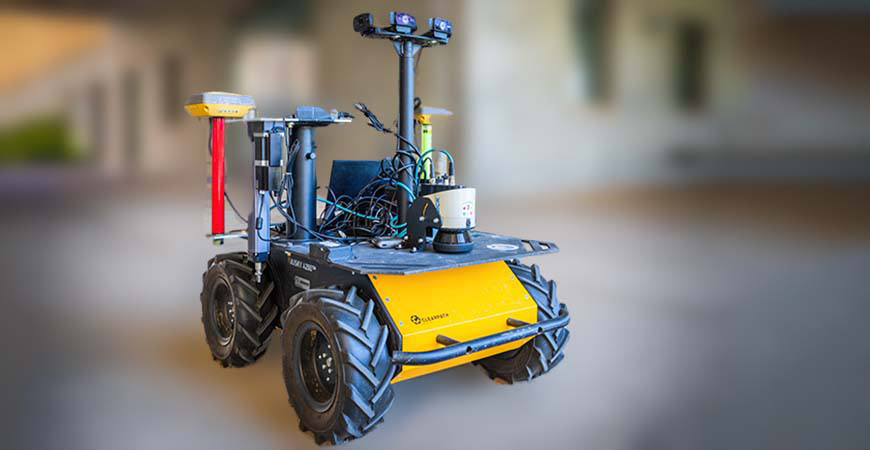
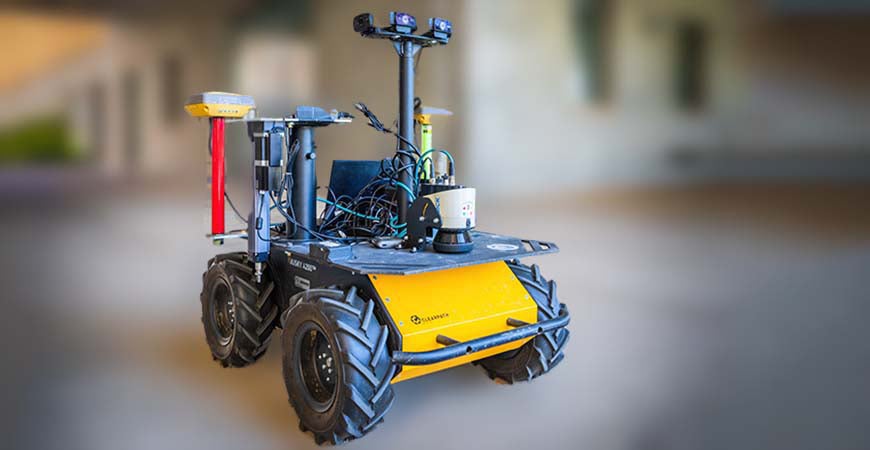
Carpin has already worked with colleagues at UC Davis and UC Berkeley to create the Robot-Assisted Precision Irrigation Delivery, or RAPID, system, which travels along rows of crops adjusting irrigation flows according to sensor data that tells the robot precisely what’s needed for each plant.
The project will use the same mobile base robot as in RAPID but equip it with a custom-made robotic leaf sampler and pressure chamber being designed by the researchers at UC Riverside, and pair it with drones that can survey the fields and direct the robot to areas of interest.
“Using this process, growers could survey plants all day long, even in large fields,” Carpin said.
The four-year project will support graduate students as well as summer research opportunities for undergraduates. The project has four phases: development of the chamber; developing machine vision so the robot can “see” the water coming from the leaf stems; coordinating multiple robots — in the air and on the ground; and evaluation.
The researchers plan to have the first set of automated pressure chamber prototypes fabricated by spring 2021, and to evaluate their performance and refine designs in controlled settings over spring and summer 2021. They expect to have a completed setup by winter 2022, so they can begin controlled field testing.
“We have to be quick about it because if we miss a peak growing season, we have to wait another nine months for the next one,” Carpin said. “We’d like to be able to start testing next summer and test every summer, and we need to be able to maximize the tests.”
When all of the components have been designed, the designs and code will be made open source, and all the data collected during the project will be made available to the scientific community, the researchers wrote in their proposal.
The project came about after Carpin and Viers, director of the Center for Information Technology Research in the Interest of Society, or CITRIS, at UC Merced, had been talking with area farmers about the challenges of growing almonds and grapes. Karydis and Roy-Chowdhury had been hearing the same challenges from citrus and avocado growers in the Riverside area, so the four partnered up.
“California agriculture presents a challenge in terms of scalability,” Carpin said. “But this an exciting collaboration because we’ll get to develop a system that will work on different kinds of crops.”







