

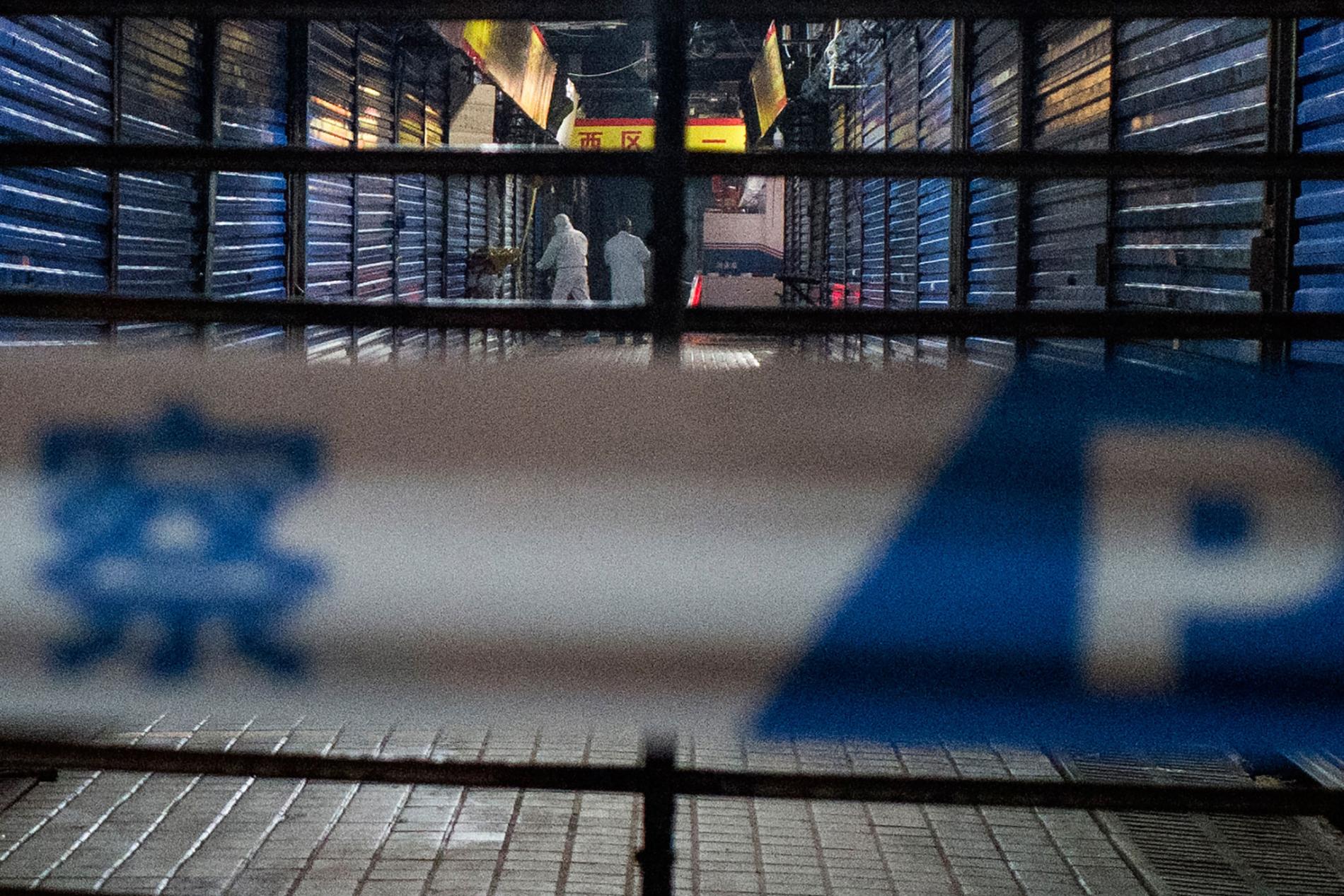
Ten months have passed since health officials cited Wuhan’s Huanan Seafood Wholesale Market as ground zero for the COVID-19 pandemic—and a global debate over how the pandemic began has existed for nearly as long. But the public may soon learn answers as the World Health Organization embarks on the final stages of a search for the coronavirus’s origins.
During an October 23 news conference, Michael Ryan, the WHO Health Emergencies Programme executive director, said Chinese scientists have already begun early studies for the two-phase investigation. Based on what those experts find, the WHO will then deploy an international team in China to collaborate with many of the country’s top scientists in tracing COVID-19’s roots. A week later, WHO director-general Tedros Adhanom Ghebreyesus said a group of international experts had held a first virtual meeting with their Chinese counterparts, before pledging the WHO’s full support for the process. And on November 5, the WHO quietly released details on its mission with China, which it describes as a global study of the origins of SARS-CoV-2.
The months-long delay in starting this investigation has raised criticism from public health researchers and world leaders, such as U.S. President Donald Trump, who have accused the WHO of being too deferential to China’s wishes. During the first phase of the search, a WHO team won’t be present for the on-the-ground surveys and will only review and discuss data collected by Chinese researchers. Some reports have described this arrangement as the WHO ceding responsibility, given the organization is sponsored by individual nations and China is its second-biggest funder after the United States.
But disease detectives who have worked on similar hunts say this is business as usual. The WHO lacks the staffing—with 7,000 employees spread across 150 countries—to conduct a full-scale investigation on its own and always relies on national teams or international volunteers for field work.
“If you go in with a mindset of whose fault is it, your view is different than if you go in wondering why did it spread and what can we learn,” says Sian Griffiths, who co-chaired the Hong Kong government’s inquiry into the SARS epidemic in 2003. She stresses the need for objectivity in such a process: “Frankly, looking back and blaming is not very relevant.”
In 2003, a WHO team arrived in China nearly three months after the initial case of the SARS coronavirus outbreak and was still able to identify the animal source within weeks. Such pinpointing is possible long after the emergence of diseases thanks to genetic tracing, which has only become more advanced since then. That experience, and other past investigations, can reveal what the public should expect from this latest virus hunting effort.
The hunt for the host
WHO’s Ryan said that planning actually began in February, though the scope of the final mission coalesced in July, when a two-person WHO team completed a three-week preliminary assignment: “We’ve been working with all parties to put together the necessary studies to better understand the origins of this virus.” The project will include epidemiological studies of COVID-19 cases, biologic and genetic analyses, and animal health research.
WHO spokesperson Margaret Harris says this research into the pandemic’s origins couldn’t have begun sooner because the organization’s early COVID-19 missions in China had to put priority on dealing with the virus’s effects on the human population.
At the time, nothing took precedence over “how to treat it medically, what factors are helping it spread, what strategies are working to try to stop transmission,” Harris says. “We needed to learn very quickly what this virus was and what were the best ways to prevent illness and death.” Meanwhile, months of genetics research has already concluded that the pandemic started with what’s known as a zoonotic spillover, an event in which a germ passes from an animal to humans.
Determining how this unfortunate leap occurred can now be accomplished by using epidemiology and genetics to trace “patient zero,” says Linfa Wang, a biologist and the director of the Programme in Emerging Infectious Diseases at Duke-NUS Medical School in Singapore. Wang is known colloquially as “The Batman,” thanks to his pioneering research during SARS in 2003. The WHO recruited Wang during that mission to follow the thread from humans, and he traced the virus to an intermediate host called a civet cat and then to bats.
For COVID-19, the most crucial piece of this enterprise would involve testing biological samples—such as blood—that are routinely collected and stored at hospitals. Researchers would study samples from both before and after the coronavirus outbreak was publicly declared in late December 2019. Ideally, this retrospective survey would extend throughout China and into neighboring countries.
“I would test banked human blood samples for antibodies to find out how long SARS-CoV-2 has been circulating in the human community and where it has been circulating,” says Ian Lipkin, the director of Columbia University’s Center for Infection and Immunity, whose team used this tactic to trace the MERS coronavirus to camels in the Middle East. (MERS emerged in 2012. It is a cousin of the novel SARS-CoV-2 coronavirus and the original SARS).
This testing will help build an early COVID-19 timeline. Christine Johnson, an epidemiologist at UC Davis says among the key questions would be: “What behaviors and occupations did people have that were initially exposed or infected? Were people more likely to have interacted with certain animal species, or traveled to specific locations?”
Researchers need to assess travel history and animal contact, Wang says, to identify which activities put people more at risk of infection. The surveys collect samples of blood, urine, and feces from animals such as bats, pangolins, civet cats, or any other mammal found in markets, animal trade and supply chains, on farms, and in wild habitats. Then, scientists can deploy routine measures for detecting infections. This includes polymerase chain reaction (PCR) tests, for spotting the virus’s genetic signature, and antibody tests, which detect blood proteins that defend the body from viruses, indicating exposure. Some specimens would also be taken back to the lab to see if viable virus can be grown, a sign of a contagious infection.
China’s ability to perform this research shouldn’t be underestimated, especially during COVID-19, says Wang. “The scientific investment and infrastructure there today is vastly different from what it was in 2003, and the Chinese scientists are capable of doing anything the international team can think of,” he says. For instance, today’s next-generation genetic sequencing speeds up the process.
Raina MacIntyre, an infectious diseases expert and professor at the University of New South Wales in Australia, says Chinese scientists have already done significant research on the potential animal origins of the SARS-CoV-2 virus. China and other countries have contributed genetic sequences of the coronavirus collected from humans to a database for tracking the germ’s evolution. By comparing entries, multiple research groups have reached the conclusion that the novel coronavirus “has probably come from bats, perhaps through an intermediary animal host,” MacIntyre says.
The multitude of SARS-esque viruses that horseshoe bats retain make them a prime suspect in the current pandemic’s origins. And those nocturnal cave dwellers are not only found in China but in the bordering countries of Myanmar, Laos, and Vietnam. “We need a WHO-sponsored international collaborative network, like the one we had in 2003, and we need to seriously consider investigations beyond China,” Wang says.
How solving this medical mystery saved lives
What do milk, sheep, and vaccines have in common? Louis Pasteur. Learn how he helped prove to the world that germs cause disease and usher in an unprecedented era of medical breakthroughs.
While uninitiated onlookers might anticipate plot twists akin to Outbreak, Contagion, and other pandemic-themed blockbusters, in reality, most of the work involves Powerpoint presentations and spreadsheets.
“To be absolutely frank, missions like this are more for knowledge and idea exchange than for ‘wet science’ field work,” says Wang. By that, he means the international experts involved review data findings, share information, brainstorm, and collaborate.
The field work leading up to a WHO mission can be done by Chinese scientists that have all the required knowledge, funding, and tools, Wang says. What’s more it’s not uncommon for governments to limit outsiders in pandemic investigations. “I don’t imagine that the U.S. would invite Chinese scientists in to collect and analyze samples,” Lipkin says.
And during the 2003 search for the SARS host in China, Wang recalls how a “prior agreement was required for a specific agenda and itinerary of any WHO mission before the team could enter the nation.”
Too little, too late, still mysterious?
Some experts fear the WHO’s new project won’t find anything useful because it has been nearly a year since COVID-19 emerged. Yanzhong Huang, a senior fellow for global health at the Council on Foreign Relations, worries that key samples or evidence may have been lost, noting it’s been reported that the Huanan market was doused in disinfectants before scientists investigated the site.
But disease detective Daniel Lucey says there are indications China has already completed considerable legwork.
“Of course they would have done that,” says Lucey, who works at Georgetown University, because “it’s in China’s national interest to do an investigation as quickly as possible, for the sake of public health.”
Lucey points to China’s tracking of the first confirmed pandemic patient to November 17, 2019. Then there was a January investigation conducted by 29 Chinese researchers across a medley of institutions that examined how many early COVID-19 patients could be linked to the Wuhan wet market. Their results indicated that 14 of 41 early cases weren’t exposed there.
Still, some mystery remains around the initial surveys at ground zero. The Chinese Center for Disease Control and Prevention said in late January that it had collected nearly 600 samples at the market, and Wuhan Institute of Virology virologist Shi Zhengli made public statements this past summer about testing samples from the ground, sewage, and door handles at the market.
But new details from the WHO mission plan say nearly 1,200 specimens were collected from the Wuhan market, which had 653 sellers peddling items ranging from seafood and chipmunks to giant salamanders and sika deer. Yet, of the 336 animals sampled at the market, none tested positive for SARS-CoV-2. By contrast, 8 percent of the environmental swabs—many involving drains and sewage—carried the virus.
“As such, it remains unclear whether the market was a contamination source, acted as an amplifier for human-to-human transmission, or a combination of those factors,” the report authors write. The report also points to a springtime survey that found 14 percent of domestic and stray cats in Wuhan tested positive for the virus. In The Netherlands, the coronavirus has plagued mink farms, and these furry mammals are also widely raised in China.
Why would environmental samples test positive while the animals test negative? In January, Lipkin of Columbia University visited China to lend his expertise, which included a meeting with George Gao, chief of the Chinese CDC. Gao said at the time that the Huanan seafood market had been cleaned and its animals removed prior to sample collection, Lipkin recalled in an email correspondence with National Geographic.
“This prevents collection of blood that could be used to test for antibodies that would persist even if virus was no longer present,” Lipkin says. “Antibody tests have an edge thanks to their ability to detect evidence of exposure regardless of if the virus has been cleared.”
He adds that even though the search might begin in Wuhan, it will very likely expand throughout Hubei Province, and he “would not be surprised if we learned that it has been in humans before the Wuhan outbreak was detected in 2019.”
Wang places another goal above all. He says the key is for Chinese scientists and officials to have an open discussion with the WHO team. He adds that investigations into the virus’s origins are so politicized that any talk of such missions now “is symbolic until the politics are resolved.”
The best step, Wang says, would be “to discuss the origin in a totally non-political environment and with an open mind, recognizing that SARS-CoV-2-related viruses most likely exist in bats outside of China.”







