

GLOBAL RESEARCH SYNDICATE
No Result
View All Result
  • Login
  • Latest News
  • Consumer Research
  • Survey Research
  • Marketing Research
  • Industry Research
  • Data Collection
  • More
    • Data Analysis
    • Market Insights
  • Latest News
  • Consumer Research
  • Survey Research
  • Marketing Research
  • Industry Research
  • Data Collection
  • More
    • Data Analysis
    • Market Insights
No Result
View All Result
globalresearchsyndicate
No Result
View All Result
Home Data Collection

New research on imposter stars may improve astronomical data

globalresearchsyndicate by globalresearchsyndicate
November 5, 2020
in Data Collection
0
New research on imposter stars may improve astronomical data
0
SHARES
1
VIEWS
Share on FacebookShare on Twitter

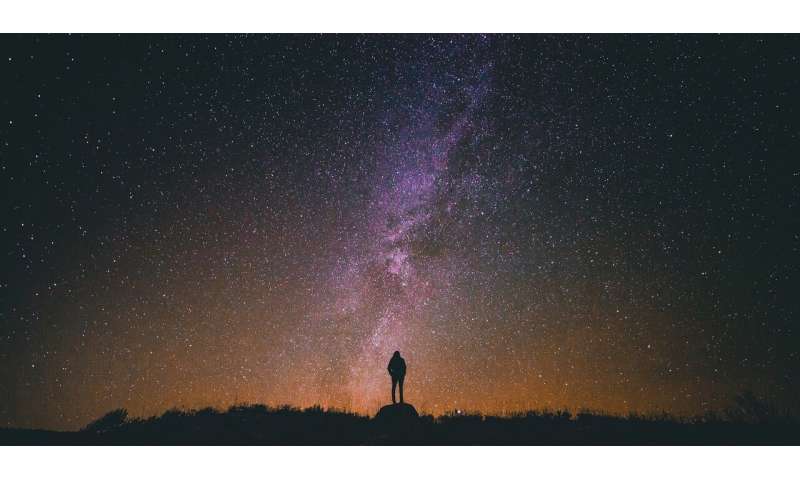
stars
Credit: CC0 Public Domain

Quick flashes of light in the night sky have been linked to the growing mass of satellites and debris zipping around Earth’s orbit.

The orbital flashes, often mistaken for stars, occur 1,000 times an hour, according to new research led by the University of North Carolina at Chapel Hill that may improve the accuracy of astronomical data.

Stargazers have long been tantalized by the inexplicable glimmers and the study published Nov. 5 in The Astrophysical Journal Letters provides a potential explanation for those mysterious flashes.

Most of the flashes require powerful telescopes for viewing, but up to 100 of them are bright enough to see with the naked eye in a suburban community.

“Astronomical surveys have seen occasional reflected light glints from satellites; those flashes can cause false alarms in surveys looking for new events in the sky,” said lead study author Hank Corbett, graduate student at the UNC-Chapel Hill Department of Physics and Astronomy.

“For the first time, we have studied the flashes in a systematic way that will help reduce their impact on astronomical discoveries.”

The team at UNC-Chapel Hill, along with collaborators from San Diego State University and the University of Barcelona, reported more than 100,000 flashes over a six-month period.

The flashes were observed with the Evryscopes, telescopes in California and Chile constructed and funded by the National Science Foundation. The pair of robotic, gigapixel-camera telescopes observe the entire sky above their observatories every two minutes.

“These measurements allow us to predict the impact of reflected-light flashes on both current and future professional observatories and develop techniques to mitigate their effects on data,” Corbett said.

The orbital flashes are reflected not only from the satellites relied on for navigation, communication, weather forecasting, and more, but also from space trash such as dead satellites, paint chips and errant nuts and bolts that has accumulated since space exploration began six decades ago.

These short duration flashes can be indistinguishable from stars in images from professional observatories and are typically visible for only a fraction of a second.

“Millions of stargazers have likely observed these quick glimmers of light in the night sky,” Corbett said. “Reflected-light flashes happen so fast that observers may dismiss them as visual noise, but this research provides a potential explanation for those mysterious flashes.

Rogue reflections from Earth satellites take two forms: short duration flashes that can lead to mistaken astrophysical events and streaks associated with fast-moving or slowly rotating satellites like SpaceX Starlink.

Companies are competing to launch thousands of satellites capable of beaming internet coverage to Earth. However, in the new study, researchers conclude that the upcoming satellite internet constellations, like SpaceX Starlink, are unlikely to contribute significantly to the appearance of flashes, though there are other potential impacts of satellite constellations on astronomers.

Bright streaks caused by sun-illuminated satellites moving across an image are a separate class of events that needs to be studied.


Temperature of lunar flashes measured for the first time


More information:
Astrophysical Journal Letters (2020). DOI: 10.3847/2041-8213/abbee5

Provided by
University of North Carolina at Chapel Hill


Citation:
New research on imposter stars may improve astronomical data (2020, November 5)
retrieved 5 November 2020
from https://phys.org/news/2020-11-imposter-stars-astronomical.html

This document is subject to copyright. Apart from any fair dealing for the purpose of private study or research, no
part may be reproduced without the written permission. The content is provided for information purposes only.


Related Posts

How Machine Learning has impacted Consumer Behaviour and Analysis
Consumer Research

How Machine Learning has impacted Consumer Behaviour and Analysis

January 4, 2024
Market Research The Ultimate Weapon for Business Success
Consumer Research

Market Research: The Ultimate Weapon for Business Success

June 22, 2023
Unveiling the Hidden Power of Market Research A Game Changer
Consumer Research

Unveiling the Hidden Power of Market Research: A Game Changer

June 2, 2023
7 Secrets of Market Research Gurus That Will Blow Your Mind
Consumer Research

7 Secrets of Market Research Gurus That Will Blow Your Mind

May 8, 2023
The Shocking Truth About Market Research Revealed!
Consumer Research

The Shocking Truth About Market Research: Revealed!

April 25, 2023
market research, primary research, secondary research, market research trends, market research news,
Consumer Research

Quantitative vs. Qualitative Research. How to choose the Right Research Method for Your Business Needs

March 14, 2023
Next Post
At 10.7% CAGR, Asia-Pacific ATM Market Projected to Grow $7.9 Billion By 2020

At 10.7% CAGR, Asia-Pacific ATM Market Projected to Grow $7.9 Billion By 2020

Categories

  • Consumer Research
  • Data Analysis
  • Data Collection
  • Industry Research
  • Latest News
  • Market Insights
  • Marketing Research
  • Survey Research
  • Uncategorized

Recent Posts

  • Ipsos Revolutionizes the Global Market Research Landscape
  • How Machine Learning has impacted Consumer Behaviour and Analysis
  • Market Research: The Ultimate Weapon for Business Success
  • Privacy Policy
  • Terms of Use
  • Antispam
  • DMCA

Copyright © 2024 Globalresearchsyndicate.com

Welcome Back!

Login to your account below

Forgotten Password?

Retrieve your password

Please enter your username or email address to reset your password.

Log In
This website uses cookies to improve your experience. We'll assume you're ok with this, but you can opt-out if you wish. Cookie settingsACCEPT
Privacy & Cookies Policy

Privacy Overview

This website uses cookies to improve your experience while you navigate through the website. Out of these cookies, the cookies that are categorized as necessary are stored on your browser as they are essential for the working of basic functionalities of the website. We also use third-party cookies that help us analyze and understand how you use this website. These cookies will be stored in your browser only with your consent. You also have the option to opt-out of these cookies. But opting out of some of these cookies may have an effect on your browsing experience.
Necessary
Always Enabled
Necessary cookies are absolutely essential for the website to function properly. This category only includes cookies that ensures basic functionalities and security features of the website. These cookies do not store any personal information.
Non-necessary
Any cookies that may not be particularly necessary for the website to function and is used specifically to collect user personal data via analytics, ads, other embedded contents are termed as non-necessary cookies. It is mandatory to procure user consent prior to running these cookies on your website.
SAVE & ACCEPT
No Result
View All Result
  • Latest News
  • Consumer Research
  • Survey Research
  • Marketing Research
  • Industry Research
  • Data Collection
  • More
    • Data Analysis
    • Market Insights

Copyright © 2024 Globalresearchsyndicate.com



