

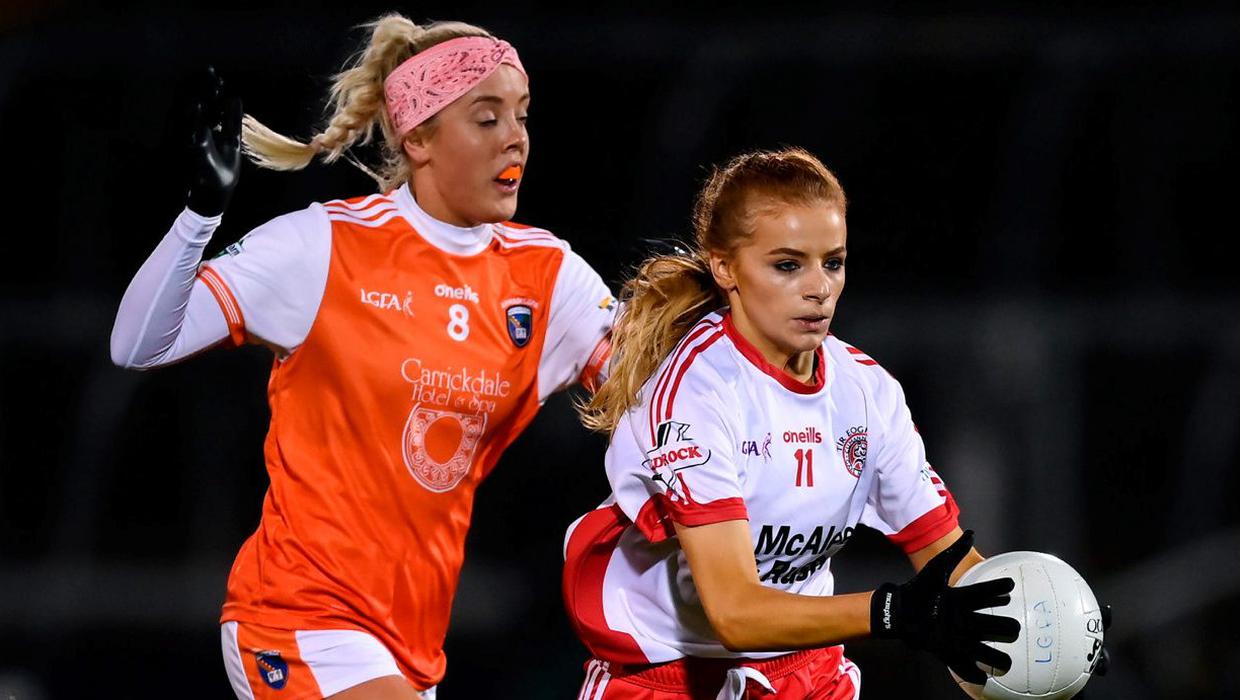
The Women’s Gaelic Players Association’s new report ‘Levelling the Field’ would nearly remind you of that old George Berkeley phrase: if a tree falls in a forest and no one is around to hear it, does it make a sound?
he WGPA survey, which was published this week, shows that the training commitments of female inter-county players is nearly the same as male inter-county players.
Because women’s Gaelic games gets less coverage, funding and support compared to the men’s game, it means there’s a relatively low level of awareness of the commitment they give to our national sport.
So if we see less of the hard work they do, does that mean their commitment doesn’t really exist to the rest of us? That’s ridiculous, of course, but that is the strange kind of vacuum that female inter-county players exist in.
When the 296-page ESRI report ‘Playing Senior Inter-County Games: Experiences, Realities and Consequences’ was published in September 2018, it confirmed anecdotal evidence of what we already knew about the commitment of male inter-county players. A key finding from that wide-ranging survey was that players spend up to 31 hours a week with their county team between travel, prep, collective and individual training.
A second 195-page ESRI report was published in December 2019 which looked at the challenges male players have with balancing career/education with being an inter-county player.
Satisfaction
Chapter six goes through players’ satisfaction levels on issues like expenses, timing of expenses paid, gear, timing of gear provided, inter-county training and gym facilities, satisfaction with their county board, their manager.
There was little that wasn’t covered and the results gave us an even greater understanding and appreciation of what male inter-county players put themselves through.
The 29-page ‘Levelling the Field’ survey also confirmed anecdotal evidence about the women’s game. Such is the staggering inequity between women’s and men’s Gaelic games that it was like the burden of proof was on female inter-county players to show in black and white what they do for ‘our’ national sport and how little support they receive in return.
The WGPA survey was done earlier this year before Covid-19. Over 500 female inter-county players completed the questionnaire and it found that female players spend five to six days a week training.
The report stated: “These statistics paint a similar picture to the time invested by male players, as reported in the most recent ESRI report completed in 2018. Female and male players train on 5.6 v 6.1 days per week for 2.7 and 2.9 hours respectively.”
There’s more: 93 per cent of female inter-county players do NOT get travel expenses and on average they spend €55 a week on fuel travelling to and from training with some players spending as much as €200 per week. This is out of their own pocket.
There’s more: 77 per cent of players pay towards their own physiotherapy, 69 per cent of players pay towards gym fees and 65 per cent of those who take part in marketing and promotional activity do not receive any compensation.
“These findings clearly demonstrate the increasingly unsustainable demands of the female inter-county games,” WGPA chairperson, Maria Kinsella, also said in the report.
So from two very different historical starting points, the commitment shown by female inter-county players has caught up with the men yet their ambition is not being matched by the conditions that are in place to support them.
Male inter-county players get 65 cent per mile for travelling expenses (this has been reduced to 50 cent per mile because of the financial impact of Covid). Only seven per cent of female inter-county players get travelling expenses. Seven per cent!
(Because of restrictions for this championship, the Ladies Gaelic Football Association have agreed to pay towards mileage costs for players. The Camogie Association are set to announce something similar. As it stands, this would be in place for this season only.)
Female inter-county players don’t even get a break with Government funding. Male inter-county players receive over four times more Government funding than female players – €3million compared to €700,000 in 2019. If this disparity between Government funding happened in any other aspect of our society then the Joe Duffy phonelines would be rammed.
Out of that €700,000, every female inter-county team gets a grant of €9,000 with only 20 per cent of that allowed to be spent on facilities. And because the LGFA and Camogie Association don’t have the kind of facilities the GAA have, women’s teams have to rent off the men’s.
So what we see are situations like one particular women’s inter-county Gaelic football team who have had to spend between €11,000-€15,000 a year to rent the GAA centre of excellence in their county. Centres of excellence are like the ultimate GAA private members club: open to boys and men for use, but girls and women have to pay for the privilege of using them.
In the case of this particular senior women’s football team, there have been occasions when they’ve rented a pitch in advance at the centre of excellence but they’ve still been bumped down to another pitch to accommodate a visiting male inter-county team from another county or an U-20s men’s team.
What kind of ‘GAA Family’ is this exactly? How have basic values like respect and equality been lost in an amateur organisation? And imagine how that €11,000-€15,000 could be used for a women’s team instead of paying for the right to use a facility that women and men in the county would have fundraised for. How is this still happening in 2020?
There are some arguments that the way female inter-county players are treated is not a gender issue. It 100 per cent is a gender issue. If you’re a female player you’re a member of the LGFA or Camogie Association which simply cannot be compared to the pulling power, influence and structure of the GAA.
Female players have to dig around for pitches to play on, they have to pay their own travel expenses, gym, physio and how long more will some players be able to afford to play for their county with these costs?
One question that wasn’t asked in the WGPA survey was if there should be full integration between the GAA, LGFA and Camogie Association. How long has that drum been banged for and yet it’s the current female players who’re the ones losing out with the expectation that they perform above the sub-standard conditions they have to train in. While the plan is to lobby the Government to increase funding to achieve a more equitable balance with the men, the WGPA’s Gemma Begley believes an answer is in a One County – like One Club – model where county boards work together and facilities are shared.
“That’s achievable in the short-term quicker than full integration (with the GAA). It would cover double-headers, joint sponsors, shared resources, shared facilities, shared gyms,” Begley said. “That’s just one simple solution whereby counties could be shown a way to work together, without having to be reconstituted, if you like.”
Women have traditionally played an invaluable support act to the GAA. They did administration jobs, washed jerseys, made sandwiches, fundraised and provided support at home.
Women no longer just fill those roles in our national sport and that needs to be recognised by the GAA with easier access, for a start, to facilities especially during these times. The GAA simply wouldn’t be what it is today without the support of generations of Irish women.
The association needs to return that support to the current and future generations of female players.







