

Background
Influenza vaccination during pregnancy prevents influenza among women and their infants
but remains underused among pregnant women. We aimed to quantify the risk of antenatal
influenza and examine its association with perinatal outcomes.
Methods
We did a prospective cohort study in pregnant women in India, Peru, and Thailand.
Before the 2017 and 2018 influenza seasons, we enrolled pregnant women aged 18 years
or older with expected delivery dates 8 weeks or more after the season started. We
contacted women twice weekly until the end of pregnancy to identify illnesses with
symptoms of myalgia, cough, runny nose or nasal congestion, sore throat, or difficulty
breathing and collected mid-turbinate nasal swabs from symptomatic women for influenza
real-time RT-PCR testing. We assessed the association of antenatal influenza with
preterm birth, late pregnancy loss (≥13 weeks gestation), small for gestational age
(SGA), and birthweight of term singleton infants using Cox proportional hazards models
or generalised linear models to adjust for potential confounders.
Findings
Between March 13, 2017, and Aug 3, 2018, we enrolled 11 277 women with a median age
of 26 years (IQR 23–31) and gestational age of 19 weeks (14–24). 1474 (13%) received
influenza vaccines. 310 participants (3%) had influenza (270 [87%] influenza A and
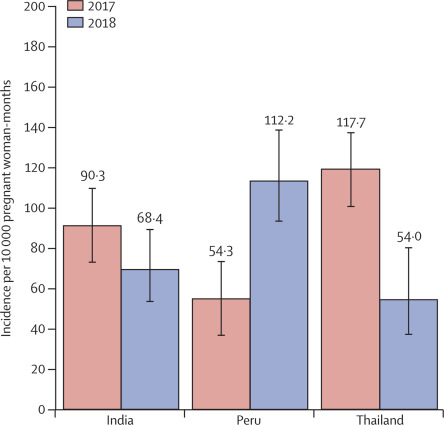
40 [13%] influenza B). Influenza incidences weighted by the population of women of
childbearing age in each study country were 88·7 per 10 000 pregnant woman-months
(95% CI 68·6 to 114·8) during the 2017 season and 69·6 per 10 000 pregnant woman-months
(53·8 to 90·2) during the 2018 season. Antenatal influenza was not associated with
preterm birth (adjusted hazard ratio [aHR] 1·4, 95% CI 0·9 to 2·0; p=0·096) or having
an SGA infant (adjusted relative risk 1·0, 95% CI 0·8 to 1·3, p=0·97), but was associated
with late pregnancy loss (aHR 10·7, 95% CI 4·3 to 27·0; p<0·0001) and reduction in
mean birthweight of term, singleton infants (−55·3 g, 95% CI −109·3 to −1·4; p=0·0445).
Interpretation
Women had a 0·7–0·9% risk of influenza per month of pregnancy during the influenza
season, and antenatal influenza was associated with increased risk for some adverse
pregnancy outcomes. These findings support the added value of antenatal influenza
vaccination to improve perinatal outcomes.
Funding
US Centers for Disease Control and Prevention.
Translations
For the Thai, Hindi, Marathi and Spanish translations of the abstract see Supplementary
Materials section.







