

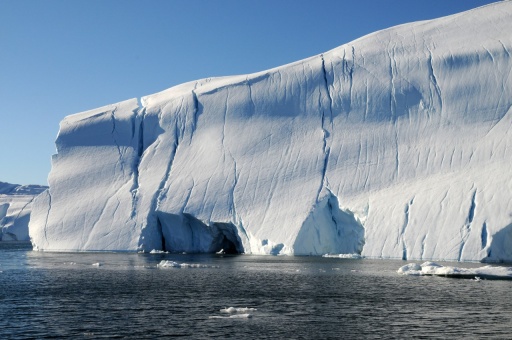
BUFFALO, N.Y. — Ice loss from the Greenland Ice Sheet has accelerated significantly over the past two decades, transforming the shape of the ice sheet edge and therefore coastal Greenland, according to a study published Oct. 27 in the American Geophysical Union’s Journal of Geophysical Research: Earth Surface.
The changes to the ice sheet could have far-reaching impacts on ecosystems and communities, as the flow of water under the ice sheet, as well as nutrient and sediment flow, are altered, scientists say.
University at Buffalo geology researchers Beata Csatho and Ivan Parmuzin were co-authors of the study, which was led by Twila Moon, PhD, deputy lead scientist of the National Snow and Ice Data Center.
“The speed of ice loss in Greenland is stunning,” Moon says. “We can now see many signs of a transformed landscape from space. And as the ice sheet edge responds to rapid ice loss, the character and behavior of the system as a whole is changing, with the potential to influence ecosystems and people who depend on them.”
“The paper’s methodology and results could help improve our understanding of the physical processes controlling ice sheet mass loss, ultimately leading to more accurate ice sheet models,” says Csatho, PhD, professor and chair of geology in the UB College of Arts and Sciences. “This study is an important step toward understanding the complexity of ice sheet changes in a regional scale. Previous studies using multiple observational techniques mostly focused on single glaciers or entire ice sheets. The intermediate scale — the ability to examine a system of neighboring outlet glaciers — informs us about potential reorganizations of ice flow that impact ice loss in a warming climate.
The team compiled data from NASA, the U.S. Geological Survey and other sources from 1985 to 2015 to compare ice edge position, ice sheet surface elevation, and glacier flow over three decades. Advancements in satellite technology allowed them to observe the changes to the ice sheet in much greater detail than was possible in the past.
Much of the data used was from the NASA Inter-mission Time Series of Land Ice Velocity and Elevation (ITS_LIVE) project, which facilitates ice sheet, ice shelf and glacier research by providing a global record of land ice velocity and elevation derived from nearly three decades of satellite observations. The research incorporated data acquired by NASA’s Program for Arctic Regional Climate Assessment (PARCA); Operation IceBridge; and Ice, Cloud and land Elevation Satellite (ICESat). Csatho was involved in all three NASA missions, completing field work for PARCA and serving on the science team for Operation IceBridge and ICESat.
The most consistent trend, found across the entire ice sheet, is widespread ice edge retreat. While there is a range of behavior among glaciers across the ice sheet, there is a noticeable lack of sustained ocean-connected glacier advance. Out of 225 ocean-connected glaciers that were measured, none have substantially advanced, while 200 have retreated, particularly since 2000. This is notable even in regions dominated by slower-moving glaciers and cooler ocean water, such as the northern and northeastern regions of the ice sheet.
In addition, while the vast majority of glaciers are retreating, ice flow response on those glaciers, such as speeding up or slowing down, is affected in large part by topography and upstream factors. This includes the slope of the landscape and the presence and shape of bedrock and sediments underneath the glacier. Therefore, even glaciers within the same regional or local area can behave differently.
As the researchers examined changes in the Greenland Ice Sheet, they found that zones of fast glacier flow are narrowing, ice is being rerouted, and in some cases, the flow of new ice to glaciers is slowed, stranding glaciers in place. These processes could have a variety of downstream impacts, such as altering how water moves under the ice sheet, which could affect the availability of water to communities and animals, altering where nutrients and sediment enter the ocean, exposing new land areas, opening new fjord waters, and altering ecosystems and physical landscapes.
“As the Arctic ocean and atmosphere warm, we can clearly see the flow of ice into the ocean accelerate and the ice edge retreat,” says study co-author Alex Gardner, PhD, a research scientist at NASA’s Jet Propulsion Laboratory. “When we look more closely, however, we can see the complexity of how individual glaciers respond, owing to differences in the properties of the ocean water that reach the glacier front, the bedrock and till that lie below, and in how meltwater runoff is routed beneath. Understanding the complexity of individual glacier response is critical to improving projections of ice sheet change and the associated sea level rise that will arrive at our shores.”
“Spatial distribution of ice loss drives the spatial distribution of sea-level rise,” Csatho says. “Predicting future sea-level rise requires understanding processes controlling ice sheet changes, especially outlet glacier mass loss.”
Parmuzin, a geographic information science expert, is a senior research support specialist in the UB Department of Geology. In addition to Moon, Gardner, Csatho and Parmuzin, Mark A. Fahnestock, PhD, of the University of Alaska Fairbanks also collaborated on the study.







