

Watch this webinar to discover how scientists at the Cedars-Sinai Advanced Clinical Biosystems Research Institute are streamlining the processing of blood metabolites
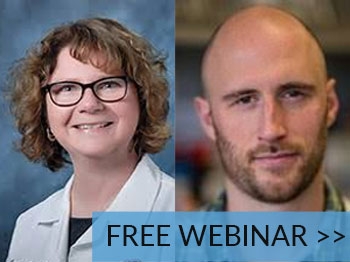
 Left, Dr. Jennifer Van Eyk and right Weston Spivia, Advanced Clinical Biosystems Research Institute
Metabolites in blood exist in a state of dynamic equilibrium, making efficient sample processing and handling after blood sampling key to biologically relevant analyses.
In a webinar now available on demand, we explore a method for evaluating room temperature quenching, lipid removal and metabolite isolation from plasma samples and how this protocol can be automated using the Agilent Bravo Metabolomics Sample Prep Platform.
Experts, Dr. Jennifer Van Eyk, Erika J. Glaer Chair in Women’s Heart Health and Director of the Cedars-Sinai Advanced Clinical Biosystems Research Institute, and Weston Spivia, Research Associate III at the Advanced Clinical Biosystems Research Institute, share their work and discuss the benefits of this method, including its ability to minimize post-sampling variability and its compatibility with downstream LC-MS/MS analysis of metabolites.
Read on for highlights from the live Q&A session or register to watch the full webinar on demand.
Q: What is the extent of post-sampling metabolic changes if you do not precipitate the proteins according to your protocol?
JE: You have to precipitate the proteins in order to have the metabolites in a form that you can put on to the LC – it is a fundamental step that we have to do. If you don’t crash the proteins, you won’t see the proteins.
Q: What is the expected time cut-off between blood sampling and analysis when deciding if you need to do on-site or off-site sample prep?
JE: What we showed from the data is that you should try to precipitate the proteins as quickly as possible and, more importantly, consistently. If you’re going to precipitate it for 20 minutes, then you should always do it at 20 minutes, for example.
In our hospital, we do it within an hour of collecting the plasma, if not faster, but that’s not always possible and especially when people are off-site. Our preferred method is to precipitate the proteins as soon as possible, but if you can’t, then we try to keep consistency instead.
WS: I would agree. Our off-site and on-site collection methods are really designed for that. If someone processes the samples and mails them as shipments of frozen samples then we’d recommend they followed the off-site methodology, so everything is done as quickly and consistently as possible across the collection of all the samples, minimizing the time between collection and the freezing of the plasma. The ideal time would be less than four hours but less than an hour is preferable.
JE: We have to remember that within the plasma, the metabolic enzymes are still changing the metabolism and that’s what we’re trying to control. You want to stop those enzymes and get them out of there through the protein precipitation so that you’ve preserved the true metabolome that was in the blood of that patient.
Q: How do you store the precipitated samples for off-sites ahead of the Bravo prep?
WS: Freezing to minus 80 as quickly as possible.
Q: Do you remove clotting factors from plasma for your analysis?
WS: The organic crash will inherently remove proteins from the sample, which includes the clotting factors.
JE: We used potassium EDTA, the tubes were lavender top tubes. That’s typically what we use for both proteome and for metabolome collection, but we know from clinical chemistry that different analytes can be better in serum versus plasma.
One thing to clarify is that we don’t switch between serum and plasma in the study. If you have a cohort of 1,000 individuals, we will not move from some people using plasma and other people using serum and expect the metabolites to be the same. We have not done those crossover studies; you’d have to be very careful. We keep the sample type consistent.
Q: Is the platform of preparation valid for other mass spectrometers? Can you recommend extraction kits ready to use for lipids and amino acids?
JE: The sample prep on the Bravo system and the Captiva plate are independent, whatever your LC-MS system is. Both at the manual and automated level, you can use a Captiva plates even if it’s not automated.
The LC-MS is really the assay that you’re performing. You can use this platform for discovery metabolomics or targeted as we’ve done. There are many different targeted assays out there for metabolomics. You can choose your own platform, your own assay, but what we’re recommending is really the automation of sample prep, especially as you move to higher numbers, which we believe both for proteomics and metabolomics. You need to understand the variability between people, which was so nicely illustrated in the four individuals that we showed you.
Q: Did you consider using molecular weight cut-off plates for protein removal?
JE: You could do that, but you’re not going to remove the lipids. What’s so nice about the Captiva plate is we’re able to remove the lipids successfully, as well as remove any protein precipitation.
You may wonder why and how often you need to remove the lipids – we do it to keep the spectrometer clean, which increases the sensitivity and the intensity of several of the analytes., but also because we work in cardiovascular disease and diabetes, you get a lot of lipids in some individual samples and you need to be able to get rid of them.
Q: How many microliters of plasma was used and what is the reconstituted solvent and volume after drying with supernatant?
WS: The method utilizes 100 microliters of plasma and upon reconstitution, you’re able to customize how much you want to reconstitute the sampling, the way we do it is by resuspending the sample at 100 microliters. The 100 microliters being a final concentration of 20% organic monomers, methanol, and then fill up the volume to 100 microliters with 80 microliters of water.
Q: What matrix is used for making up standard curves for target assays?
WS: In this case, we weren’t per se, making a standard curve to use for quantitation, if we use linear regression and then generation of absolute quant. In the standard curves that we presented, for the small volume study – that’s a dilution of plasma input into an assay, ranging from 200 microliters down to 10 microliters.
Q: What is the methanol to ethanol volume ratio, and the plasma to organic ratio?
WS: The methanol ethanol ratio was 1:1, 50% of each, and the ethanol to plasma ratio, in this case, was 4.5:1.
Q: Does the Bravo platform provide filtration automation?
WS: Yes, absolutely. With the Captiva plate it serves a dual purposes of lipid removal and actual filtration of the precipitated sample. This allows us to not have to centrifuge our samples before loading them onto the automated Bravo platform, and in this case, just directly add the precipitated sample to the platform.
(For Research Use Only. Not for use in diagnostic procedures)
Find out more on this topic by watching the full webinar on demand>>
SelectScience runs 3-4 webinars a month across various scientific topics, discover more of our upcoming webinars>>







