

The National Geospatial-Intelligence Agency’s $2.1 million global MagQuest competition—intended to reimagine and reshape the collection of data used in measuring the Earth’s magnetic field—came to a completion Tuesday, with results announced via an online event.
Iota Technology’s miniaturized satellite, or CubeSat, equipped with modern geomagnetic analysis instruments and built with a focus on sustainability, was selected as the first place winner and is set to receive $350,000. Four other solutions were also tapped to gain prize funds, and all five might be considered by the Pentagon as it explores advanced, alternative means for collecting key magnetic data.
“The World Magnetic Model—whether or not you’re aware of it—everybody has used it,” geodetic earth scientist and NGA’s World Magnetic Model program manager Mike Paniccia explained on a call with reporters following the awards announcement Tuesday. “Any navigation app in your cellphone uses the World Magnetic Model. It’s actually embedded into your phone.”
That model (deemed WMM for short) is at the core of the competition, which sought to advance novel data collection methodologies meant to inform it. WMM is embedded in thousands of wayfinding systems. Airplanes, cruise ships—and NGA’s lead customer, the Defense Department—rely on it for navigation using the magnetic field. The model is considered a “joint product” of NGA and the United Kingdom’s Defence Geographic Centre, and it’s also leveraged as a standard model by DOD, the U.K. Ministry of Defence, NATO, and the International Hydrographic Organization. WMM is additionally used in a vast range of other applications including satellite and solar panel orientation, space weather modeling and prediction, and more.
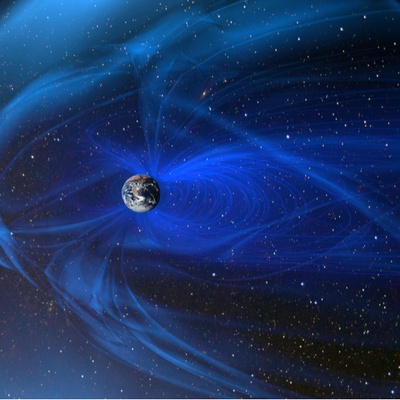
The model evolves alongside the evolution of the planet’s magnetic field structure and is produced by National Oceanic and Atmospheric Administration and British Geological Survey at five-year intervals. As MagQuest’s information page puts it, “Earth is a giant magnet,” and compasses are therefore oriented by the magnetic force at their location. Geographic and magnetic poles do not align, but “geomagnetic models like [WMM] correct for this difference.”
The current system used to capture data that informs the model envelops space-based magnetic field measurements that the European Space Agency-steered Swarm mission provides, and has done so since 2013. The information comes from a constellation of satellites, but as Paniccia said on the call, “it’s time to look to the future—what is going to be the next collector for this important data, so that we can build and operate the [WMM], really for the world?”
With sights set on meeting a DOD-made requirement for NGA to offer up new mechanisms for collecting the crucial magnetic data—independent of Swarm—the geospatial-focused agency’s personnel thought up the award contest.
“As NGA has been on our innovation journey, we’ve discovered that the super-most important factor to our success is our workforce, and they are examples we should try to follow,” Christy Monaco, the agency’s chief ventures officer, said during the virtual event. “They took basically a traditional bureaucratic requirement for an analysis of alternatives from the Pentagon, asked if there was a better way to meet that requirement, and then worked with our NASA partners to use a prize competition as a creative and innovative way to gather potential solutions from the ground.”
During the press briefing, Paniccia further elaborated on that requirement, noting that a Pentagon-led Joint Capabilities, Integration and Development System, or JCIDS, procurement process is unfolding—and NGA knows that through that, it must help deliver a new means of collecting magnetic data to underpin WMM by 2027. Officials are analyzing all possible alternatives, and then deciding on a path forward.
“MagQuest fits directly into that. [The winners of this competition] are alternatives that we will present to the Pentagon by the end of the year, along with some other possibilities, and it will be sort of their decision as to what they want to pull the trigger on and spend and build,” Paniccia told Nextgov during the call. “There may be a procurement next year, there may not.”
The global, multiphase challenge to ultimately generate and accelerate “novel approaches to geomagnetic data collection for” the WMM kicked off in early 2019 and the first two phases played out through September of that year. Roughly $1.2 million in cash prizes were issued through those initial phases and NGA then invited several participants to move onto Phase III, through which an additional $900,000 in cash prizes was awarded this week.
Runners-up of the competition receiving $50,000 each include the Royal Meteorological Institute of Belgium, which created what NGA called a “flexible network of automated magnetic observatories on land and the seafloor,” as well as Stellar Solutions, which produced a resource that taps planned satellite missions by adding easily integrated magnetometer payloads and an expanded ground-based array of the magnet force-measuring instruments.
The University of Boulder created a Compact Spaceborne Magnetic Observatory, or COSMO, CubeSat, which placed second and will receive $225,000, as will Spire Global and SBQuantum, another second place winning team. The two collectively put forth “a diamond quantum magnetometer system deployed on a CubeSat” as a solution.
And London-based Iota Technology is set to secure the top prize of $350,000 for what NGA called a “3U CubeSat featuring a novel deployable boom and digital magnetometers,” or devices that conduct measurements of the magnetic field. Teams from Oxford Space Systems and AAC Clyde Space contributed to the work.
Geomagnetic monitoring satellites have historically been large and bulky—comparable to the size of dining tables. But for this project, as Iota Technology Founder Hugo Shelley explained while it was all still in-the-works, “we’re shrinking ours to the size of a coffee pot.” On the call with reporters, Shelley noted that the top-rated solution uses off-the-shelf magnetometers, and that the effort really combined proprietary and open source work.
“One of the biggest things we focus on is sustainability, and being able to pack this technology into something” so incredibly small, could have “a lot of potential impacts” to push forward CubeSat-driven pursuits, low Earth orbit explorations and more, he detailed.
NGA’s entire initiative was about 18 months in-the-making, and it didn’t come without some disruptions—most notably, the novel coronavirus pandemic. Shelley noted that the global health emergency slowed some of the team’s work and processing and NGA’s Paniccia added that it forced NGA to pivot a great deal of in-person plans to be executed completely remotely.
“Our recent experiences with COVID-19 have taught us that change is inevitable and it can be swift,” NGA Senior GEOINT Authority Dr. J.N. Markiel also remarked on the topic, during the event. “But if we work together, we can find new ways to adapt and overcome.”







