

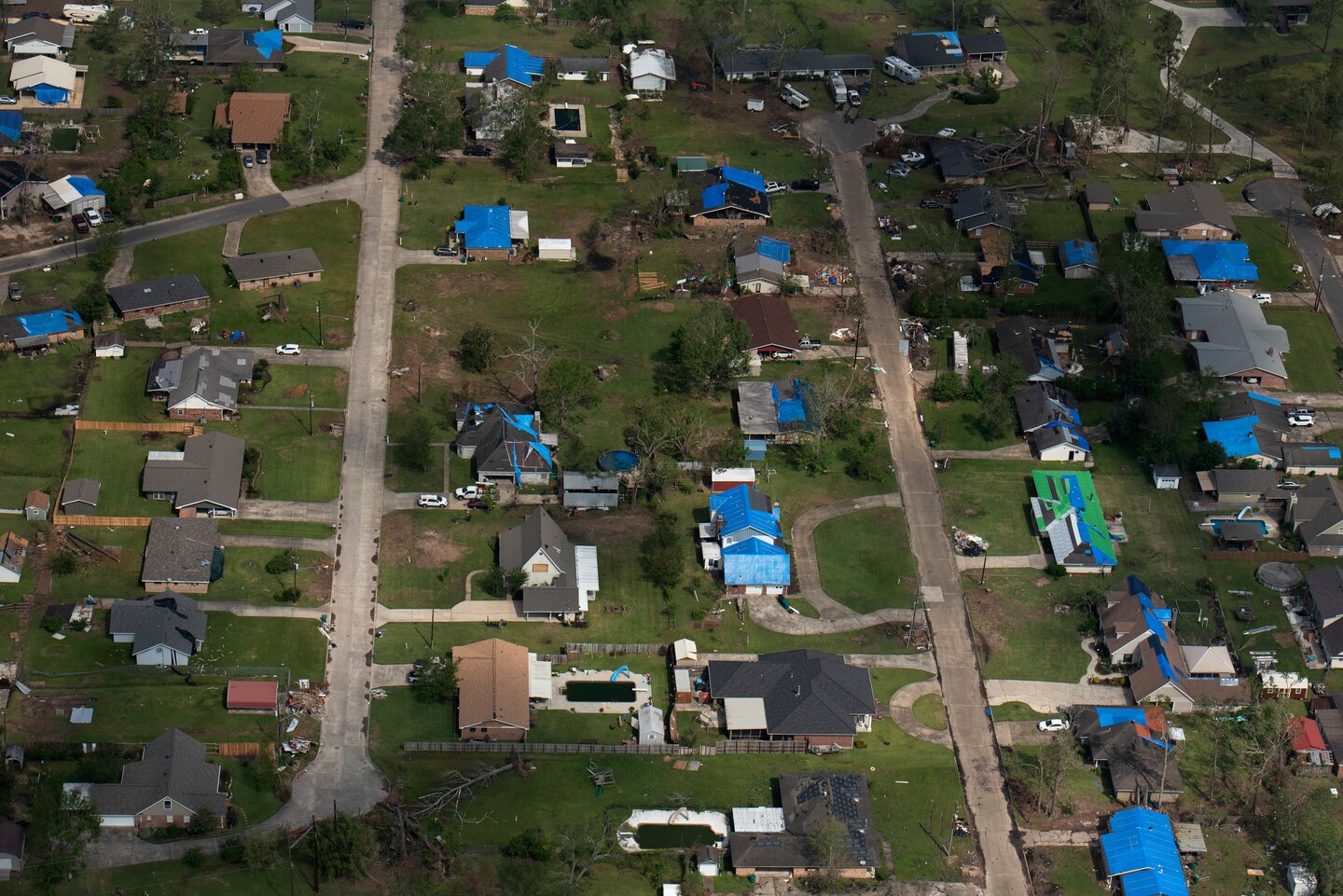
Power had returned in many neighborhoods and some traffic lights were working again. Some outlying areas were still underwater after a double-dose of storm surge from Delta on Friday and Hurricane Laura in August, though water levels had lowered across the city.
Statewide, almost half of all power outages stemming from Delta had been restored by Sunday evening, officials said, after peaking at nearly 690,000 — more than during Laura. But in a testament to the storms’ lasting devastation, more than 9,000 Louisianans remain in shelters, most of them people displaced by Hurricane Laura who still need temporary housing, authorities say.
The Federal Emergency Management Agency previously promised to deliver alternative housing for residents whose homes were destroyed in Laura by mid-October, said Mayor Nic Hunter in an interview Sunday, and the agency said that will still be the case following Delta.
But how much financial assistance this besieged city of 78,000 residents will receive from the federal government is still uncertain, Hunter said. FEMA Administrator Peter Gaynor declined to provide assurances that the city will receive full reimbursement for municipal costs incurred during the hurricane, Hunter said.
The federal government provided full reimbursement in extreme cases before, the mayor said, including after hurricanes Rita and Katrina in 2005 and Hurricane Michael in 2018.
“To have us go through what we are going through right now, and to be treated differently than Michael was in 2018, to me it’s going to be a slap in the face,” Hunter said.
In response Sunday, FEMA said that public assistance in disaster areas typically covers 75 percent of expenses.
“FEMA is not able to change the cost-share amount,” the agency responded in a statement. “Only the President and Congress have the ability to adjust the cost-share percentages.”
With an economy heavily reliant on tourism, Lake Charles was already was struggling due to the coronavirus pandemic. Now the city and Louisiana have to recover from a punishing storm season, too. Laura and Delta are believed to have caused billions of dollars of damage across the state, including tens of millions in Lake Charles.
And Delta’s toll is still emerging. Officials on Sunday announced the first death linked to Delta: an 86-year-old man in St. Martin Parish killed by a generator-sparked fire. At a news conference later that day, Gov. John Bel Edwards (D) urged “extreme caution” in using the devices.
Delta made landfall in the tiny town of Creole in rural Cameron Parish on Friday night, arriving with Category 2 strength and 100 mph winds before spinning north. While the damage from Hurricane Delta’s storm surge was less severe than Hurricane Laura, the storm’s expansive wind field led to a record in at least one location. At Freshwater Canal Locks, La., the surge climbed to at least 9.3 feet as the storm made landfall.
Some neighborhoods in Lake Charles were left in thigh-deep water on Saturday, though it receded over the course of the day under sunny skies.
Authorities were continuing to survey the damage Sunday. At a Lake Charles airport, Coast Guard Rear Adm. John P. Nadeau, the service’s top official in the Gulf Coast, climbed into an HC-144 propeller plane on Sunday and flew over rural Cameron Parish to the south, where Laura and Delta made landfall 15 miles apart.
Nadeau took note that while water was draining, many streets were still submerged and impassable. He said officials are working hard to ensure waterways run because of their importance to the local economy.
“They’ve faced so much in just the past six weeks, first with Laura going through, and now with Delta,” Nadeau said.
Lake Charles residents Wayne and Nichole Keating know how the two powerful storms have combined to push families to the brink.
When Laura’s winds pushed four trees onto their roof, exposing their home and belongings to torrential rains, they dipped into their savings to afford shelter for their three children and Nichole’s 82-year-old grandfather. The family says they have yet to receive money from their insurance company since the first storm — even as bills mount from hotels and gas.
Then, when Hurricane Delta bore down, new evacuees filled hotels, making it difficult for the Keatings to book a room in Lafayette, a city about 100 miles east of Lake Charles.
“We had the worst time finding something, as you can imagine,” said Nichole Keating, 36.
In Lafayette, hotels are sheltering “several hundred if not more than a thousand” people who received state vouchers after hurricanes Laura and Delta, according to city spokesperson Jamie Angelle. But that does not include all those scrounging to pay for the stays themselves.
Even as they have moved from hotel to hotel in five cities, the Keatings and Nichole’s grandfather still commute for hours every day to their jobs in Lake Charles. They are battling financial pressure on multiple fronts, as the coronavirus pandemic shuts down businesses: Nichole filed for unemployment after being furloughed from a dentist office that closed for weeks.
She says she is still waiting on aid.
“It’s stressful,” she said, “and we don’t have an end date.”
At Sunday’s news conference, the governor also emphasized that Louisiana is facing dual threats, as the need to social distance complicates relief efforts. Announcing 20 additional deaths related to covid-19, the disease caused by the coronavirus, Edwards urged people to remember to social distance and wear masks.
“We are responding to Hurricane Delta and continue to recover from Hurricane Laura in a covid environment,” he said.
Some residents suspect yet another threat that barreled through this weekend: tornadoes.
A family in Rayne said a twister came through their properties, tearing apart trees and two barns. Bob Wagner, a meteorologist for the National Weather Service’s New Orleans/Baton Rouge office, said NWS does not have records of tornadoes during Delta but said it’s plausible a twister hit Rayne, as they sometimes accompany hurricanes.
The Post could not reach the NWS office overseeing the Rayne area Sunday evening. Wagner noted that it could be hard to tell hurricane damage from tornado damage given the wind speeds seen around Delta’s eye.
Stan Gates, 66, could tell it was a tornado that wrecked his barn instead of powerful hurricane winds because of how the structure’s 18-foot wood beams — buried five feet into the ground — were plucked up and twisted. A wall and the roof were thrown into a neighboring field. White insulation speckled his lawn like snow.
“We’ve never experienced anything like this,” said Gates, a catastrophe claims specialist.
In the same beeline of destruction, Gates’ neighbor, 62-year-old Larry Hornsby, said the tornado peeled off part of his barn’s roof.
The day following Delta’s landfall, Hornsby was released from the hospital after liver surgery and was barely able to walk. On Saturday more than a dozen family and friends took apart the precariously hanging sheet metal as Hornsby sat in a rocking chair in the shade.
Typically on his feet for hours a day herding cattle, Hornsby was comforted by the assistance, as many of the family members were still without power or had experienced damage of their own.
“It hits here,” he said, pointing at his heart.
Kornfield reported from Lafayette and Raynes. Knowles reported from Washington. Andrew Freedman contributed to this report from Washington.







