

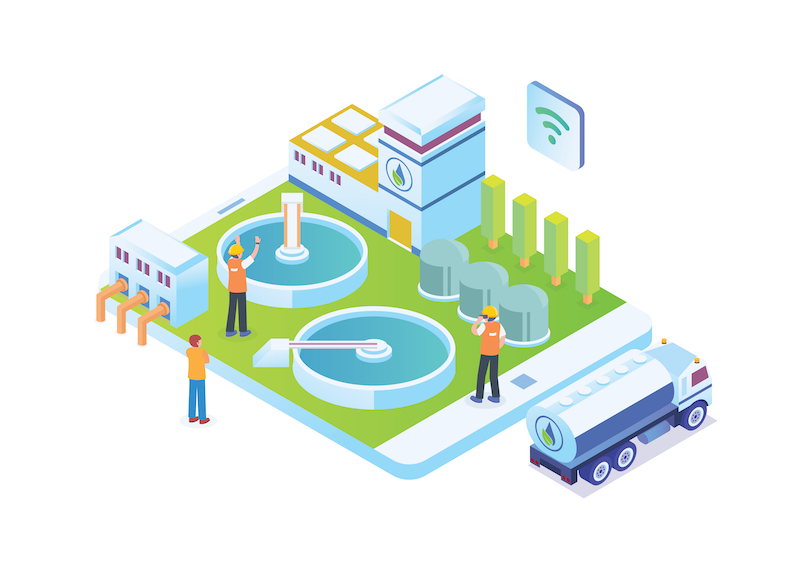
Water treatment and distribution system operators worldwide are facing significant challenges, not only in countries with developing economies, but also within the western world. Digital transformation will be crucial to meeting these challenges by properly operating, optimizing, and maintaining these facilities.
Advertisement
Most of the western world has the needed water facilities in place, but the infrastructure is aging. Physical piping and equipment are subject to failure, threatening the purity and availability of potable water. Older automation system architectures simply do not deliver the deep data needed to support analytics used for improving operations. Rapid urbanization clusters in locations like California, Florida, Texas, and other southern states are putting a strain on existing infrastructure and are a driver for enhanced water network performance. These factors are also driving increased adoption of water recycling and desalination.
For these reasons and more, water treatment and distribution operators are embarking on efforts to make new and existing operations smarter. The need for digital transformation in the industry is more acute than ever, with COVID-19 posing significant operational and maintenance challenges in terms of the need for workforce availability, remote operations capability, and faster responses to breakdowns or avoiding them altogether. This demand on industry to undertake a robust digital transformation is permanent. A key part of these undertakings is using the latest edge controller technology to support a digital transformation journey. This type of upgrade provides access to industrial internet of things (IIoT) data for monitoring, diagnostics, prediction, and optimization.
The Push for Data
Traditional treatment and distribution systems are not the only operations with valuable data. As freshwater sources decline due to saltwater intrusion and water tables fall, these dwindling resources are pushing an upward trend in water recycling and desalination. Many advanced desalinization projects have come online in recent years, and these energy-intensive systems can realize valuable savings and maximized performance through optimization.
Collecting the right data from wide-ranging water treatment and distribution processes is fundamental to developing intelligent decisions and improvements, such as:
- Better water quality;
- Cleaner effluent;
- Reduced non-revenue water losses;
- Minimized energy consumption;
- Maximized availability;
- Theft reduction; and
- Non-compliance reporting and alarming.
These lead to better operational outcomes and reduced operational expenditures.
Advertisement
A Smart Water Philosophy
There are many aspects regarding digital transformation for water treatment and distribution systems, including:
- Enhanced instrumentation using intelligent instruments: More data points, richer context.
- Data timestamping and historization: Site-located to handle vast data sets, providing fast access and lookup of data.
- Cloud connected data storage: Cloud historians support visibility and analysis worldwide.
- Integrated Visibility: Supplied locally at the operating equipment, in site-located control rooms, or at remote locations or on mobile devices via the cloud so that all operators, maintenance, and management personnel can access information across multiple assets and sites.
- Edge controller computing: Control the process in real time, and act on directions advised by operators or analytics.
- Data analysis algorithms: Performed locally on an edge controller, or in a more centralized site or cloud location, to find data correlations and show how parameters impact output.
- Multi-site data analytics: Enables performance comparisons and corrective action across a fleet of comparable processes or equipment.
- Condition based monitoring: Supports proactive and preventative maintenance of equipment based on operating conditions and failure prediction.
- Energy management: Evaluate equipment operating efficiency, enabling opportunities for savings.
- Enhanced cybersecurity: Modern automation hardware, software, and networking protect against disruptive cyber-attacks.
Accessing the data to support a smart water initiative requires a journey of digital transformation.

which begins with monitoring data.
Road to Implementation
Taking advantage of IIoT means and methods is fundamental to implementing smart water projects, but it is just a piece of the puzzle. There are several progressive steps in this process, each repeated on a continuing basis to improve results.
- Monitor: Know the current system state
- Diagnose: Understand causes and effects
- Predict: Use the information to predict and avoid problems like equipment breakdowns or critical process deviations
- Optimize: Use the information to improve efficiency
- Learn: Learn how to forecast operational behaviors
Much of the existing water automation infrastructure is suboptimal and has not progressed beyond steps 1 or 2, where users only monitor their processes, and perhaps apply basic diagnostic skills.
For new and updated systems, designers and users should follow an approach of incorporating IIoT-enabled capabilities, with clearly defined business outcomes to reduce water theft, water loss due to leakage, and energy consumption—and to move from calendar-scheduled or hours-scheduled to condition-based maintenance
The basic steps to accomplish each of these goals are:
- Identify the input/output (I/O) points to be monitored.
- Identify or install instruments (preferably intelligent) to monitor these data points.
- Incorporate edge controllers suitable for connecting to these data points and processing them, or communicating them to higher level systems.
- Historize these data points as timestamped values, so they are available for analysis.
Many types of advanced analytics are possible, including machine learning (ML), computer vision, neural networks, and artificial intelligence (AI). Each of these possibilities requires extensive source data. Fortunately, a new class of industrial edge controller is available to meet the need.
Advertisement
Edge Automation Enhances Instrumentation, Control, and Analysis
It has long been possible to stitch together a variety of instruments, programmable logic controllers (PLCs), I/O, networking, and computer software to gather data for analysis. But it is difficult to design, operate, and maintain these conglomerations of parts and technologies, especially considering the geographic spread of many water operations.
This is why newly available edge controllers are a better choice to implement digital transformation of water processing and distribution operations. Edge controllers are robust industrial devices much like PLCs. The key is that they are really two systems in one—using hardware virtualization to create a deterministic real-time controller in parallel with a general-purpose operating system like Linux. The deterministic and general-purpose systems operate independently but in parallel, and they can securely communicate via industry standard OPC UA.
The deterministic system can directly monitor and control equipment via I/O just like a powerful PLC. It can communicate via leading operational technology (OT) communications protocols like PROFINET, SRTP, Ethernet Global Data (EGD), and Modbus TCP/IP to gather all necessary field data.
The general-purpose system is available to perform higher level functions like data processing, analysis, and visualization. This portion of the edge controller can run many applications and programming languages, and it supports modern protocols like MQTT which is IT-centric, firewall-friendly, and consumes low bandwidth. The general-purpose system can also host custom drivers for devices unsupported by the deterministic system thereby providing extensibility to the control system’s ability to communicate and control with family of devices.
Because an edge controller combines a deterministic system with a general-purpose system, it offers unique capabilities compared with assembling a system out of many other elements (Figure 3). The deterministic controller directly monitors and controls equipment—such as flowmeters and valves—gathering data which is communicated to the on-board general-purpose system. The general-purpose system can provide the data to higher-level systems, and can also directly analyze the data to determine optimum operating values. In turn, the general-purpose system can inform the deterministic system of these values so it can take action.

The edge controller platform provides the combined ability to perform real-time process control with computing for optimization and learning. This provides better connectivity and visibility for operations and management, while taking the AI and ML layer closer to the field.
Tying it all Together
A common example shows how valuable a smart water philosophy can be. Typical rotating equipment, like a water pump, might be:
- Driven by an intelligent variable frequency drive;
- Controlled by a PLC with additional I/O for bearing temperatures;
- Fitted with a separate vibration monitoring system; and
- Monitored by other ambient temperature sensors or power distribution systems;
An edge controller can connect to each of these sources. It can gather and make available all the data, which can be used to develop a linear regression model predicting the health index of the equipment. Many of these pumps across different locations can be compared in context with each other to learn their performance characteristics and failure modes.
Translating all this raw data into useful information helps the operations team schedule equipment maintenance and order spares on an as-needed basis, saving on operating expenses by increasing inventory turns. This methodology can be applied to many forms of equipment.
Edge controllers are fundamental for implementing the digital transformation data needed to support optimized operation and management of water treatment and distribution facilities.







