

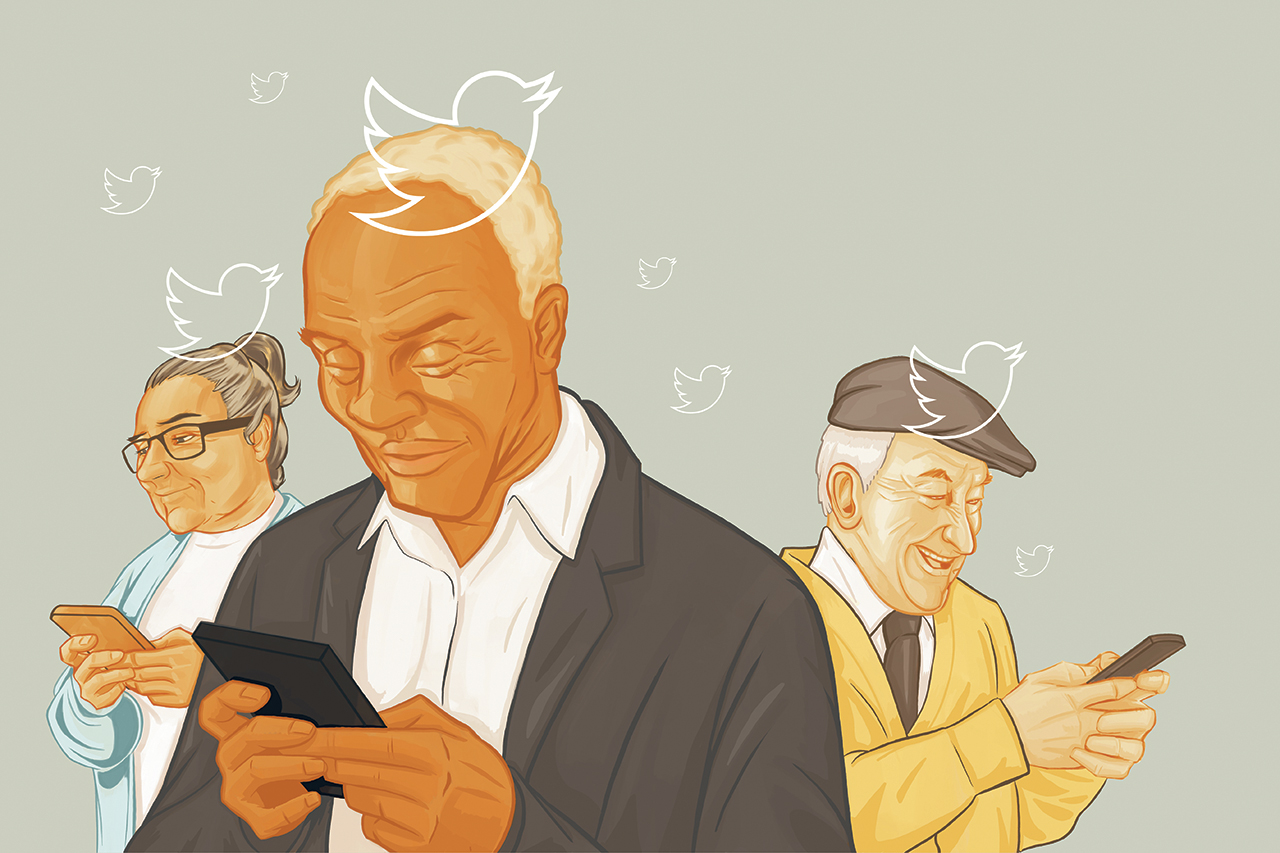
On the first day the #GoldenTweets program was offered, a man walked in saying he was there to learn about birdcalls. When a professor told him it was a training program on the social media network Twitter and asked if the man would still be interested, he turned around and walked out.
That’s how the pilot program for #GoldenTweets began in 2015. The ongoing research and educational project teaches those 55 and older how to log in, tweet, retweet, follow a trending topic using a hashtag, and engage in wide-ranging conversations about everything from baseball to geopolitics. One participant started a conversation with actor Ben Stiller. Another was thrilled when a local restaurant reached out to her.
Dr. Jennine Harvey-Northrop, an associate professor in the Department of Communication Sciences and Disorders (CSD), teamed with Dr. Caleb T. Carr, an associate professor in the School of Communication, to design the 13-week social media training program using Twitter, with the goal of teaching participants the skills and confidence needed to seek out and establish new social connections, as well as explore the world and their interests.
Northrop studies what happens to the brain and behavior as humans age, and what can be done to influence successful aging. “Not all of our cognitive skills decline as we age. Some cognitive areas even improve, so how do we capitalize on areas of improvement to help those areas that become more challenging?”
Carr researches how human communication utilizes and is affected by technology, including for making hiring decisions and in decision-making. He explores how boundaries (including personal-professional and intimate-public) are blurred through technology.
The professors were interested in examining how participation in the program may alter communication and perception of self and others in normally aging adults. During the initial phase of the program, participants included individuals with normal cognitive aging or mild cognitive impairment.

Dr. Jennine Harvey-Northrop, an associate professor in the Department of Communication Sciences and Disorders (CSD) who co-created the #GoldenTweets project.
As a speech-language pathologist, Northrop works with clients recovering from strokes or traumatic brain injury, as well as those with mild cognitive impairment and dementia. While technology and social media are commonly used in everyday communications, there is no standard for training older individuals how to use technology or social media. She thought social media has the potential to improve language and cognitive function and enhance social engagement. However, she couldn’t find any training in her field.
Carr also thought about other populations who have indicated benefitting from communicating online. “If you take folks who have some sort of stigmatization, either burn victims or cancer patients who don’t want to be known by that, or have some language or other processing issues, we can put them online and now they’re not stigmatized by that. If we can help those with some cognitive deficiencies get online, is this a way to circumvent or maybe help rebuild some of their skills?”
People living in rural or isolated areas could also expand their communication and social network by being online, Northrop added.
“We know that the more isolated you are, the more likely you are to experience depression symptoms, leading to signs of cognitive decline. If we can create a program that helps social media become more accessible, that’s huge.”
#GoldenTweets also provides a unique training opportunity for first-year CSD graduate students. They were assigned to the program as part of their clinical experience and were paired with participants.
“It led to this intergenerational learning piece that was unexpected,” Northrop said. “Older individuals love to interact with younger individuals. They have this beautiful kind of rapport that builds. This program capitalized on that because they were learning something new together. The biggest finding was that both the students and participants learned and enhanced their ability to interact and communicate online. But they also loved learning from each other. That intergenerational piece was the biggest takeaway from the first phase of the program.”
Also, the researchers were surprised how much the graduate students learned about Twitter.
“We assumed students would have mastered the use of Twitter, as with many social media. However, we found that the students were learning the intricacies of the platform right alongside the participants,” Northrop said. “The #GoldenTweets program helped train graduate students in integrating social media into communication goals by learning how to teach someone else of a different generation or background how to use a technology, how to use a different linguistic skill set for Twitter communication specifically, and also how Twitter was intended to be used, and how other populations would use it.”
Because it was important that all the participants used the same hardware, rather than a mix of laptops, tablets, and smartphones, the researchers purchased laptops with a grant awarded by the Interdisciplinary Initiative Grant Program in the College of Arts and Sciences.
During the semesterlong training program, teams worked side-by-side in a campus classroom for one hour each week. During the engagement component, they sat across from each other and communicated online. Each week graduate students created an action plan for their clients based on their strengths and challenges, modifying homework based on skill level. Some students had to design visual and memory aids for the participants.
“This teaches students another way to work with a client. It shows them you can layer a real-world application for someone who has a language disorder like aphasia,” Northrop said.
The researchers offer the program over 13 weeks each spring semester; however last March, the sessions were cut short due to the coronavirus (COVID-19) pandemic. There’s a wait list for the program, with plans to offer it again next spring. #GoldenTweets is delivered in four phases—pre-assessment, social media training, social media engagement, and post-assessment. Training and engagement include in-person group discussion and interaction, as well as multiple online discussions and interactions throughout the week.
Classes start with the basics, offering information about the internet, security, and privacy concerns. One participant asked whether a bank account could be compromised; another wondered if he could be exposed to the Islamic State militant group (ISIS).

Dr. Caleb T. Carr, an associate professor in the School of Communication, co-created the #GoldenTweets program. (Editor’s note: The photograph was taken prior to the coronavirus pandemic.)
“That’s a valid concern when we say we can let you get on the world and talk with anybody,” Carr said. “The first year was a good learning experience of the things we should have thought of and just couldn’t as we were building the program.”
The professor follows and interacts with participants online throughout the week, watching their engagement and comfort level grow.
“It’s fun watching some people really hesitantly step online with “Hello Twitter.” And then we’ve got a couple who have sort of kicked the door in and taken no prisoners and have really learned how to do it.”
The program covers media literacy, how to identify fact from opinion, and how to verify Twitter accounts for authenticity.
Participant Christa Lawhun had a Twitter account four years ago, but she’d forgotten her password. She wanted to get back on Twitter to communicate with her grandchildren and stay current with technology.
But there was a bigger reason too. After being home on disability for four years, suffering from anxiety so deep she could only leave her home for doctors’ appointments, she was ready to reconnect.
“I was getting back to work and trying to get back into life. It was another way to get out and learn and do something,” she said.
Now she’s using Twitter on her computer and phone, getting back to one of her passions, networking with animal rescue groups.
“I loved the opportunity to get in and learn more,” she said. “It’s a good thing for older people.”
Carr and Northrop chose Twitter over other social media platforms because of the low usage rate by older adults, as low as 8 to 10 percent according to AARP. Beyond encouraging new social connections, Twitter offers sources of news and information. And unlike Facebook, any Twitter user may follow anyone else without permission.
“Twitter is such a tremendous platform because it’s inclusive. They can talk to somebody on the other side of the planet,” Northrop said.
The pilot program was offered off-site at an assisted living community, where a 92-year-old participated.
“She was a great example of what we want to do with this program,” Northrop said. “I don’t think she would have come if she had to leave her home. She did a great job and was just a real spitfire. She thrived interacting with her clinician and with us online.”
The program may be taken off campus again, as the researchers modify the training for different populations, including those with communication disorders, and individuals 18 and older with aphasia, mild cognitive impairment, traumatic brain injury, stuttering, or voice disorders. Also, the researchers may offer introductory and advanced levels.
“We’re beginning to pull that information and that data so we can enhance the manual for different populations,” Northrop said. “It’s going to help us to understand how we can help those with normal aging.”
Read more
In a paper co-authored with CSD Professor Dr. Ann Beck, Carr and Northrop published their preliminary findings in August 2019 in the peer-reviewed journal Perspectives of the ASHA Special Interest Groups.







