GLOBAL RESEARCH SYNDICATE
No Result
View All Result
  • Login
  • Latest News
  • Consumer Research
  • Survey Research
  • Marketing Research
  • Industry Research
  • Data Collection
  • More
    • Data Analysis
    • Market Insights
  • Latest News
  • Consumer Research
  • Survey Research
  • Marketing Research
  • Industry Research
  • Data Collection
  • More
    • Data Analysis
    • Market Insights
No Result
View All Result
globalresearchsyndicate
No Result
View All Result
Home Data Collection

Researchers determine escape route travel times for firefighters

globalresearchsyndicate by globalresearchsyndicate
September 19, 2020
in Data Collection
0
Researchers determine escape route travel times for firefighters
0
SHARES
7
VIEWS
Share on FacebookShare on Twitter

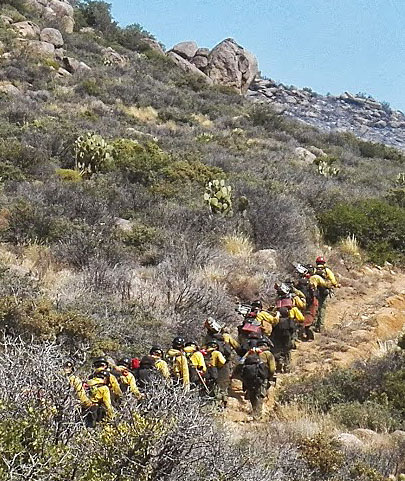
Granite Mountain Hotshots hike to the fire, June 30, 2013
Granite Mountain Hotshots hike to the Yarnell Hill Fire, the morning of June 30, 2013. Photo by Joy Collura.

When crews of wildland firefighters in a remote area have to quickly move to a safer location due to an approaching flaming front, they hike on what they call an escape route to get to a safety zone where they can be out of danger without having to deploy their fire shelters. An average of 11 firefighters die each year while fighting fire. Of these deaths, about 44 percent are caused by entrapment or burnover events.

A key to moving to a safety zone is the travel time. Underestimating the required time can be fatal, in the worst of circumstances. That may or may not have been one of the many factors involved in the deaths of 19 firefighters on the 2013 Yarnell Hill Fire in Arizona.

Firefighters know how long it takes them to hike the three miles within less than 45 minutes while carrying 45 pounds as required by the Pack Test, or Work Capacity Test. From that it’s pretty easy to calculate their miles per hour. But that is on flat ground, a situation that is not always the case when escaping from a wildfire. Throw in steep uphill or downhill slopes, and the times will increase.

Previous research on the subject includes:

A new study uses a different database for the speed at which fire crews can hike. It is titled, “Modeling Wildland Firefighter Travel Rates by Terrain Slope: Results from GPS-Tracking of Type 1 Crew Movement.” (download, 2.3 Mb)

As the name implies, instead of using public crowd-sourced hiking speed data, the researchers issued GPS units to nine Type 1 Interagency Hotshot Crews in the Spring of 2019. Nine of the 11 participating IHCs received seven GPS units each, and the other two received 20 GPS units each. In addition to the GPS units, crews were provided with data collection sheets and armbands to carry the GPS units.

Using data collected by firefighters — a uniquely physically fit population that usually carries heavy loads while moving —  provides a set of robust, adjustable travel rate models built from instantaneous travel rate data that can be applied in a variety of contexts.

The data was collected while on training hikes. Rather than rely on GPS for elevation, which is not always accurate, only locations having the more accurate lidar data were used.

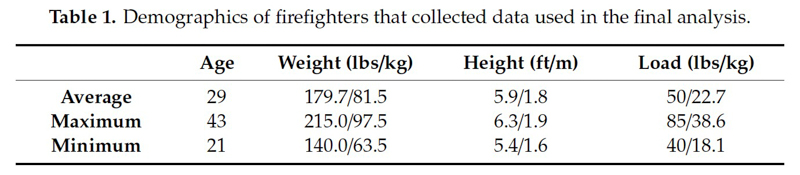
The tables below are from the research paper.
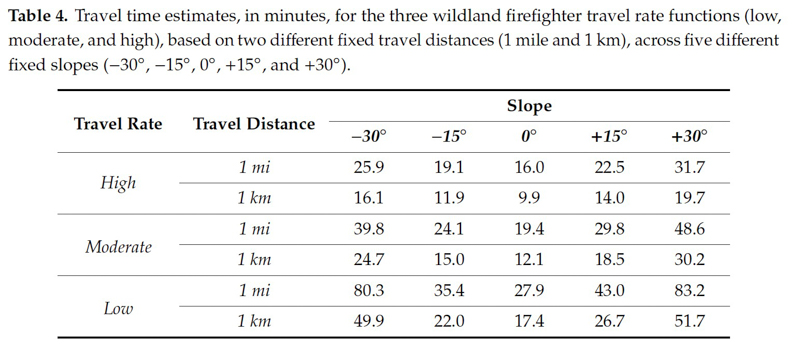
Results -- travel times by slope


Demographics of the Type 1 crews.

Here is an excerpt from the paper:

“The effects of the slope on the instantaneous travel rate were assessed by three models generated using non-linear quantile regression, representing low (bottom third), moderate (middle third), and high (upper third) rates of travel, which were validated using k-fold cross-validation. The models peak at about -3o (downhill) slope, similar to previous slope-dependent travel rate functions. The moderate firefighter travel rate model mostly predicts faster movement than previous slope-dependent travel rate functions, suggesting that firefighters generally move faster than non-firefighting personnel while hiking. Steepness was also found to have a smaller effect on firefighter travel rates than previously predicted. The travel rate functions produced by this study provide guidelines for firefighter escape route travel rates and allow for more accurate and flexible wildland firefighting safety planning.”


The authors of the paper are, Patrick R. Sullivan, Michael J. Campbell, Philip E. Dennison, Simon C. Brewer, and Bret W. Butler.

Related

Related Posts

How Machine Learning has impacted Consumer Behaviour and Analysis
Consumer Research

How Machine Learning has impacted Consumer Behaviour and Analysis

January 4, 2024
Market Research The Ultimate Weapon for Business Success
Consumer Research

Market Research: The Ultimate Weapon for Business Success

June 22, 2023
Unveiling the Hidden Power of Market Research A Game Changer
Consumer Research

Unveiling the Hidden Power of Market Research: A Game Changer

June 2, 2023
7 Secrets of Market Research Gurus That Will Blow Your Mind
Consumer Research

7 Secrets of Market Research Gurus That Will Blow Your Mind

May 8, 2023
The Shocking Truth About Market Research Revealed!
Consumer Research

The Shocking Truth About Market Research: Revealed!

April 25, 2023
market research, primary research, secondary research, market research trends, market research news,
Consumer Research

Quantitative vs. Qualitative Research. How to choose the Right Research Method for Your Business Needs

March 14, 2023
Next Post
Functional Mushroom Market with Analysis, In-Depth Research & SWOT analysis by Major Companies to 2027 – The Daily Chronicle

Dried Fruit Snack Market with Analysis, In-Depth Research & SWOT analysis by Major Companies to 2027 – The Daily Chronicle

Categories

  • Consumer Research
  • Data Analysis
  • Data Collection
  • Industry Research
  • Latest News
  • Market Insights
  • Marketing Research
  • Survey Research
  • Uncategorized

Recent Posts

  • Ipsos Revolutionizes the Global Market Research Landscape
  • How Machine Learning has impacted Consumer Behaviour and Analysis
  • Market Research: The Ultimate Weapon for Business Success
  • Privacy Policy
  • Terms of Use
  • Antispam
  • DMCA

Copyright © 2024 Globalresearchsyndicate.com

Welcome Back!

Login to your account below

Forgotten Password?

Retrieve your password

Please enter your username or email address to reset your password.

Log In
This website uses cookies to improve your experience. We'll assume you're ok with this, but you can opt-out if you wish. Cookie settingsACCEPT
Privacy & Cookies Policy

Privacy Overview

This website uses cookies to improve your experience while you navigate through the website. Out of these cookies, the cookies that are categorized as necessary are stored on your browser as they are essential for the working of basic functionalities of the website. We also use third-party cookies that help us analyze and understand how you use this website. These cookies will be stored in your browser only with your consent. You also have the option to opt-out of these cookies. But opting out of some of these cookies may have an effect on your browsing experience.
Necessary
Always Enabled
Necessary cookies are absolutely essential for the website to function properly. This category only includes cookies that ensures basic functionalities and security features of the website. These cookies do not store any personal information.
Non-necessary
Any cookies that may not be particularly necessary for the website to function and is used specifically to collect user personal data via analytics, ads, other embedded contents are termed as non-necessary cookies. It is mandatory to procure user consent prior to running these cookies on your website.
SAVE & ACCEPT
No Result
View All Result
  • Latest News
  • Consumer Research
  • Survey Research
  • Marketing Research
  • Industry Research
  • Data Collection
  • More
    • Data Analysis
    • Market Insights

Copyright © 2024 Globalresearchsyndicate.com