

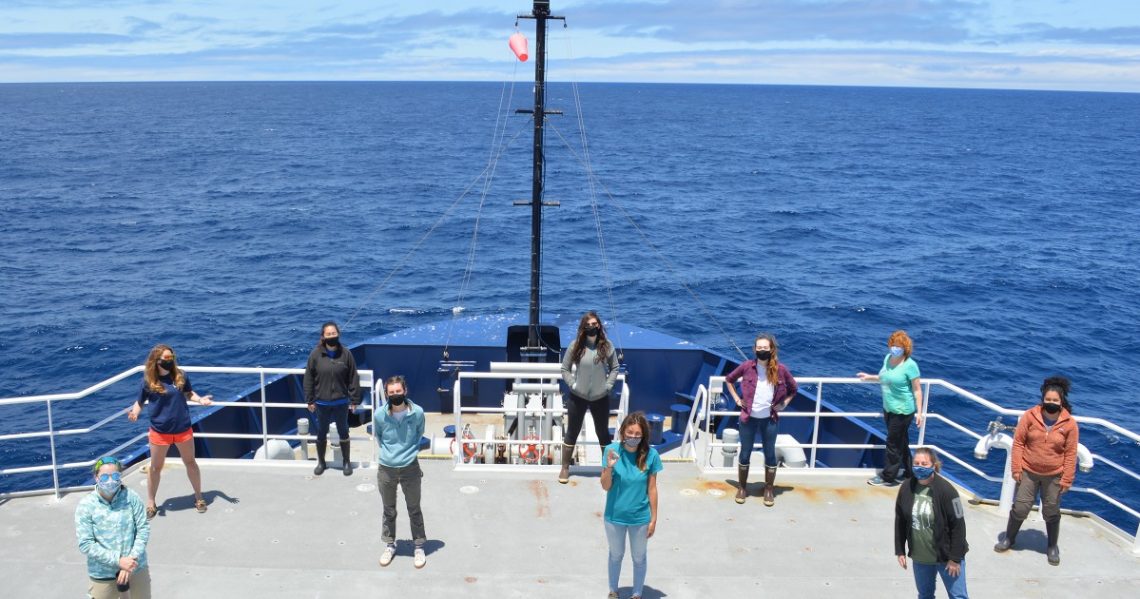
As Chief Scientist Angela Klemmedson checked her team’s roster for this summer’s research cruise of the California Current, she realized they had something in common: every scientist sailing was a woman.
The July cruise marked the first time in its 71-year history that the California Cooperative Oceanic Fisheries Investigations, known as CalCOFI, included an all-female science party.
It also happened to coincide with the 100th anniversary of women’s suffrage in the United States. And it took place aboard the naval research vessel R/V Sally Ride, named in honor of the first female American astronaut. In addition, the ship’s crew included a female third mate, boatswain, and two able-bodied crewmembers.
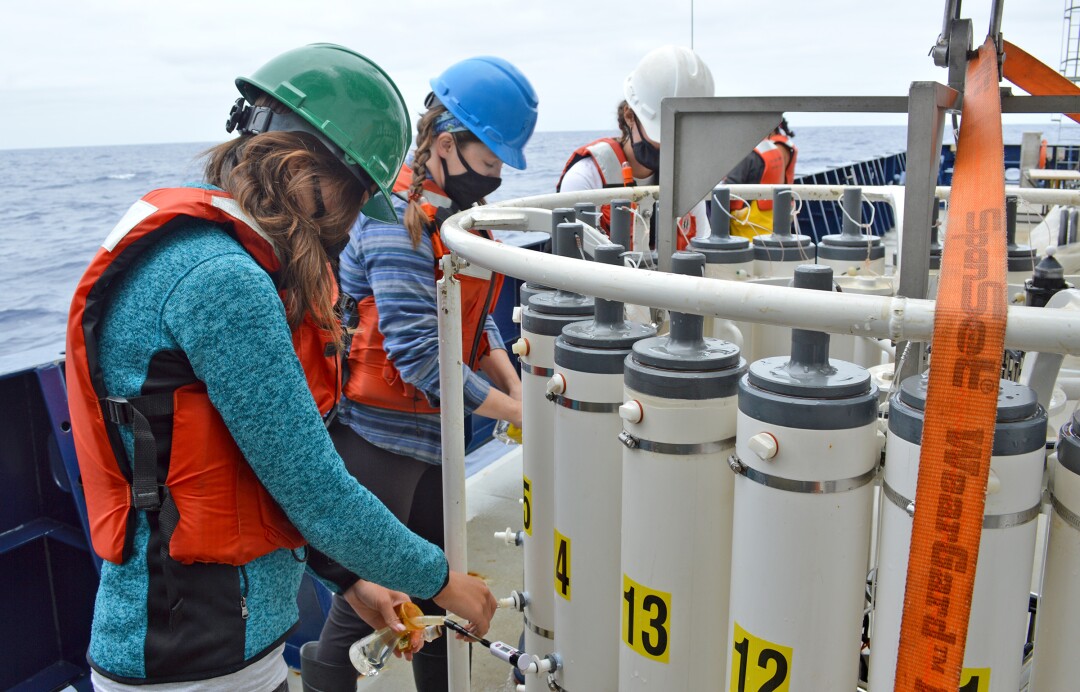
Members of the all women CalCOFI research team deploy equipment and working in labs aboard the Naval research vessel R/V Sally Ride.
(Photo by Angela Klemmedson)
“I’m really happy that CalCOFI has now reached that milestone,” said Klemmedson, 29. “It’s been moving in that direction over the ages. Oceanography has always been such an old man thing, and it’s really cool now that we’re including more female scientists. It’s empowering, and I was really happy about that.”
The fact that this milestone occurred during a pandemic, with exceptionally rigorous safety protocols, made it all the more groundbreaking, the researchers said.
“It was challenging that my first cruise as chief scientist was also the first cruise in a pandemic, so there were significantly more regulations that need to be followed, but I had a great time,” Klemmedson said. “And I’m really impressed with how my team of scientists handled it. I’m happy we accomplished all of our science objectives, and no one got sick.”
The CalCOFI program began in 1949, following the collapse of sardine fisheries in California, and has continued through the 21st century, amid rising seas and warming waters. It represents the oldest and largest time series in marine science.
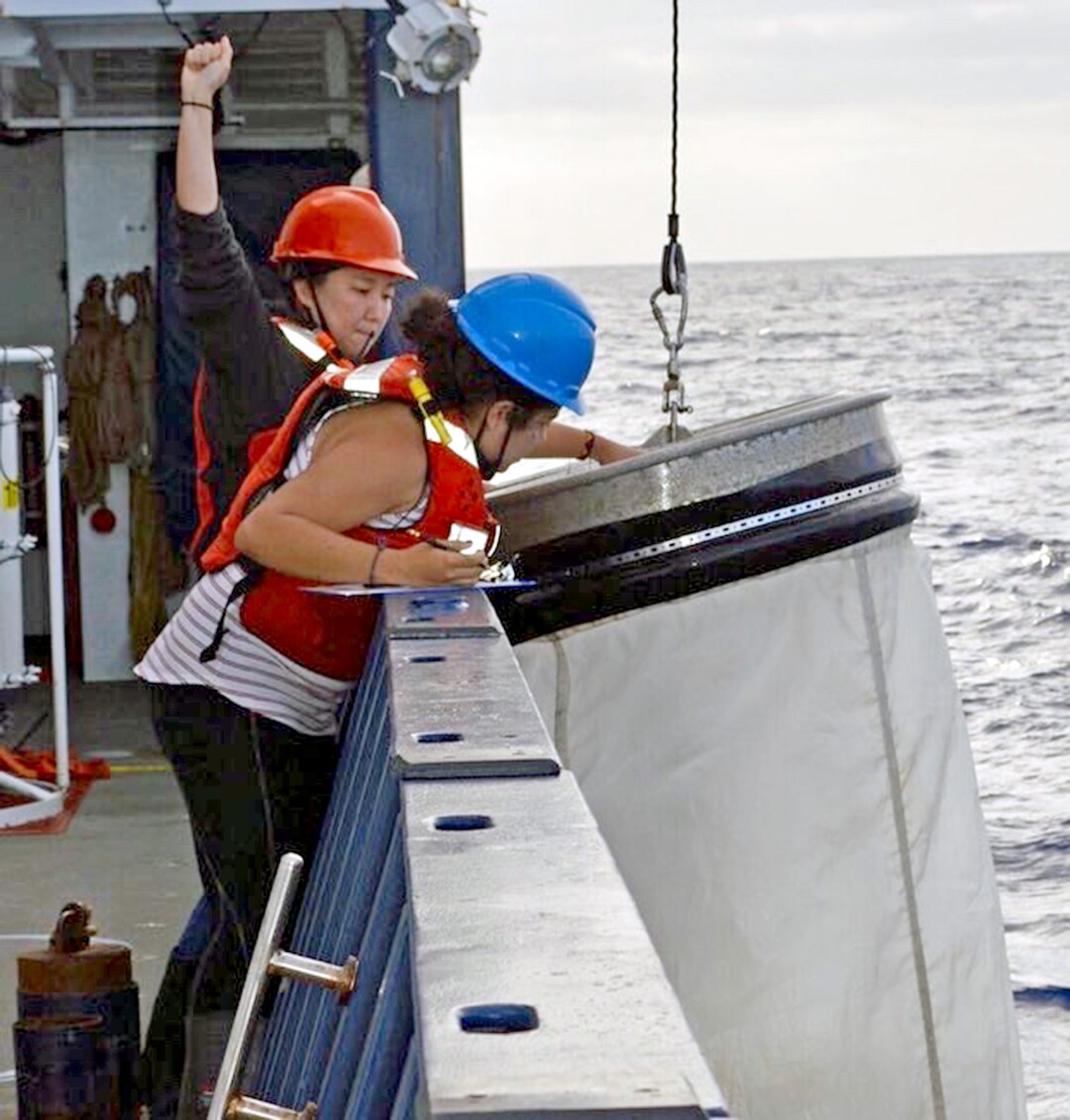
Members of the all women CalCOFI research team deploy equipment and working in labs aboard the Naval research vessel R/V Sally Ride.
(Photo by Angela Klemmedson)
For 71 years, researchers with the National Oceanic and Atmospheric Administration, Scripps Institution of Oceanography and the California Department of Fish and Game have conducted quarterly surveys of the California coast from the Mexican border to either Point Conception or San Francisco, with few interruptions.
Except for this spring.
The spreading COVID-19 threat shut down the cruise, grounding scientists, including Klemmedson, and interrupting the otherwise continuous data set. CalCOFI scientists were determined not to allow that gap to extend into the summer, so they prepared plans for a socially distanced cruise, with tight pandemic protections.
Prior to the cruise, each team member had to quarantine for 14 days, spending eight days at home and another six days sequestered in a hotel room. Each had to undergo a series of three negative COVID-19 tests, at the start, middle and end of that period. That isolation period, on top of the 15-day cruise, ruled out many veterans of the research effort.

Members of the all women CalCOFI research team deploy equipment and working in labs aboard the Naval research vessel R/V Sally Ride.
(Photo by Angela Klemmedson)
“That was the quarantine method that Scripps had set up to allow people to go out on ships,” said Laura Lilly, a graduate student at Scripps who participated in the cruise this year. “But people with children or other obligations couldn’t commit to that period of quarantine.”
In the end, they assembled a team of 10 researchers, the bare minimum needed to do all the requisite measurements, Lilly said. The team skewed younger, and as it turned out, entirely female and especially resourceful. As they prepared for the trip, the science team collaborated with seasoned researchers who lent their expertise remotely, as no one who had not undergone quarantine was allowed on the ship, she said.
“There was this nutrient analyzer that has to be set up a certain way,” said Lilly, 30. “The person who has done it for 20 years, he couldn’t go on the cruise, and couldn’t even come on the ship to set it up. One of our technicians was on FaceTime with him for two days, with him walking her through setting it up.”
Most science team members had previous experience on research cruises, and all were able to handle the sampling professionally, they said. And while they missed the institutional knowledge of longtime CalCOFI researchers, their shared sense of adventure helped them overcome obstacles.

Members of the all women CalCOFI research team deploy equipment and working in labs aboard the Naval research vessel R/V Sally Ride.
(Photo by Angela Klemmedson)
“We had all these young, excited scientists, and I think that the young energy helped us stay positive even though it was challenging with the new protocols,” Klemmedson said.
In general, research cruises must be tightly run, because any technical glitches at sea can’t be remedied by a trip to the hardware store. This time, those restrictions extended to the entire period of preparation. There was a physical barrier erected around the shop, and no one was allowed to pass without two weeks of quarantine and three negative COVID tests, Lilly said.
“That was a challenge in general, because with every cruise, we’re used to running on and off to get last-minute supplies, and running to Home Depot or West Marine,” she said. “And we couldn’t do it. We had to be extremely organized with all our planning.”
Similarly, life at sea during the weeks of the cruise had to be more regimented than usual. Scientists on the CalCOFI cruise work day or night shifts, with 12 hours off and 12 hours on. Under normal circumstances, they work together closely while on duty, and spend free time socializing, watching movies and sharing meals. This time meals were on 15-minute rotations, with just a few people eating at once. The common area was closed, and even laboratory space was rationed, with limited researchers allowed at one time, Lilly said. They wore masks round the clock, except in their staterooms.
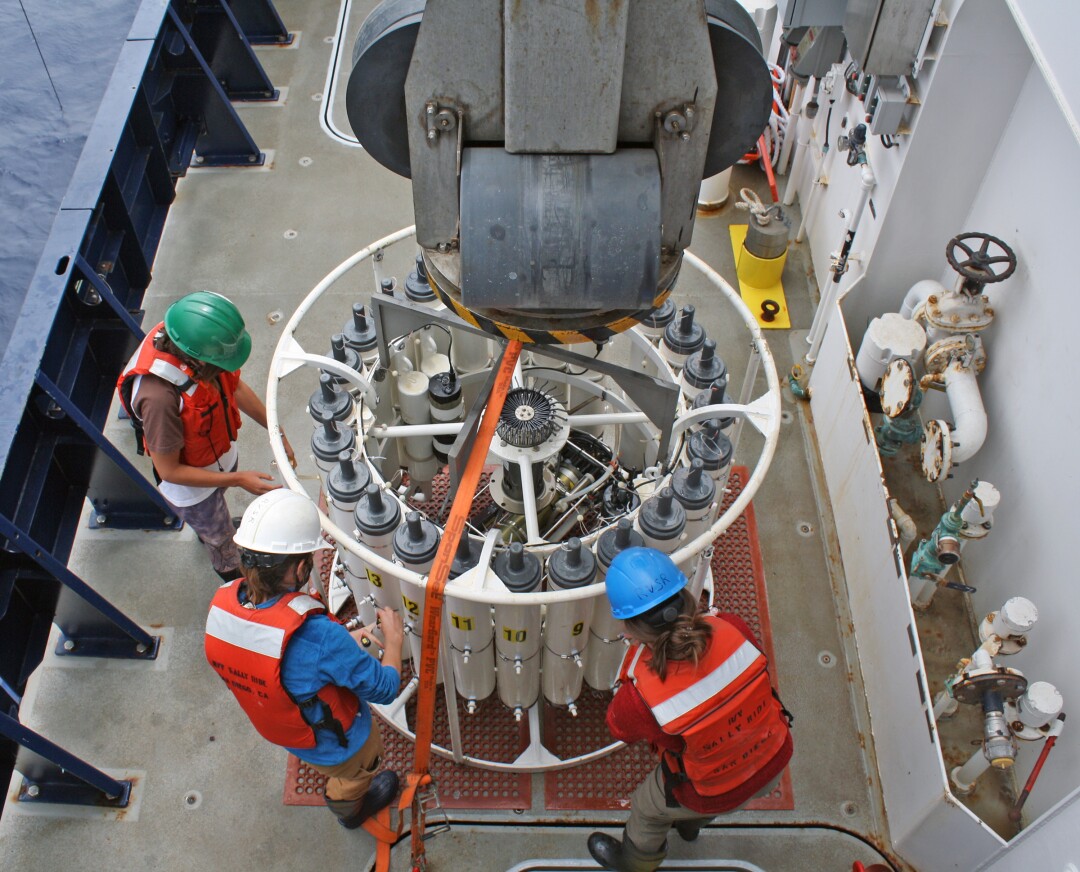
Members of the all women CalCOFI research team deploy equipment and working in labs aboard the Naval research vessel R/V Sally Ride.
(Photo by Laura Lilly)
Crew members made the best of it, sometimes taking meals together, at a distance, on the deck, or competing in an outdoor cribbage tournament, Lilly said.
It’s too early to tell what the data will show about the state of the ocean this year, she said, though physical water conditions appeared typical. As far as marine life, Lilly said, they saw a fair number of whales and dolphins around the Channel Islands, but few elsewhere.
In her samples, the water was green with phytoplankton — plant-like microorganisms — indicating high productivity in the sea. They also saw a lot of pyrosomes: free-floating, bioluminescent colonial organisms that are genetically identical, and form a structure to filter phytoplankton from seawater.
“They’re gelatinous, long, pink tubes that float along at the surface of the ocean and appear in these large blooms,” Lilly said. “We didn’t see too many of those blooms, but our zooplankton nets brought back a lot of their young states.”
These appeared en masse during “the blob,” a mass of warm, stagnant water that appeared off the Pacific Coast around 2014. Last year’s CalCOFI cruise also spotted many of the ethereal, tube-like organisms, and scientists are working to understand why they are so abundant, and what that reveals about current ocean conditions.
“I think the green waters and the pyrosomes are probably related, that the pyrosomes are taking advantage of this high productivity,” she said.
Lilly said this was her first CalCOFI cruise, though she has used the time series data in her doctoral work, and has participated in other research cruises. She was excited to realize that this was also part of the first all-female science party.
But perhaps the most notable aspect of that milestone was that it was an afterthought, and not a planned effort. Lilly said she and her colleagues owe that confidence about their role in science to the women who fought for a place in a laboratory, ship, or spacecraft before them.
“In my scientific career, I take it for granted that I don’t think about my gender,” Lilly said. “I can just do what I want to do. But that’s because so many women have pushed for so long, for equal treatment in science and other walks of life. Marie Curie, 100 years ago, was running around working on radiation. It’s thanks to women like that, and Sally Ride, and women whose names we don’t even remember, that I can walk on a ship and not even think about it at first that we have an all-female science party.”






