

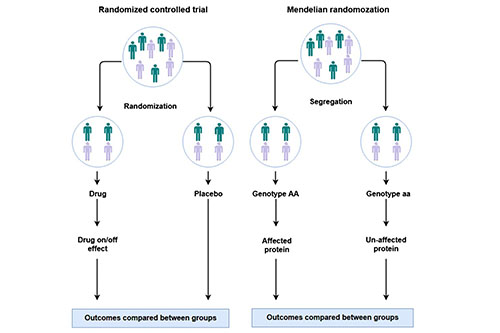
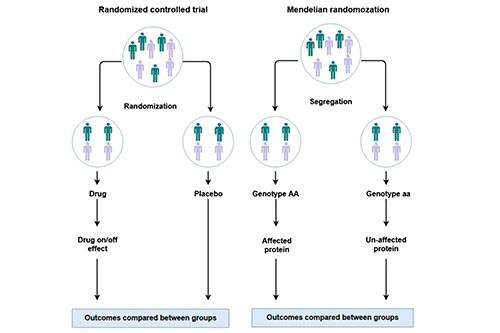
Comparison between randomised controlled trial and the genetic approach “Mendelian randomization”.
Press release issued:
7 September 2020
An innovative genetic study of blood protein levels, led by researchers in the MRC Integrative Epidemiology Unit (MRC-IEU) at the University of Bristol, has demonstrated how genetic data can be used to support drug target prioritisation by identifying the causal effects of proteins on diseases.
Working in collaboration with pharmaceutical companies, Bristol researchers have developed a comprehensive analysis pipeline using genetic prediction of protein levels to prioritise drug targets, and have quantified the potential of this approach for reducing the failure rate of drug development.
Genetic studies of proteins are in their infancy. The aim of this research, published in Nature Genetics, was to establish if genetic prediction of protein target effects could predict drug trial success. Dr Jie Zheng, Professor Tom Gaunt and colleagues from the University of Bristol, worked with pharmaceutical companies to set up a multi-disciplinary collaboration to address this scientific question.
Using a set of genetic epidemiology approaches, including Mendelian randomization and genetic colocalization, the researchers built a causal network of 1002 plasma proteins on 225 human diseases. In doing so, they identified 111 putatively causal effects of 65 proteins on 52 diseases, covering a wide range of disease areas. The results of this study are accessible via EpiGraphDB.
Lead author, Dr Zheng, said their estimated effects of proteins on human diseases could be used to predict the effects of drugs targeting these proteins.
“This analysis pipeline could be used to validate both efficacy and potential adverse effects of novel drug targets, as well as provide evidence to repurpose existing drugs to other indications.
“This study lays a solid methodological foundation for future genetic studies of omics. The next step is for the analytical protocol to be used in early drug target validation pipeline by the study’s pharmaceutical collaborators. We hope that these findings will support further drug development to increase the success rate of drug trials, reduce drug cost and benefit patients,” said Dr Zheng.
Tom Gaunt, Professor of Health and Biomedical Informatics, University of Bristol, and a member of the NIHR Bristol Biomedical Research Centre, added: “Our study used publicly available data published by many researchers around the world (collated by the MRC-IEU OpenGWAS database), and really demonstrates the potential of open data sharing in enabling novel discoveries in health research. We have demonstrated that this re-use of existing data offers an efficient approach to reducing drug development costs with anticipated benefits for health and society.”
Paper
‘Phenome-wide Mendelian randomization mapping the influence of the plasma proteome on complex diseases’ by Jie Zheng et al in Nature Genetics.
Further information
This research is the work of a multi-disciplinary research collaboration between the MRC Integrative Epidemiology Unit, Bristol Medical School, University of Bristol and pharmaceutical partners.
The MRC Integrative Epidemiology Unit at the University of Bristol (IEU) conducts some of the UK’s most advanced population health science research. It uses genetics, population data and experimental interventions to look for the underlying causes of chronic disease. The unit exploits the latest advances in genetic and epigenetic technologies. We develop new analysis methods to improve understanding of how our family background, behaviours and genes work together. Using these to investigate how people develop and remain healthy or become ill.
The Data Mining Epidemiological Relationships programme, led by Professor Tom Gaunt, is funded by the UK Medical Research Council as part of the MRC Integrative Epidemiology Unit at the University of Bristol. The team is interested in understanding the mechanisms of disease, and approach this through the integration of diverse biomedical and epidemiological data and the development of software tools for analysis of these data. One of our key developments is EpiGraphDB, a database that integrates epidemiological and biomedical data to support mechanism discovery and aid causal inference.
About the lead author
Dr Jie Zheng is supported by the Vice-Chancellor fellowship from University of Bristol, which created a unique opportunity to expand this collaboration between university and pharmaceutical industry partners. Jie is also supported by the MRC Proximity to Discovery Industry Engagement Fund via the Elizabeth Blackwell Institute for Health Science, University of Bristol to further develop the causal evidence synthesis for drug development.
About the National Institute for Health Research
The National Institute for Health Research (NIHR) is the UK’s largest funder of health and care research. The NIHR:
- Funds, supports and delivers high quality research that benefits the NHS, public health and social care
- Engages and involves patients, carers and the public in order to improve the reach, quality and impact of research
- Attracts, trains and supports the best researchers to tackle the complex health and care challenges of the future
- Invests in world-class infrastructure and a skilled delivery workforce to translate discoveries into improved treatments and services
- Partners with other public funders, charities and industry to maximise the value of research to patients and the economy
The NIHR was established in 2006 to improve the health and wealth of the nation through research, and is funded by the Department of Health and Social Care. In addition to its national role, the NIHR commissions applied health research for the direct and primary benefit of people in low- and middle-income countries, using UK aid from the UK government.
About NIHR Bristol BRC
The National Institute for Health Research Bristol Biomedical Research Centre’s (NIHR Bristol BRC) innovative biomedical research takes science from the laboratory bench or computer and develops it into new drugs, treatments or health advice. Its world-leading scientists work on many aspects of health, from the role played by individual genes and proteins to analysing large collections of data on hundreds of thousands of people. Bristol BRC is unique among the NIHR’s 20 BRCs across England, thanks to its expertise in ground-breaking population health research.







