
The coronavirus outbreak has pushed millions of Americans, especially young adults, to move in with family members. The share of 18- to 29-year-olds living with their parents has become a majority since U.S. coronavirus cases began spreading early this year, surpassing the previous peak during the Great Depression era.
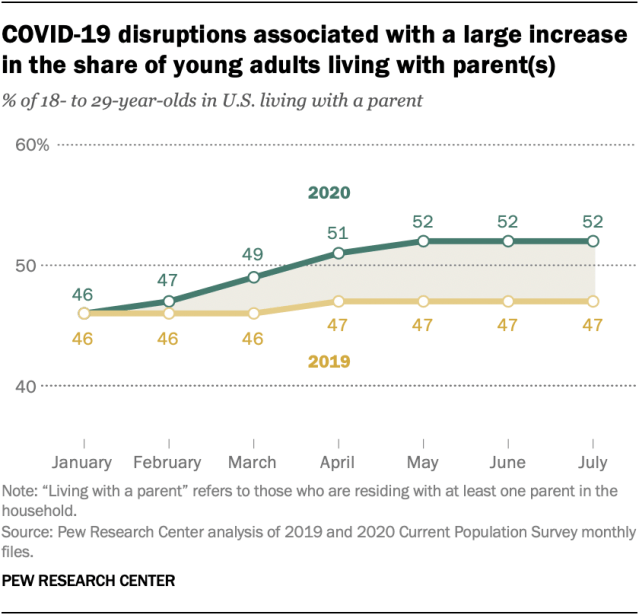
In July, 52% of young adults resided with one or both of their parents, up from 47% in February, according to a new Pew Research Center analysis of monthly Census Bureau data. The number living with parents grew to 26.6 million, an increase of 2.6 million from February. The number and share of young adults living with their parents grew across the board for all major racial and ethnic groups, men and women, and metropolitan and rural residents, as well as in all four main census regions. Growth was sharpest for the youngest adults (ages 18 to 24) and for White young adults.
The share and number of young adults living with their parents rose during the Great Recession era a decade ago, as family became an economic refuge for many. We wanted to see whether young adults again resorted to that “private safety net” amid widespread shutdowns and rough economic conditions caused by the coronavirus pandemic.
The analysis of recent trends and characteristics is based on the monthly Current Population Survey (CPS), conducted by the U.S. Census Bureau for the Bureau of Labor Statistics. The CPS is the nation’s premier labor force survey and is the basis for the monthly national unemployment rate released on the first Friday of each month. The CPS is based on a sample survey of about 60,000 households. All estimates use complete datasets supplied by the Census Bureau; the estimates are not seasonally adjusted.
The CPS somewhat overstates the number of young adult college students who live with their parents. That is because unmarried college students residing in dormitories are counted as living with their parents. So the CPS cannot be used to measure the migration of college students living in dormitories to their parents’ homes since the onset of the pandemic. Not all unmarried college students ages 18 to 29 live in dormitories or with their parents. In February 2020, of the 12.6 million unmarried 18- to 29-year-old college students counted in the CPS, 5.2 million lived neither in dormitories nor with their parents.
The COVID-19 outbreak has affected data collection efforts by the U.S. government in its surveys, especially limiting in-person data collection. This resulted in a 15.3 percentage point decrease in the response rate for the CPS in July 2020. It is possible that some measures of employment and enrollment and its demographic composition are affected by these changes in data collection.
Analysis of historical trends in young adults’ living arrangements for the years 1900-1990 is based on decennial census data from the U.S. Census Bureau.
Sample data from IPUMS for the censuses of 1900-1990 were analyzed online using the IPUMS Survey Documentation and Analysis system (SDA).
The CPS and census public-use microdata have variables identifying each individual respondent’s parents if they live in the household – mother and/or father and, in recent years, a second mother or second father. We used these variables to determine which individuals were living with one or more parents.
The total number of young adults living with parents would have been even higher had we included those living with the parents of their spouse or partner. Among 18- to 29-year-olds, 1.3%, or 680,000 people, did so in July 2020, according to the CPS; this group has remained relatively stable over the past decade. We omitted this group to be consistent with the historical decennial census data.
The share of young adults living with their parents is higher than in any previous measurement (based on current surveys and decennial censuses). Before 2020, the highest measured value was in the 1940 census at the end of the Great Depression, when 48% of young adults lived with their parents. The peak may have been higher during the worst of the Great Depression in the 1930s, but there is no data for that period.
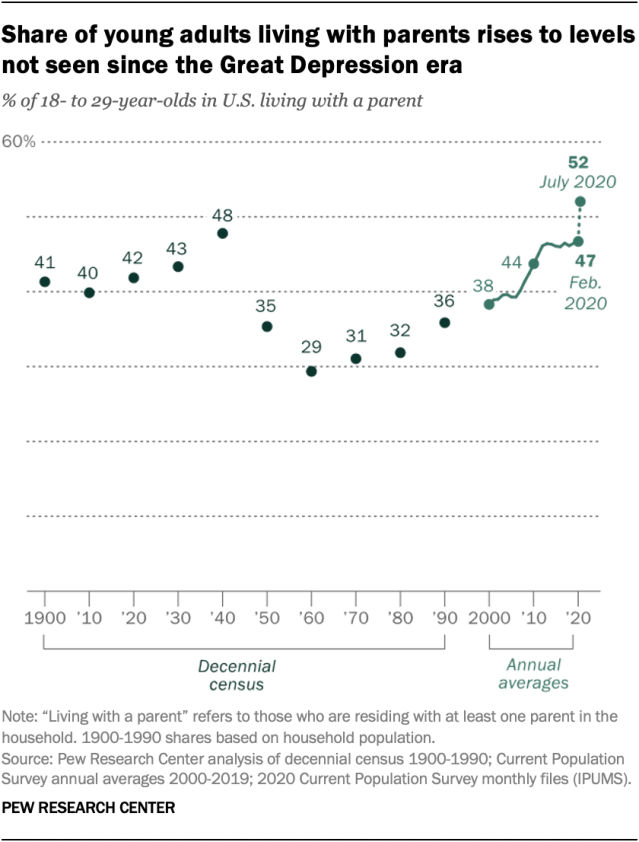
The share of young adults living with parents declined in the 1950 and 1960 censuses before rising again. The monthly share in the Current Population Survey has been above 50% since April of this year, reaching and maintaining this level for the first time since CPS data on young adults’ living arrangements became available in 1976.
Young adults have been particularly hard hit by this year’s pandemic and economic downturn, and have been more likely to move than other age groups, according to a Pew Research Center survey. About one-in-ten young adults (9%) say they relocated temporarily or permanently due to the coronavirus outbreak, and about the same share (10%) had somebody move into their household. Among all adults who moved due to the pandemic, 23% said the most important reason was because their college campus had closed, and 18% said it was due to job loss or other financial reasons.
These new living arrangements may have an impact not just on young adults and their families, but on the U.S. economy overall, reflecting the importance of the housing market to overall economic growth. Even before the outbreak, the growth in new households trailed population growth, in part because people were moving in with others. Slower household growth could mean less demand for housing and household goods. There also may be a decline in the number of renters and homeowners, and in overall housing activity. Between February and July 2020, the number of households headed by an 18- to 29-year-old declined by 1.9 million, or 12%. The total went from 15.8 million to 13.9 million.
The vast majority of young adults who live with their parents – 88% – live in their parents’ home, and this group accounts for the growth in the population of adult children living with their parents. Nearly all of the remainder live in their own homes along with their parents, or in homes headed by other family members. These shares have been relatively stable for the past decade.
Most of the increase in young adults living with parents was among the youngest adults
The youngest adults (ages 18 to 24) accounted for most of the growth in the number of 18- to 29-year-olds living with their parents from February to July – 2.1 million of the 2.6 million increase was attributable to them. Most in this youngest age group already lived with their parents, but the share grew to 71% in July from 63% in February.
The pattern is consistent with employment losses since February. The youngest adults have been more likely than other age groups to lose their jobs or take a pay cut. The share of 16- to 24-year-olds who are neither enrolled in school nor employed more than doubled from February (11%) to June (28%) due to the pandemic and consequent economic downturn.
It is worth noting that in these Current Population Survey numbers, unmarried students who reside in on-campus college dorms are counted as living in their family home, so any increase in young adults living with parents this year would not be due to the pandemic-related closure of college dorms in the spring.
That said, there generally is a seasonal pattern to young adults living with their parents: The share tends to rise slightly in the summer, after college final exams. In 2019, for example, the share living with their parents rose by less than 2 percentage points in July compared with February. But this year, the increase was much sharper – more than 5 points.
Racial and ethnic differences in the share of young adults living with parents have narrowed
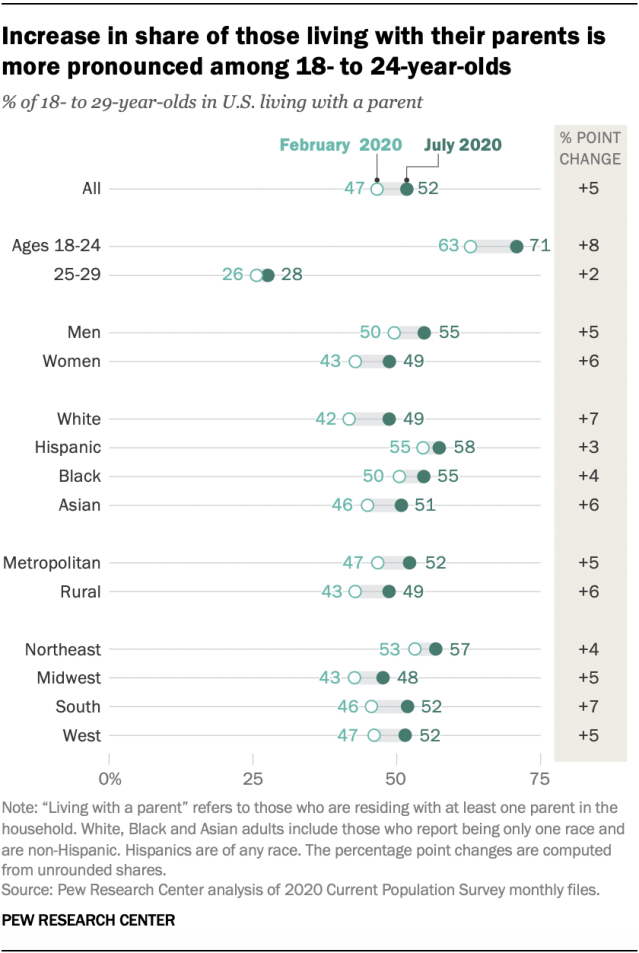
In past decades, White young adults have been less likely than their Asian, Black and Hispanic counterparts to live with their parents. That gap has narrowed since February as the number of White young adults living with their mothers and/or fathers grew more than for other racial and ethnic groups.
In fact, Whites accounted for about two-thirds (68%) of the increase in young adults living with their parents. As of July, more than half of Hispanic (58%) and Black (55%) young adults now live with their parents, compared with about half of White (49%) and Asian (51%) young adults.
Young men are more likely than young women to live with their parents, and both groups experienced increases in the number and share residing with mom, dad or both parents since the beginning of the coronavirus outbreak. Similarly, a higher share of young adults in metropolitan areas compared with rural ones live with their parents now, but the number in both areas grew from February to July.
By region, the number and share of young adults living with parents grew throughout the country. Growth was sharpest in the South, where the total rose by more than a million and the share increased by 6 percentage points, from 46% to 52%. But the Northeast retained its status as the region where the highest share of young adults live with parents (57%).