

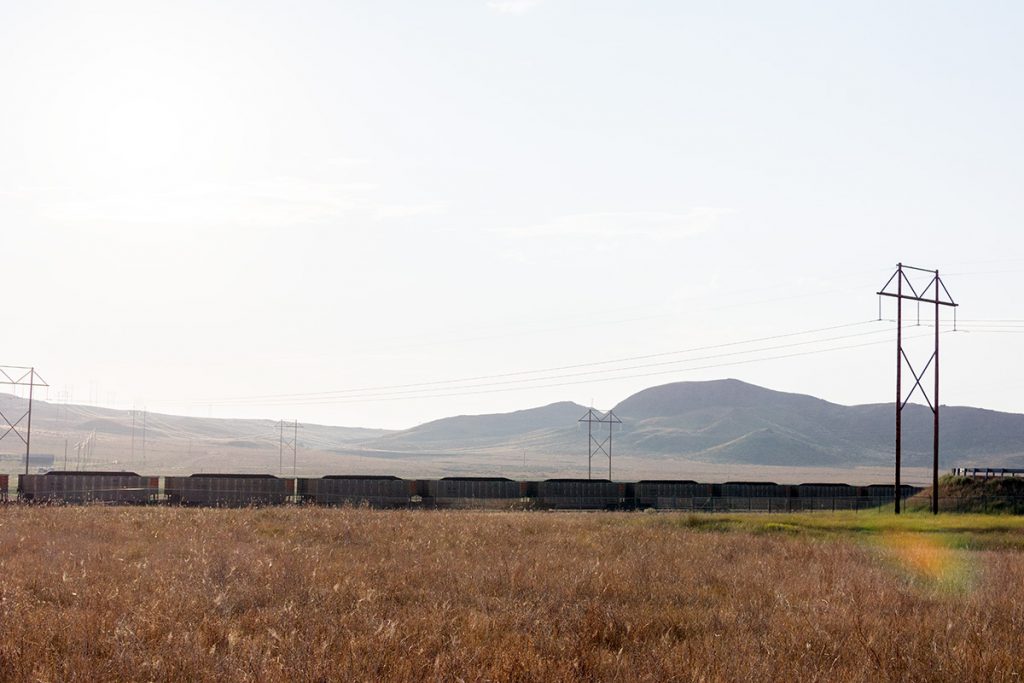
A train hauls coal near Dry Fork Station north of Gillette as crews ready for the fourth consecutive day of geophysical surveying Aug. 28.
Like a slow-moving trail of ants with heads bowed in concentration, the four vibroseis ‘thumper’ trucks plodded up the gravel hill on the north grounds of Dry Fork Station (DFS) en route to their first target. A blue sky yawned lazily overhead as Wade Bard, director of Carbon GeoCycle, Inc. and site manager for the survey, squinted underneath the lip of his hardhat as he watched the caravan veer left onto a wind-burnt patch of grass with vibrating plates hovering in ready position. The trucks paused in a straight line before lowering the plates in a cloud of dust as the ground gently vibrated.
“Feel that?” Bard yelled above the machinery with a big smile. They’re doing their source test, he said, which means syncing up their plates for maximum vibration to reach up to two miles down in the ground underneath. And despite the thundering engines, the tremor on the ground was barely perceptible from less than 100 feet away.
The purpose of the geophysical survey is to test the viability of building a commercial-scale complex underground at DFS for storing carbon dioxide. The three-year, $19.1 million project, funded by the U.S. Department of Energy (DOE) along with other state and federal entities, as part of Wyoming’s CarbonSAFE initiative to mitigate CO2 emissions, is spearheaded by scientists at the University of Wyoming’s School of Energy Resources (SER) with other partners, including Basin Electric Power Cooperative, Carbon GeoCycle and others.

The four geophysical seismic mapping vehicles line up to hit their targets on the grounds of Dry Fork Station.
The thumper trucks will take about six days to survey approximately nine square miles of land surrounding DFS, reading geophone sensors spaced at 660-foot intervals, vibrating for up to two minutes at each spot placed roughly 220-feet along lines, Bard said.
Last Thursday morning, his crews were making up for lost time after a brief shutdown Wednesday, the day prior. The Dawson geophysical surveying team hail from Midland, Texas, a part of the Permian Basin and oil industry epicenter, and are one of the best in the field, Bard noted. After the brief delay caused by equipment failure on a couple of the trucks, including a flat tire from running over a ‘clinker,’ which Bard explained was a leftover lump of burnt and fused rock caused by an underground coal-seam fire that occurred sometime in the geologic past.
“This is clinker country,” Bard said, gesturing with both arms wide open, “and the mule didn’t see it.”
Like many specified fields, the world of seismic geology is rife with industry jargon, from mules – the ATVs that run lookout in front of the trucks – to ‘stomping jugs,’ or planting the fist-size GPS recording units that store information from the handful of geophones looped in a circle on top of the ground around the device and battery pack.

These boxes are strategically mapped out and laid down to collect data from the seismic trucks.
The geophones, Bard explained, are sensors that record sound to calculate depth and surface density to create a velocity profile. The geophones record sound based on shockwaves created by the vibrating devices, which much like echoes, vary based on surface density, porosity, and depth. The harder the density, Ward said, the faster sound travels.
“After they shoot seismic,” he said, “they (geophysicists) measure differences is seismic wave travel time to help figure out geologic attributes, like the volume capacity for storing CO2.”
This particular area in the Powder River Basin is a bit tricky, he noted, because of the competing noise from nearby road traffic and mine blasting and activity. To compensate, the crews did a signal-to-noise ratio for contrast.
The receivers are so sensitive that they can pick up noise from nearby voices and footsteps, let alone passing trucks and road traffic.

Wade Bard overlooks the four ‘thumper’ trucks as they head toward their next target.
Then, there’s the steep hills, which Bard said the trucks can easily handle.
The end goal of the survey is to translate the information into a 3-D model of the rock layers under the surface to gauge the volume of carbon dioxide (CO2) that can be safely stored underground, including where injected gas might travel while identifying any potential risks and the best locations for storage.
SER Director of Research Scott Quillinan and colleague, Fred McLaughlin, senior research scientist and project manager, are eager to get their hands on the models, which will likely be ready within the next month.
Based on information from the well, drilled, and surveyed last fall on DFS grounds as part of the first phase of the project, they’re curious to see how the rest of the area looks underground.
As coal prices continue to dwindle in the wake of the nation’s appetite for carbon-free fuels, capturing carbon and storing it underground, also called carbon capture and sequestration could be a game-changer for both the state and the Powder River Basin, which provides roughly 40% of the nation’s carbon fuels.

The vibrating plates generate vibrations used for 3-D mapping.
The process of storing carbon or other gasses underground is not new, McLaughlin explained, noting other facilities like the Petra Nova power plant in Houston as well as Canada’s Boundary Dam Power Station. As McLaughlin noted, carbon storage technology has been around for the past 50 years with many gas processing facilities relying on gas injection. Unlike Petra Nova, however, which utilizes the captured carbon for enhanced oil recovery, this project seeks to put carbon into saline aquifers.
Based on the findings from the first well test, Quillian said, they’ve already determined that the area has good sealing lithology, composed of shales, mudstones, and clay, as well as porous spaces by which to inject the CO2 underneath. Based on these initial findings, Quillian is encouraged that the rest of the land will also have the same good sealing and porous reservoir rock.
To work, the reservoir has to have the right porosity, permeability, volume, saltwater, and be devoid of oil and natural gas. Finding only saltwater is integral, he explained, because it means the reservoir will not be used for future drinking water or oil and gas production.

Dust swarms as the trucks vibrate the gravel road.
On top of these logistics, McLaughlin noted, the survey will also look at any potential safety to the drinking water or seismicity and pressure buildup in the rock that could destabilize the ground.
Another enormous variable is the regulatory issues surrounding Class VI wells that involve CO2 injections. Right now, they are waiting to hear whether the Environmental Protection Agency (EPA) will agree to transfer primacy to the Wyoming Department of Environmental Quality (WYDEQ), which will transfer regulatory authorities from the federal government to the state. If granted Wyoming will be only the second state to receive primacy along with North Dakota.
“From a permitting side,” McLaughlin said, “the science has to be built in to meet regulatory goals.”
That and whether or not it will be viable financially in the long-run, which on a commercial scale, will be up to 2 million tons of CO2 per year.
“It’s got to pencil,” Quillian added. “Or it’s not going to work.”

The Dawson crew meets for a safety briefing before loading up in their trucks.
Right now, however, he’s encouraged by the financial backing from both federal entities and private investors to test and hone the technology, which both agree is a huge investment but one they are hoping will pay off, not just to give coal a second life but to be at the edge of advancing a new technology that would benefit both the state and country in the long-term as the nation leans toward a lower carbon energy source.
“Whether you agree with the science,” Quillian said, “our customers outside of the state care about carbon emissions, and this technology is extremely important for Wyoming fossil fuels. And so far, we haven’t seen anything from a technical standpoint that will keep it from working.”
For his part, Ward, a petroleum engineer by trade who grew up in the oil patch and has lived and worked on off-site drilling rigs all over the world, also agrees with the premise of the necessity of new technology to lower the carbon footprint of fossil fuels and thinks Dry Fork Station is a good place to start.
“You’ve already got the coal plant here,” he said. “The idea now is to see if it can be carbon neutral.”







