

Wildfires are burning at an unprecedented six reserves in the UC Natural Reserve System across northern and central California, and threaten a seventh. Blazes sparked by both lightning and arson have consumed nine buildings and one vehicle, as well as an untold number of acres of grassland, forest, chaparral, and other natural habitats.
Beginning the evening of Tuesday, Aug. 18, a thunderstorm hit California with an astonishing 12,000 lightning strikes. The strikes kindled more than 580 fires in an area stretching from the Sacramento Valley through the Bay Area and along the Central Coast. The fires, many of which have merged into so-called fire complexes, have burned nearly a million acres. Drought conditions following a low rain year have made fields and forests exceptionally vulnerable to ignition.
“Wildfires are one of the natural processes that define California’s ecosystems, but enduring so many large, catastrophic fires at the same time is unprecedented for the NRS. Our reserve managers and stewards have been absolutely heroic in their efforts to save life and property. We’re so grateful for their fire management expertise and dedication, which have minimized property and kept everyone safe,” says Peggy Fiedler, executive director of the UC Natural Reserve System.
From north to south, the reserves most affected by the flames are McLaughlin Natural Reserve, located at the intersection of Napa, Lake, and Yolo counties; Quail Ridge and Stebbins Cold Canyon reserves near Lake Berryessa; Blue Oak Ranch Reserve on Mount Hamilton; Hastings Natural History Reservation in Carmel Valley; and Landels-Hill Big Creek Reserve in Big Sur. A seventh reserve, Point Reyes Field Station, is located within two miles of a fire burning in Point Reyes National Seashore.
A storm bringing more dry lightning is expected to arrive between Sunday and Tuesday, potentially sparking more fires. Reserve staff in the region and overstretched firefighting crews remain on the alert.

Credit: Shane Waddell
Quail Ridge Reserve
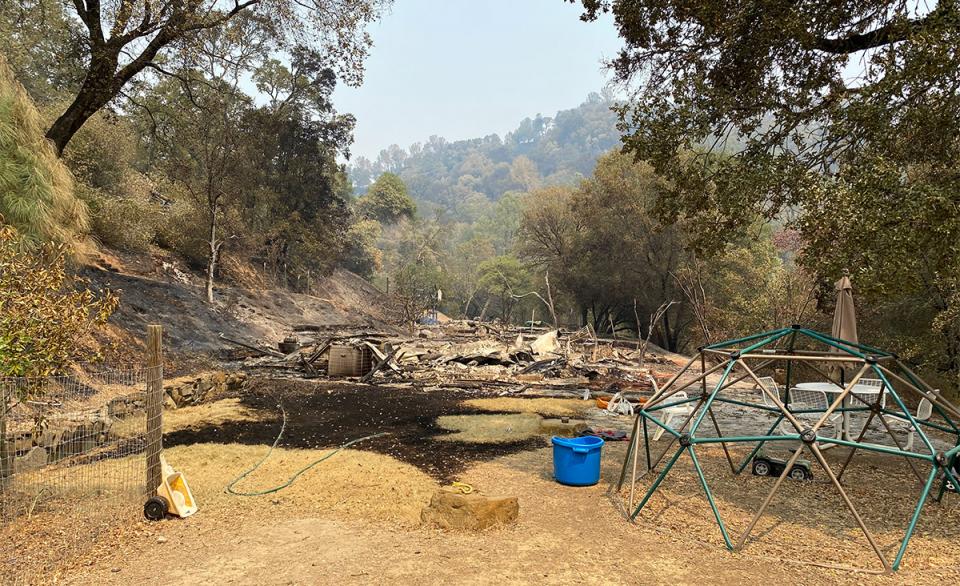
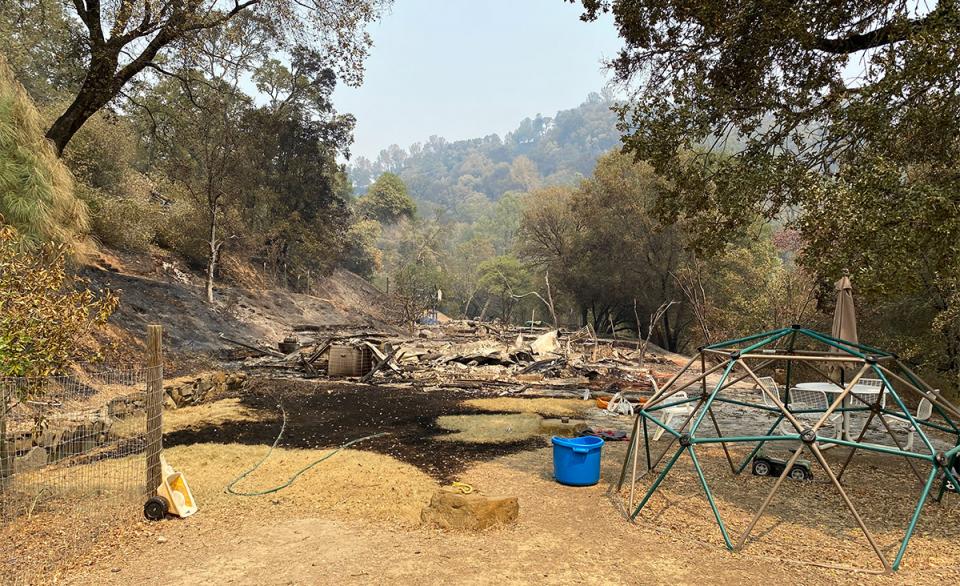
The facilities at Quail Ridge Reserve were hardest hit. Flames from the Quail Fire completely consumed reserve director Shane Waddell’s residence, leaving only the foundation and a metal play structure behind. Waddell’s family evacuated to Davis after they lost power Tuesday around 5:30 p.m. Waddell himself stayed behind to monitor the fire for the next few hours.
“Once the neighboring peninsula’s ridgeline was breached and the fire started down towards Quail, I knew it would be necessary to completely evacuate,” Waddell says. “I decided to leave around 9:30 p.m. I was going up to the field station to grab a couple last things, but when I got to the main gate flames were coming up the ridgeline onto the reserve.”
Even so, Waddell remained long enough to tell neighbors on the Quail Ridge peninsula it was time to depart for their own safety.
“I believe this first wave of fire took my house, but spared the rest of the reserve. However, the fire shifted over the next two days and consumed most of the peninsula,” he says.
The fire also incinerated eight tent cabins, used to house visiting classes, as well as a reserve truck. Other reserve buildings, including the main field station, a researcher house, and studio accommodations, remained largely unharmed. No firefighters were on hand to defend reserve buildings when the fire struck.
“The losses were terrible this time, especially for Shane and his family. We’re relieved and thankful that our evacuation and communication plans kept everyone safe,” says Jeffrey Clary, associate director of the UC Davis Natural Reserves.
Stebbins Cold Canyon
The Quail Fire also burned both slopes of Stebbins Cold Canyon, located less than five miles to the northeast. Four hikers were rescued by California Highway Patrol helicopter before the onset of the flames the morning of Sept. 19. In addition to supporting research, the reserve is open to the public and has become a popular hiking site. The reserve last burned in 2015 in the Wragg Fire. Staff had recently installed an entry kiosk and made improvements to many trails. Though the damage to Stebbins has yet to be assessed, safety concerns mean the reserve will likely be closed to the public for many months.
“The beginnings of the Stebbins fire didn’t seem as intense or fast-moving as last time around in 2015, so we can hope that there are more pockets of less severe burn,” says Sarah Oktay, director of Stebbins Cold Canyon Reserve.
The Quail Fire has since merged with other fires in the region to form the LNU Lightning Complex Fire.

Credit: Kathleen Wong/NRS
McLaughlin Natural Reserve
At a third reserve administered by UC Davis, McLaughlin Natural Reserve, reserve directors Cathy Koehler and Paul Aigner are pinned down by the LNU Lightning Complex burning along Morgan Valley Road. The complex has burned 314,000 acres thus far, making it second only to the 2018 Mendocino Fire Complex as the largest fire in state history.
Luckily, reserve buildings are surrounded by large swaths of tarmac and gravel. The reserve has also opened its doors to shelter nearby residents.
McLaughlin, too, has suffered multiple serious fires in recent years. This marks the third time the reserve has burned in five years.
“Paul Aigner worked with Barrick Mine staff (the site was a gold mine prior to joining the NRS) and first responders to create fire breaks to guide fires away from sensitive areas,” Clary says.
The reserve consists of nearly 7,000 acres of grassland, oak woodland, and chaparral. Small fires continue to simmer on reserve lands but are thought to be unlikely to pose serious future danger. “Although significant portions of the natural lands there burned, major facilities and research projects were unscathed,” Clary says. “We lost one small bridge on one of the internal roads.”

Credit: Mike Hamilton
Blue Oak Ranch Reserve
Lightning caught the chaparral and oaks atop Mount Hamilton to start the SCU Lightning Fire Complex on Tuesday evening. Blue Oak Ranch Reserve steward Zac Tuthill and his family evacuated before the advancing flames that same night. Tuthill returned shortly afterward to cut fire lines around the reserve’s buildings, which are all clustered in one area a few miles down a dirt track from Mount Hamilton Road.
“That made CalFire very happy,” says Zac Harlow, the reserve’s director. Out of the area attending his brother’s marriage celebration, Harlow drove 15 hours back to the Bay Area to keep tabs on the fire.
Firefighters used the reserve as their staging center on the mountain. Blue Oak’s water tanks, which have a capacity of 50,000 gallons, provided crews with plenty of supplies to protect the buildings. CalFire placed at least four bulldozers and ten fire engines in the reserve’s headquarters area, conducted back burns, and laid fire retardant lines to halt the conflagration’s advance.

Credit: Zac Harlow
“This is a strategic property for containing the spread to more populated areas so they are really working to contain it,” Harlow says.
Crews cut fire lines on the hills and used the reserve access road as a fire break. Their hard work, plus Tuthill’s timely interventions, protected all of the reserve’s primary buildings. Either constructed or remodeled in 2015, these included the reserve’s large Cedar Barn, which holds meeting spaces, bathrooms, kitchen, offices, and a lab; a workshop with utilities and reserve vehicles; two visitor cabins; eight indoor/outdoor screen cabins; and two staff residences.
“We feel incredibly fortunate that CalFire put so many resources into stopping the fire where they did. Had it been unchecked, it would have certainly burned through the facilities,” Harlow says.
Even so, the reserve did not emerge completely unscathed. Flames scorched an estimated 1,800 acres out of the reserve’s 3,280 acres. Among these areas was the Arbor Creek drainage. Intensively instrumented with hydrology equipment by UC Santa Cruz Professor Margaret Zimmer and the NRS’s California Heartbeat Initiative, the experiment’s many ground-based sensors and cables burned. The fire also weakened or killed many of the reserve’s signature blue oaks.
The SCU Fire Complex has scorched 340,000 acres, making it the second largest fire in California history.

Credit: Jen Hunter
Hastings Natural History Reservation
Hastings Natural History Reservation, one of the University’s first field stations and among of the oldest NRS reserves, has more than 30 buildings scattered across the drainages east of Carmel Valley Road. After nearly 83 years as a reserve, Hastings now finds itself at a terrible place: the potential intersection of two major wildfires.
The Carmel Fire has burned 5,500 acres one ridgeline to the northwest of the reserve. Nearly ten times larger, and headed to the west, the River Fire is advancing from the opposite side of Carmel Valley.
On Thursday, when it became clear that the River Fire was headed for the heart of Hastings, reserve director Jen Hunter evacuated both her family and the approximately ten users in residence.
Meanwhile, flames continued to advance from the east into the valleys that house Hastings’ collection of about 30 buildings. Several, including the Scott Barn, are historic structures that date back to the nineteenth century.
That’s when reserve steward Jaime del Valle saved the day. del Valle, who has serves as battalion chief of the neighboring Cachagua Fire District for the past 30 years, arranged to have CalFire drop pink fire retardant onto all of the facilities. This eleventh-hour action saved the buildings from the fire raging all around.
Since then, Hunter and her husband, along with several CalFire fire crews, have continued to clear brush around the buildings and dousing remaining hot spots. Others have come to the reserve’s aid as well. Several men who said they had served on prison fire crews began cutting firebreaks around the buildings. One neighbor spent days on his bulldozer cutting fire lines, while another drove his tractor through a fence to stop flames headed for the reserve’s Lower Barn.
CalFire is now on the scene, and del Valle is now coordinating efforts with state crews by calling in air drops. While the majority of the reserve’s buildings are now considered safe, the director’s residence, known as Hallisey House, remains at risk. Forecasted winds, del Valle says, might push the Carmel Fire south toward the Hunter’s home.
Hunter plans to be standing by with the fire hose. She has a safe area to shelter nearby should additional spot fires appear near that house.

Credit: Sean McStay and Feynner Arias
Landels-Hill Big Creek Reserve
Landels-Hill Big Creek Reserve in Big Sur experienced its own close call from fire. An arsonist likely set the fire Tuesday evening a few miles north of the reserve. After slowing for a short time, the Dolan Fire exploded Wednesday night. Flames raced through the reserve’s main canyon and out to its southern boundary.
“The whole reserve was pretty much on fire, there was fire everywhere,” Dayton said Big Creek Director Mark Readdie told him.
The canyon contains many of the reserve’s facilities, including a newly built classroom, researcher housing, lab, and campground, as well as a private inholding with several cabins.

Credit: Sean McStay and Feynner Arias
Years of fire preparedness were instrumental in saving the main structures from the flames. “There was really no time to prepare in the moment, as the conditions were too dangerous to move far from the main structures,” says Gage Dayton, director of the UC Santa Cruz Natural Reserves. Staff had already cleared brush from around the buildings, installed fire sprinklers, and filled reserve water tanks for just this type of emergency.
Big Creek staff stayed near the structures to battle the blaze. They helped crews navigate the reserve’s steep terrain and twisting roads, provided access to water supplies, and turned on building sprinklers. Together with some 60 firefighters from several different crews, they saved the reserve’s primary buildings.
That said, some neighboring cabins, reserve campgrounds, and remote equipment are likely lost or damaged. However, staff have not yet been able to access much of the reserve to survey the damage.
Point Reyes Field Station
Point Reyes Field Station in Marin has not yet burned, but remains threatened by the Woodward Fire burning in Point Reyes National Seashore. Situated about six miles south of the town of Olema, field station is a historic ranch house owned by the National Park Service.
The Woodward Fire ignited on Aug. 19 less than five miles from the reserve. Reserve director Allison Kidder coordinated with National Park Service staff to enable the park’s fire chief and crews to stay at the reserve during their firefighting efforts.
“As part of our partnership with the National Park Service we are happy to support the fire fighting efforts,” says Allison Kidder, director of Point Reyes Field Station.
The blaze was just 5 percent contained as of the evening of Aug. 22. The reserve remains under an evacuation warning.
“We’re keeping a close watch on the fire and grateful to the courage and persistence of the fire fighting crews. At this point we have a plan in place to rapidly retrieve key equipment if we receive an evacuation order.”







