

Introduction
Video games engagement is at an all-time high, with more people playing video games than ever before. The Covid-19 lockdown has certainly given a big boost to the industry, which during the last few months grew at an incredibly fast pace, globally, and across all platforms. Video gaming is not only an affordable and easily accessible form of entertainment. Gaming platforms like Twitch (NASDAQ:AMZN), YouTube Gaming (NASDAQ:GOOG) and Mixer (NASDAQ:MSFT) provide a sense of community to its users, both content creators and watchers, that makes these platforms sticky and monetizable. Facebook (NASDAQ:FB) has entered the game live streaming industry only in 2018, but is now starting to make a dent in the market.
Gaming Industry’s Growth
Facebook has been focusing on this industry since the Oculus acquisition back in 2014. Estimates indicate that gamers will spend $4.5 billion on immersive gaming in 2020, making it increasingly clear that virtual reality will also become a major cornerstone piece of the gaming industry. Gaming is going to be increasingly important in Facebook’s future.
The gaming industry is expected to achieve a CAGR of 12% until 2025. In 2020, revenue from the worldwide PC gaming market was estimated at almost $37 billion, and mobile gaming market estimated income reached a staggering $77 billion. GlobalData reports that the video games market could become a $300 billion industry by 2025, fostered by the strong growth of subsectors such as mobile gaming, cloud gaming, and virtual reality.
Digital sales, in particular, have increasingly gained prominence over the last few years. Digital games and interactive media earned a record $120 billion in 2019, a 4% increase over 2018. The pandemic has boosted this trend, and the percentage of digital sales seems to have now surpassed physical sales, like disc and cartridge. In particular, Sony (NYSE:SNE) reported digital sales at 51%, EA (NASDAQ:EA) at 52%, and Take-Two (NASDAQ:TTWO) at 55%.
The gaming industry, however, has grown into more than just people buying video games. There is a rapidly growing industry subset that involves people watching other people playing games, and paying them for providing the entertainment. This happens visa streaming platforms such as Twitch, owned by Amazon, YouTube, owned by Google, and Facebook Gaming. Another major platform, Mixer, has been recently discontinued by its owner Microsoft, entailing potentially industry disruptive consequences that we will discuss in a moment.
Twitch is the world’s largest streaming platform by a large margin, but it has now less of a monopoly over game streaming than it did a few years ago. Facebook Gaming, in particular, is becoming the fastest rising competitor in the market.
Facebook Gaming Key Metrics
In June 2020, Facebook Gaming had an 11% market share (based on hours watched on the platform) compared to 8.5% at the end of 2019 and 3.1% in 2018. A linear regression indicates that Facebook’s market share could reach 14% by the end of the year.
Source: StreamLabs/StreamHatchet
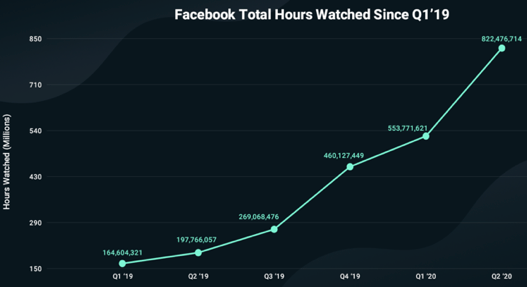
The number of hours watched on Facebook Gaming has increased 49% since last quarter, and over 300% year-over-year. In the same way, the number of hours streamed increased by 23% over Q1 and over 200% year-over-year.

Source: StreamLabs/StreamHatchet
There are little to no barriers of entry to the gamers industry, which contributes to the growing number of gamers that choose to enter the market. Unique channels on Facebook Gaming have also experienced significant growth, increasing by 55% over Q1 and almost 400% year-over-year, and confirming Facebook’s success in its efforts in growing the platform both organically and through the acquisition of popular content creators.
Another growth catalyst comes from the release of Facebook Gaming app, launched on Android devices back in April, which will help drive users to the platform directly from their mobile phone. A few days ago, after months of back and forth, Facebook managed to publish its gaming app on the Apple store as well.
Gamers satisfactions seems also to be running high on the Facebook Gaming platform as well, at least on the monetary side, as say they are earning more money on Facebook’s platform than on Twitch or YouTube.
Facebook Gaming Competition
Facebook Gaming has experienced extensive growth over the last year. However, it remains a very small part of the game streaming market, behind both Google’s YouTube and Amazon’s Twitch.

Source: StreamLabs/StreamHatchet
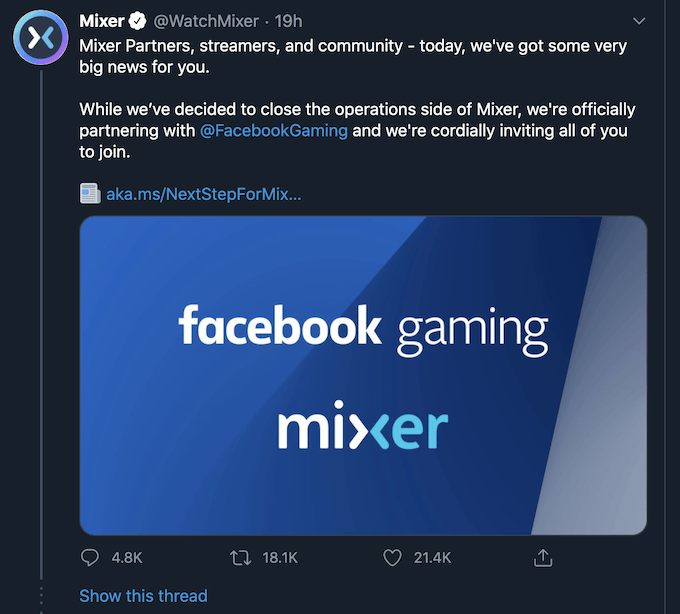
A potentially disruptive catalyst comes from the recent news that Mixer is shutting down for good this month, and Facebook Gaming has a chance to seize the opportunity to secure a large ecosystem of live streamers.
Facebook’s agreement with Microsoft will see Mixer teaming up with Facebook Gaming, with Mixer redirecting its users to the Facebook platform. However, this does not necessarily mean that Facebook will simply englobe Mixer’s market share.
Source: Twitter
In fact, it’s up to the users to decide where to make the move to. It is still unclear how many streamers will make the transition. Since many Mixer’s users originally come from Twitch, a possible scenario will see many of them defaulting back to their native platform. Another likely scenario will see users simply undertaking the guided path towards Facebook Gaming, but a few could even change completely towards YouTube.
This is a defining moment in the industry, and whichever platform can attract most of these users will build a serious advantage over the competition.
Besides this, it is still unclear whether Facebook will manage to gain additional ground over Twitch dominance. Spending in acquiring streamers from other platforms is not sustainable in the long term and it is not part of Facebook’s plan. Should Facebook manage to acquire a major portion of Mixer’s audience, the competition for dominance with Twitch could suddenly become a more accessible fight game. Early
Facebook Gaming Potential Revenue
The main source of revenue for Facebook on the platform will be advertising. Facebook’s CEO Mark Zuckerberg briefly commented on gaming trends during the Q2 earnings call, mentioning strong growth and a lot of demand from gaming advertisers. However, he also focused on the concept of building a community first. This is a very important concept for the business model of the platform. The more users feel part of the community, the more they come back to the platform to watch, play, and chat with other users. This increased engagement is what will eventually lead to long-term growth and open up possibilities for further monetization. Someone that constantly uses the platform is definitely more likely to get to the point of spending on it, rather than the occasional user.
Besides advertising, subscription fees also consist of a generous source of revenue. Officially, Twitch streamers, the content creators, receive 50% of the total subscription monthly fee, which range for $4.99 to $24.99. The other 50% will, therefore, consist of revenue for the Platform. In 2019, Twitch, with a ~65% market share, collected around $300 million in annual revenue for its parent company Amazon. As pointed above in the section above, the pie is undoubtedly getting bigger for all players. With Amazon targeting the $1 billion revenue landmark for Twitch, a similar target could be achieved by Facebook should they manage to successfully tackle Twitch’s dominance in the market.
Conclusion & Takeaway
Facebook keeps growing as a company, building growth-focused businesses on top of a healthy balance sheet. Social shopping, mobile payments, and gaming are the three major source of growth I see for Facebook in the long term. Recent developments in the gaming streaming competition landscape could cause further acceleration to Facebook’s expansion in the market. So far, the trends show that Facebook Gaming is putting up a good fight with the market-dominant Twitch, but the match is still in the early rounds. One thing is for sure, the gaming pie is getting bigger. Amazon, Google and Facebook will now try and eat Microsoft’s leftover, and whoever comes on top in the next few months will certainly gain a meaningful edge over competitors.
If you found this article of value, please follow (near the title) and/or press “Like this article” just below. I would love to hear your opinion, leave a comment!
Disclosure: I am/we are long FB. I wrote this article myself, and it expresses my own opinions. I am not receiving compensation for it (other than from Seeking Alpha). I have no business relationship with any company whose stock is mentioned in this article.
Additional disclosure: I am not a financial advisor. All articles are my opinion – they are not suggestions to buy or sell any securities. Perform your own due diligence and consult a financial professional before investing or trading.







